Stock Analysis · Zscaler Inc (ZS)
Overview
Zscaler, Inc. is a cybersecurity company that helps organizations securely connect users, devices, and workloads (such as applications running in public clouds) without relying on traditional network “perimeters.” Instead of assuming that people or computers inside a corporate network are automatically trusted, Zscaler’s approach is built around verifying access and applying security controls each time a connection is requested. This model is often described as “zero trust” and is closely tied to the shift toward cloud computing and hybrid work.
The company sells its services primarily as cloud subscriptions, meaning customers generally pay recurring fees over time rather than buying one-time hardware appliances. In its public filings, Zscaler describes its platform as being delivered from a distributed cloud infrastructure, aiming to provide secure access and data protection for users and applications regardless of location.
Main sources of revenue (as described in company filings):
- Subscription revenue (recurring fees for access to Zscaler’s cloud security platform)
- Professional services and other revenue (implementation, support, and related services; typically smaller than subscriptions)
The long-term business model focus is largely on expanding recurring subscription relationships (more users, more products, and broader deployments within existing customers) while managing infrastructure and operating costs to improve profitability over time.
Across the years shown, revenue expanded substantially (from about $673M in FY2021 to about $2.67B in FY2025). Over the same period, gross profit also grew strongly, while operating income remained slightly negative in the latest year shown. This pattern is consistent with a company prioritizing growth and product investment (notably research and development) while moving closer to operating break-even.
Key Figures
| Metric | Value | Industry ⓘ |
|---|---|---|
| Date | Feb 07, 2026 | |
| Context | ||
| Sector | Technology | |
| Industry | Software - Infrastructure | |
| Market Cap ⓘ | $26.68B | |
| Beta ⓘ | 1.02 | |
| Fundamental | ||
| P/E Ratio ⓘ | N/A | 25.66 |
| Profit Margin ⓘ | -1.45% | 6.68% |
| Revenue Growth ⓘ | 25.50% | 15.20% |
| Debt to Equity ⓘ | 92.52% | 19.82% |
| PEG ⓘ | 2.23 | |
| Free Cash Flow ⓘ | $848.11M | |
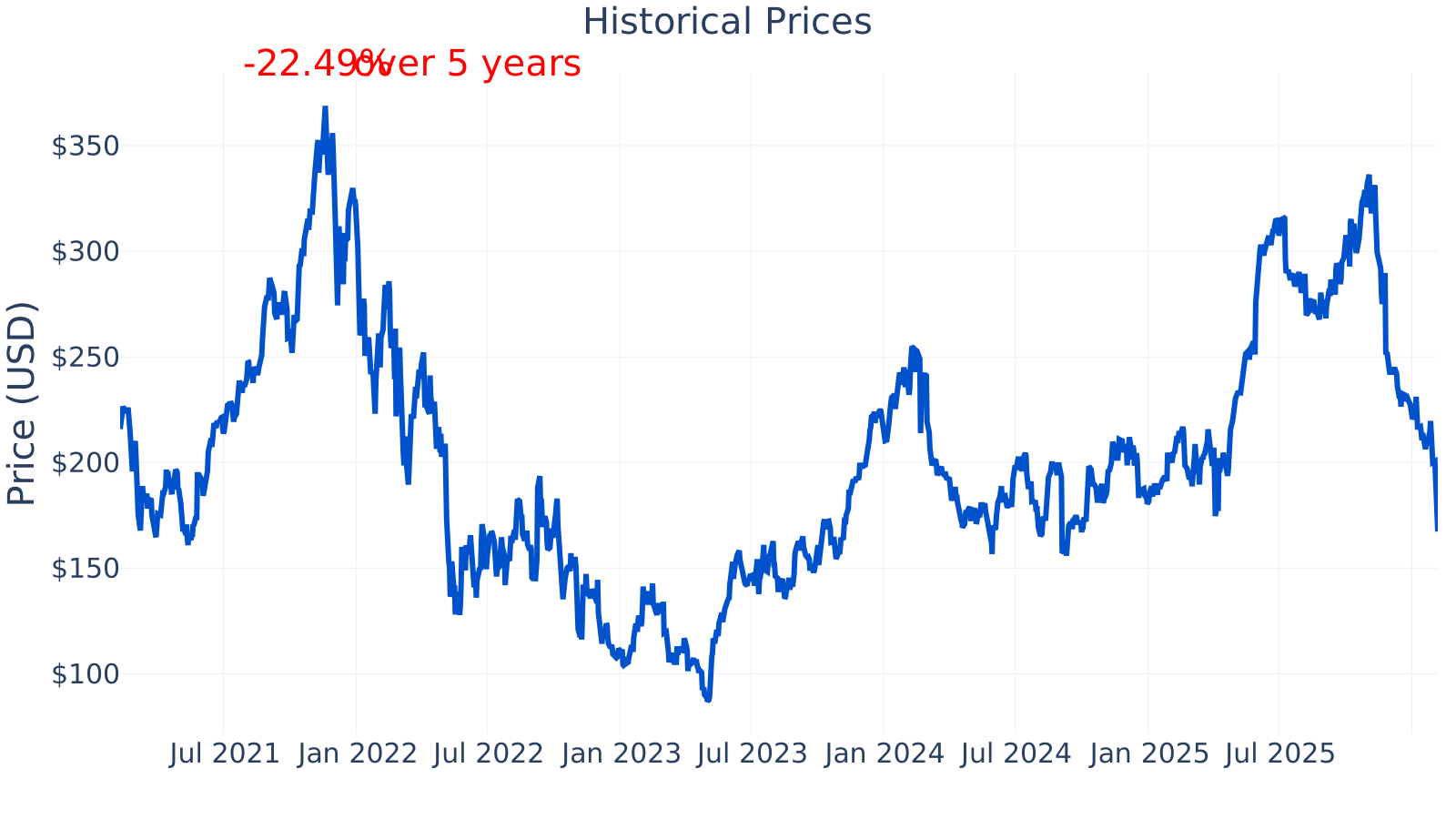
Zscaler’s market capitalization is about $26.7B, and its beta is around 1.02, which suggests the stock has historically moved roughly in line with the broader market (though individual periods can differ significantly). The company’s profit margin is about -1.45%, below the industry median of +6.68%, indicating that profitability remains a key area to watch. At the same time, year-over-year revenue growth is about 25.5%, higher than the industry median of 15.2%, reflecting faster-than-typical expansion for its peer group. The company also shows meaningful cash generation with about $848M in trailing twelve-month free cash flow. Debt-to-equity is about 92.5% versus an industry median near 19.8%, which can matter when comparing balance-sheet risk across companies.
Growth (High)
Cybersecurity remains a structurally important area as organizations move applications and data to the cloud, support remote and hybrid work, and face increasingly frequent security threats. In that context, Zscaler’s cloud-delivered model is aligned with a broader shift away from on-premises network security appliances toward services delivered over the internet. This direction can support long-term demand, especially for platforms that combine secure access and data protection across multiple environments.
Zscaler’s strategy is centered on landing customers with a core use case (secure access) and expanding over time through additional modules and wider deployments. This type of expansion can be supported by recurring subscription contracts, where growth comes from customer additions as well as deeper adoption among existing customers.
The growth rate has moderated from very high levels earlier in the period (above 50–60% year-over-year in FY2021–FY2022) to the mid-20% range more recently, with the latest point around 25.5%. A decelerating growth rate is common as revenue becomes larger, but it also raises the importance of execution: future results depend more on sustained customer expansion and disciplined spending rather than purely rapid top-line growth.
Free cash flow has increased notably over time (approximately $196M in FY2022 to about $695M in FY2025), indicating improving cash efficiency. For long-term business durability, expanding cash generation can help fund infrastructure, product development, and potential strategic initiatives without relying as heavily on external financing.
Risks (Medium-High)
This article is for informational purposes only and does not constitute financial advice. Some content is AI-generated. See Disclaimer


