Stock Analysis · Zillow Group Inc (Z)
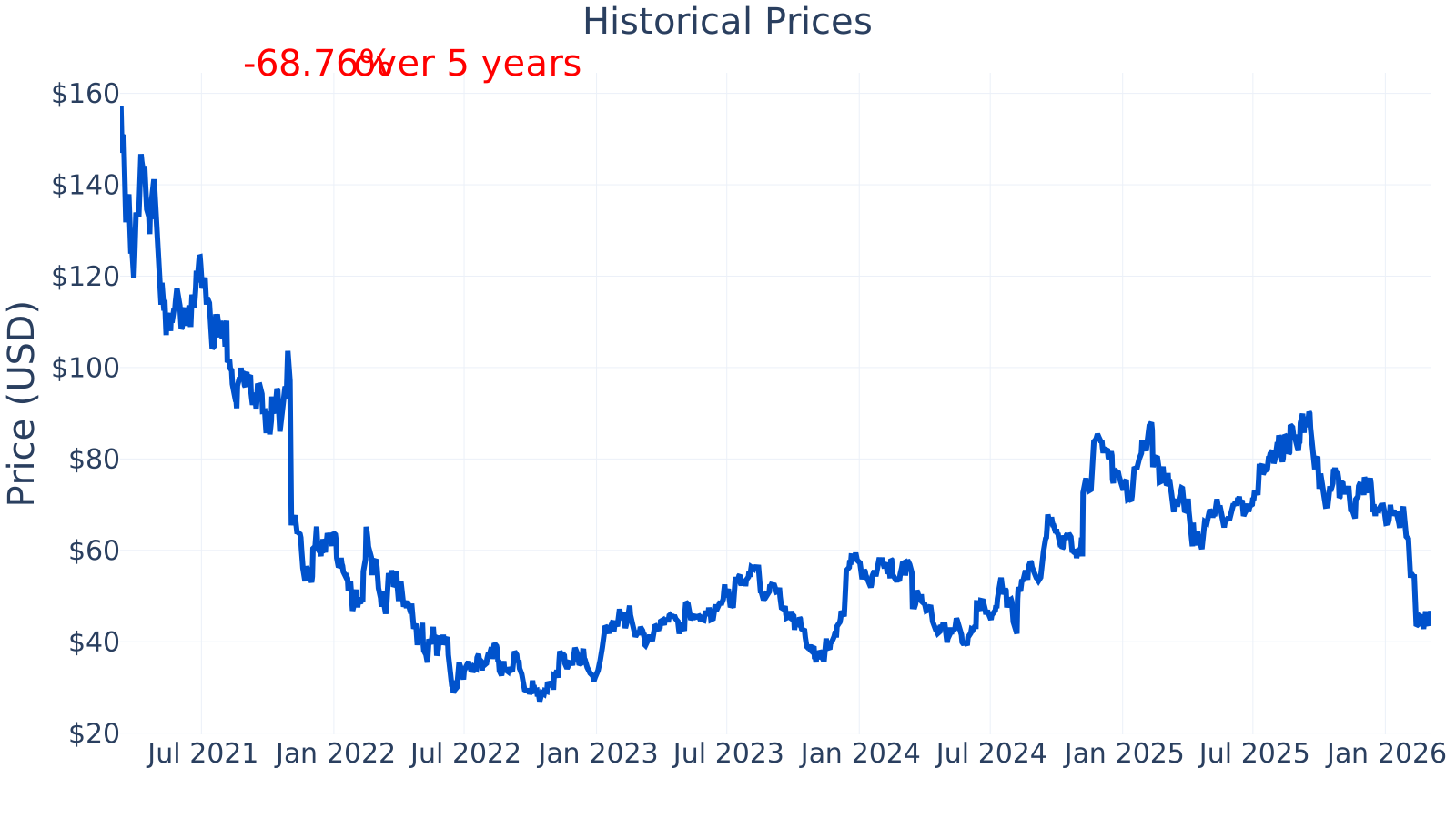
Overview
Zillow Group, Inc. operates a well-known set of real estate websites and mobile apps (including Zillow, Trulia, and StreetEasy) that help people search for homes and help real estate professionals connect with potential customers. Its business is primarily a digital marketplace: consumers use Zillow’s platforms to browse listings and home information, while agents, landlords, and other housing-related companies pay to advertise or generate leads.
In its financial reporting, Zillow organizes its activities into main segments that reflect how it earns money. The largest portion has historically come from services for real estate agents (for example, advertising and lead-generation tools). It also earns revenue from rentals (tools and listings for landlords and property managers) and from mortgage-related services (such as connecting consumers with lenders). Exact percentages can shift from year to year based on housing market conditions and product mix, so the most precise breakdown is found in the latest annual report segment disclosures.
Main sources of revenue (largest to smallest, based on how the business is commonly structured in filings):
- IMT (Internet, Media & Technology): advertising and lead generation primarily for real estate agents and brokerages
- Rentals: multifamily and rental marketplace products for landlords and property managers
- Mortgages: mortgage marketplace and related services
The longer-term picture in the company’s financial statements is that Zillow is aiming to grow a “housing super app” ecosystem—keeping consumers engaged from shopping to financing and renting—while monetizing that attention through marketplace products.
Across the years shown, total revenue rises overall (from about $2.13B in 2021 to about $2.58B in 2025). Profitability has been pressured by large operating costs—particularly research and development and selling/general/administrative expenses—while net income improves from sizable losses toward a small profit by 2025.
Key Figures
| Metric | Value | Industry ⓘ |
|---|---|---|
| Date | Mar 09, 2026 | |
| Context | ||
| Sector | Communication Services | |
| Industry | Internet Content & Information | |
| Market Cap ⓘ | $11.12B | |
| Beta ⓘ | 2.14 | |
| Fundamental | ||
| P/E Ratio ⓘ | N/A | 19.67 |
| Profit Margin ⓘ | 0.89% | 9.94% |
| Revenue Growth ⓘ | 18.10% | 6.80% |
| Debt to Equity ⓘ | 10.97% | 10.97% |
| PEG ⓘ | 0.93 | |
| Free Cash Flow ⓘ | $227.00M | |
Zillow’s market capitalization is about $11.1B. The stock’s beta of ~2.14 indicates it has historically moved more than the overall market, which can matter for long-term investors who prefer smoother returns. The table also shows a profit margin of ~0.9%, which is well below the industry median shown (~9.9%), highlighting that profitability has been comparatively thin. At the same time, year-over-year revenue growth is ~18.1%, above the industry median shown (~6.8%), suggesting stronger recent top-line momentum than many peers. Zillow’s debt-to-equity is ~11%, in line with the industry median displayed, and trailing twelve-month free cash flow is about $227M, indicating the business is currently generating cash even though accounting profits have been modest.
Growth (Medium)
Zillow operates in the online real estate marketplace, which is tied to large, long-lived trends: consumers increasingly start their home search online, and real estate professionals spend significant amounts on digital marketing to find clients. That said, Zillow’s results are also closely linked to the housing cycle—transaction volumes and mortgage rate conditions can materially change how much agents and related businesses spend on advertising and lead generation.
From a recent growth perspective, the company’s year-over-year revenue growth has moved back into consistently positive territory, reaching the high teens in the most recent periods shown.
The pattern above shows a difficult stretch with sharp declines (consistent with a housing slowdown), followed by a recovery to steady positive growth. This supports the view that Zillow’s revenue can rebound when industry conditions improve, but can also fall meaningfully in weaker periods.
Cash generation is another useful lens for long-term durability because it reflects how much cash a company produces after operating needs and capital spending.
The trajectory shows free cash flow swinging from negative to strongly positive and then normalizing to a positive level more recently (around $204M–$227M in the latest periods shown). This type of volatility can happen when working capital and market conditions change, but sustained positive free cash flow can provide flexibility for product investment and balance sheet strength.
Potential catalysts Zillow discusses in filings and investor materials typically relate to improving “conversion” across the moving journey (turning browsing into high-intent connections for agents, rentals, or lenders), and expanding products that monetize traffic more effectively. Another broad catalyst for the whole category is a recovery in home sales activity, which can increase demand for agent advertising and leads.
Risks (High)
Zillow’s biggest external risk is sensitivity to the housing market. If home sales fall, affordability worsens, or mortgage rates remain elevated, real estate professionals may reduce marketing spend, which can pressure Zillow’s core marketplace revenue. This cyclical exposure can make results less predictable than businesses driven primarily by recurring subscriptions.
Competition is also a key risk because Zillow operates in a crowded environment with other major housing platforms and listing networks. Important competitors include CoStar Group (including Homes.com and Apartments.com), Redfin, and listing/portal ecosystems connected to the National Association of Realtors (Realtor.com), as well as many local and specialized rental and real estate websites. Zillow benefits from strong consumer brand awareness and high traffic in the U.S., but competitors can challenge pricing power and advertising share, and they can invest aggressively to gain audience and agent relationships.
Operationally, profitability has been a pressure point. Recent margins have been low versus the industry median shown, even as the company invests heavily in product development and sales/marketing.
The chart indicates margins were negative for an extended period before turning slightly positive most recently (about 0.9%). Even with improvement, profitability remains well below the industry median shown, which highlights execution risk: Zillow may need sustained revenue growth and/or tighter cost discipline for stronger, more consistent earnings.
Balance-sheet risk appears more moderate than in earlier periods, based on the decline in debt-to-equity over time.
The series shows a large reduction from earlier elevated levels (peaking above 80% in 2021) down to about 11% most recently, roughly in line with the industry median displayed. Lower leverage generally reduces financial risk, but it does not eliminate the business risks tied to housing cycles and competitive dynamics.
Valuation
A commonly used valuation metric is the price-to-earnings (P/E) ratio, but for Zillow it is not consistently meaningful in the periods shown (many points are effectively not available or set to zero, which often occurs when earnings are negative or not comparable). The industry median P/E in the chart remains in a more typical range, while Zillow’s P/E is not shown as a stable, interpretable series. In situations like this, valuation discussions often lean more on a combination of revenue growth, the path toward durable profitability, and cash flow generation rather than relying on P/E alone.
In context, Zillow combines (1) revenue growth that is currently above the industry median shown, (2) improving but still low profitability, and (3) positive free cash flow. Whether the current stock price looks “expensive” or “cheap” cannot be concluded from P/E in a straightforward way here; it depends more on how sustainable the recent growth is through a full housing cycle, and whether operating margins can become consistently stronger than the near-break-even level shown.
Conclusion
Zillow is a large online real estate marketplace business with a recognized consumer brand and a monetization model centered on connecting home shoppers with agents, landlords, and mortgage providers. The company’s recent financial picture shows revenue recovering and growing, free cash flow remaining positive, and leverage declining to a relatively low level.
At the same time, the company’s results have historically been cyclical, with profitability that has lagged the industry median shown and only recently turned slightly positive. The main long-term questions are whether Zillow can translate its audience and product investments into consistently higher margins, and how resilient its revenue will be during weaker housing market periods while facing well-funded competitors.
Sources:
- Zillow Group, Inc. — Form 10-K (Annual Report) (Segment reporting, business description, risk factors)
- Zillow Group Investor Relations — SEC filings and shareholder materials (company-hosted)
- SEC EDGAR — Zillow Group, Inc. filings database (10-K, 10-Q, 8-K)
- Wikipedia — “Zillow” and “Zillow Group” (basic company background)
This article is for informational purposes only and does not constitute financial advice. Some content is AI-generated. See Disclaimer


