Stock Analysis · Zillow Group Inc (ZG)
Overview
Zillow Group, Inc. operates a well-known group of real estate and housing websites and apps in the United States, including Zillow, Trulia, StreetEasy, HotPads, and Out East. Its platforms are designed to help people search for homes and rentals, while also helping real estate professionals connect with home shoppers. In practice, Zillow’s role is mostly “digital marketplace”: it brings together consumer demand (people browsing listings and housing information) and the businesses that want to reach those consumers (agents, landlords, property managers, and some mortgage-related partners).
In its financial reporting, Zillow organizes its business around two main segments: Internet, Media & Technology (IMT) and Mortgages. IMT is the core business and includes the company’s housing “marketplace” products, such as advertising and lead-generation tools for real estate agents and other housing industry participants. The Mortgages segment includes mortgage-related products and services (for example, originating and selling loans, as well as related services), and it is smaller than IMT.
Main revenue sources (high level, based on company segment reporting):
- Internet, Media & Technology (IMT): the largest contributor; primarily marketplace revenue from real estate professionals and other housing advertisers.
- Mortgages: smaller contributor; mortgage origination and related revenue streams.
Over time, Zillow’s results have been influenced by both the housing market cycle (transaction volumes and affordability) and by how effectively the company converts its large audience into paid relationships with industry professionals.
Across the period shown, revenue rises from about $2.13B (2021) to about $2.58B (2025). At the same time, operating expenses remain large (roughly $1.57B to $1.95B), reflecting a cost structure with substantial ongoing spending in areas such as product development and sales/marketing. Net income moves from sizable losses in 2021–2024 to a small profit in 2025 (about $23M), suggesting improved profitability but not yet a wide margin of safety.
Key Figures
| Metric | Value | Industry ⓘ |
|---|---|---|
| Date | Feb 13, 2026 | |
| Context | ||
| Sector | Communication Services | |
| Industry | Internet Content & Information | |
| Market Cap ⓘ | $10.96B | |
| Beta ⓘ | 2.02 | |
| Fundamental | ||
| P/E Ratio ⓘ | 485.56 | 15.97 |
| Profit Margin ⓘ | 0.89% | 10.23% |
| Revenue Growth ⓘ | 18.10% | 7.10% |
| Debt to Equity ⓘ | 1.90% | 10.16% |
| PEG ⓘ | 0.92 | |
| Free Cash Flow ⓘ | $235.00M | |
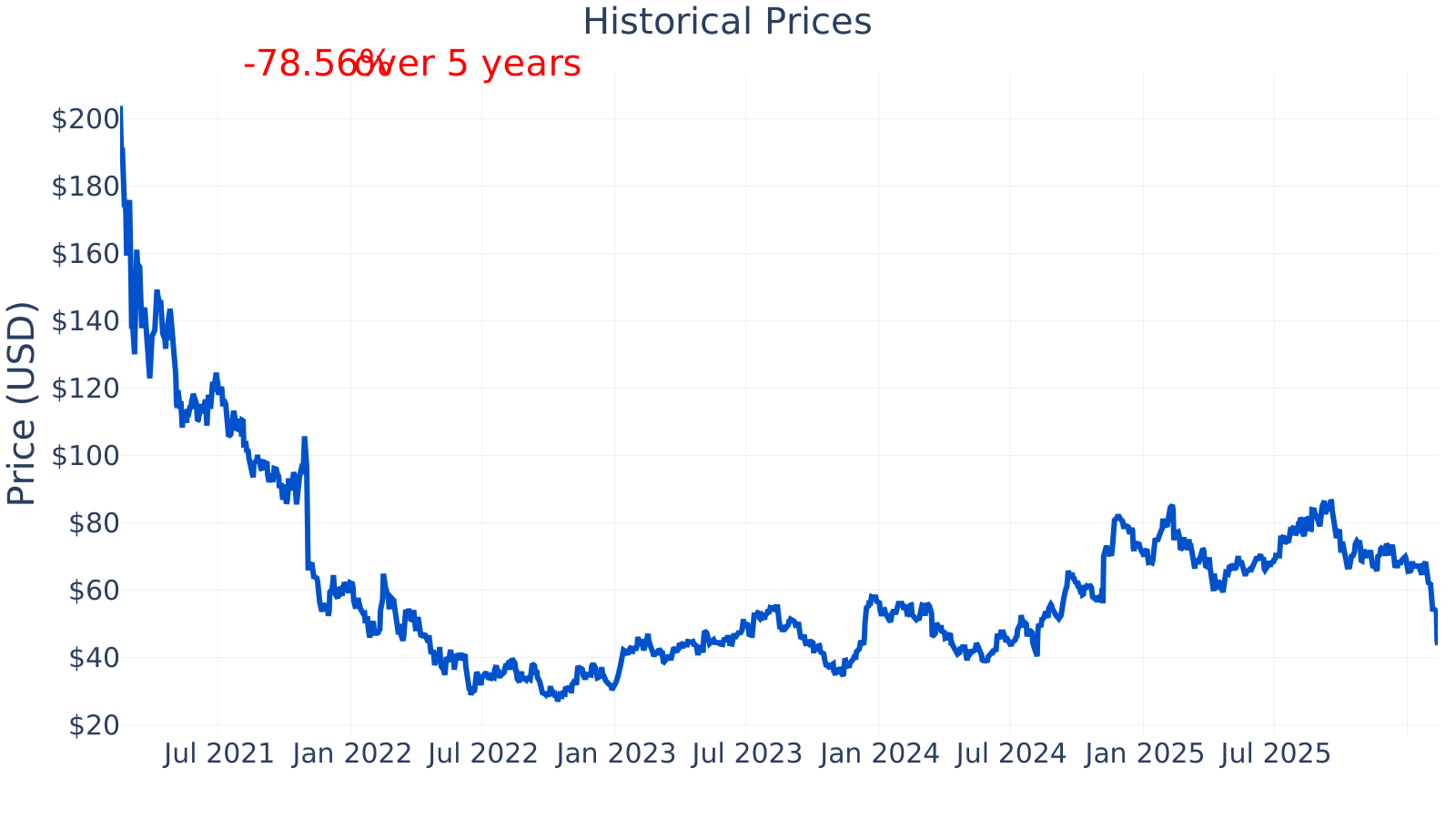
Zillow’s market capitalization is about $11.0B. The stock’s beta of ~2.02 indicates it has tended to move more than the broader market (higher volatility). Profitability is currently thin: profit margin ~0.9% versus an industry median near 10.2%. Growth is stronger than the industry median on a recent year-over-year basis: revenue growth ~18.1% versus an industry median near 7.1%. Leverage appears low at the latest point: debt-to-equity ~1.9% (industry median ~10.2%). The table also shows a P/E ratio near 485.6 (industry median ~16.0), which typically happens when earnings are very small relative to the stock price, making the ratio less stable and harder to interpret. Trailing twelve-month free cash flow is about $235M, indicating the business is generating cash overall, even with modest accounting profits.
Growth (Medium)
Zillow operates in the digital real estate marketplace, which is tied to long-term housing needs (people moving, forming households, renting, buying, and selling). However, the near-to-medium-term pace of housing transactions can swing significantly with mortgage rates, affordability, and consumer confidence. That makes Zillow’s growth pattern more cyclical than many other internet businesses: user interest in housing can remain high, but monetization (agents and other professionals spending money to acquire leads) may rise and fall with transaction volumes.
A central part of Zillow’s strategy is to use its large consumer audience and data tools to improve “matchmaking” between home shoppers and real estate professionals, and to keep more of the transaction journey within Zillow’s ecosystem. If Zillow can improve conversion (turning site traffic into revenue) and increase revenue per transaction opportunity, it may be able to grow faster than the underlying housing market during upcycles.
The year-over-year revenue trend shows a sharp downturn in 2021–2022, followed by a clearer recovery starting in late 2023 and continuing through 2024–2025. The most recent readings are around the mid-to-high teens (ending near 18.1%), which is meaningfully above the industry median shown in the key figures. This pattern highlights both the cyclicality of the business and the potential for faster growth when conditions improve.
Free cash flow has been volatile, with a negative period in 2022 (about -$153M), a very strong positive spike in 2023 (about $1.06B), and then moderating to roughly $170M in 2024 and $291M in 2025 (with the latest metric table showing about $235M TTM). For long-term analysis, this suggests the business can generate cash, but cash generation may vary widely depending on working capital needs, market conditions, and the timing of expenses and receipts.
Risks (High)
This article is for informational purposes only and does not constitute financial advice. Some content is AI-generated. See Disclaimer