Stock Analysis · Zebra Technologies Corporation (ZBRA)
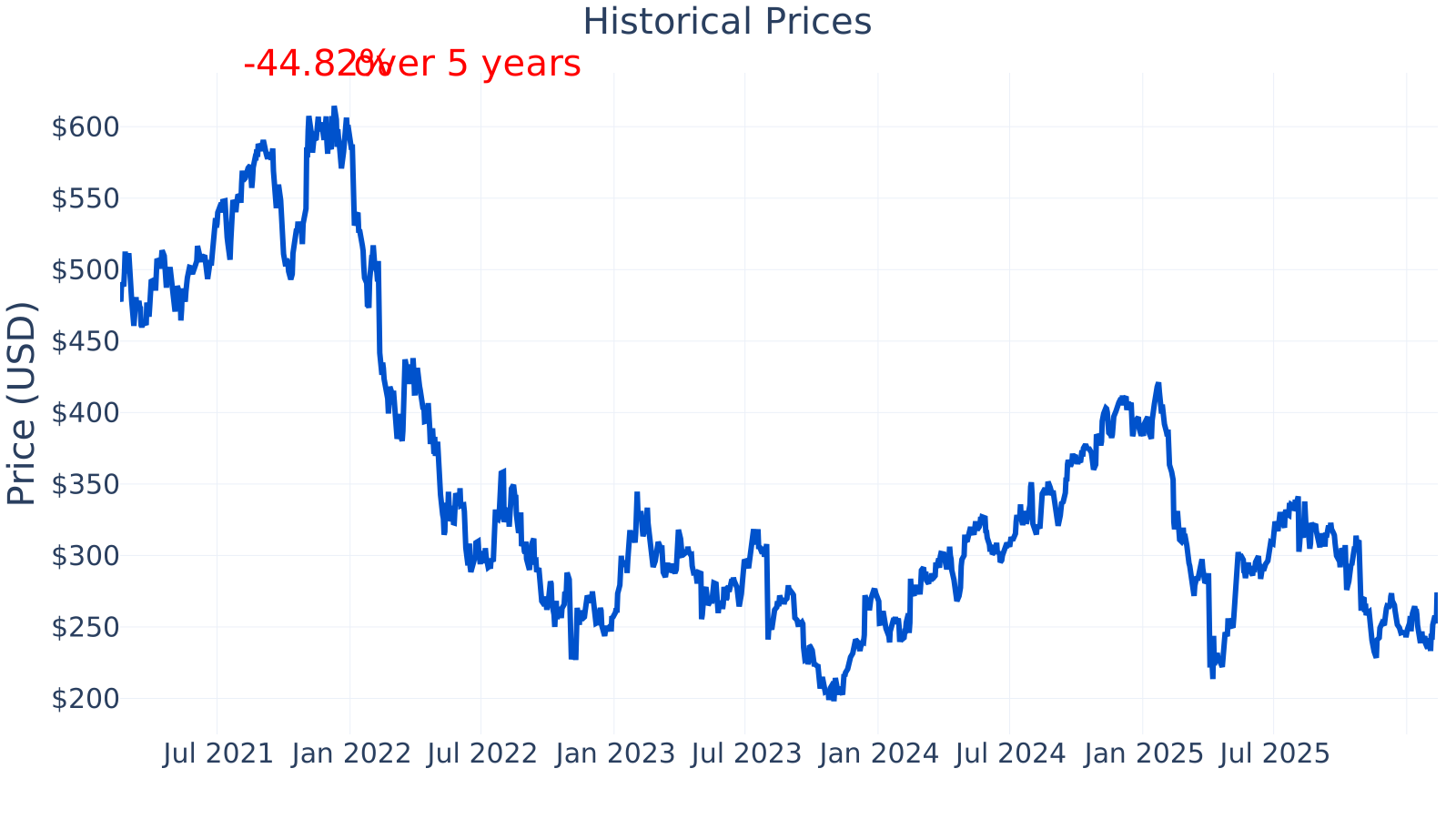
Overview
Zebra Technologies Corporation designs and sells tools that help businesses track items, manage workers, and run daily operations with fewer errors. Its products are often used in places where speed and accuracy matter: warehouses and distribution centers, retail stores, hospitals, and factories. In simple terms, Zebra helps organizations identify “what something is” (for example, a product or medical sample), “where it is” (tracking), and “what to do next” (software that supports workflows).
Zebra’s offerings typically include handheld mobile computers used by frontline workers, barcode printers and scanners, RFID (radio-based identification) solutions, and software/services that support device management and data capture. The company reports its business in two main segments in its filings:
- Enterprise Visibility & Mobility (EVM): mobile computers, scanners, RFID, and related software/services used for real-time visibility and operational execution.
- Asset Intelligence & Tracking (AIT): barcode printing and supplies (such as labels/ribbons), along with related solutions used to mark and track assets and products.
At a high level, revenue comes from a mix of hardware (devices and printers), consumables/supplies (like labels and ribbons), and software/services. In many industrial technology businesses, consumables and software/services can be important because they may repeat over time, while hardware demand can be more cyclical.
Over the 2021–2025 period shown, total revenue moved from about $5.6B (2021) to $5.4B (2025), with a notable dip around 2023 (about $4.6B) before recovering. Operating income also declined from $973M (2021) to $800M (2025), while interest expense rose versus 2021 levels (consistent with a higher debt load and/or higher rates), which can weigh on net income in weaker demand periods.
Key Figures
| Metric | Value | Industry ⓘ |
|---|---|---|
| Date | Feb 16, 2026 | |
| Context | ||
| Sector | Technology | |
| Industry | Communication Equipment | |
| Market Cap ⓘ | $13.41B | |
| Beta ⓘ | 1.66 | |
| Fundamental | ||
| P/E Ratio ⓘ | 32.39 | 40.50 |
| Profit Margin ⓘ | 7.76% | 4.65% |
| Revenue Growth ⓘ | 10.60% | 14.10% |
| Debt to Equity ⓘ | 78.48% | 60.64% |
| PEG ⓘ | 0.55 | |
| Free Cash Flow ⓘ | $831.00M | |
Zebra’s latest snapshot shows a market capitalization of about $13.4B and a beta of ~1.66, which means the stock has historically tended to move more than the overall market (higher volatility). The P/E ratio is ~32.4, below the displayed industry median of ~40.5. Profitability is positive, with a profit margin of ~7.8%, above the industry median of ~4.7%. Recent year-over-year revenue growth is ~10.6%, below the industry median of ~14.1%. Leverage is moderate: debt-to-equity is ~78% versus an industry median of ~61%. Free cash flow over the trailing twelve months is shown at about $831M.
Growth (Medium)
Zebra operates in areas tied to long-term trends: automation in warehouses, higher expectations for fast delivery, inventory accuracy in retail, traceability in healthcare, and productivity tools for frontline work. These needs are structural—organizations continue to invest in tracking, identification, and workflow tools because mistakes (wrong shipments, stockouts, lost assets, compliance errors) have real costs.
That said, Zebra’s results can also reflect business cycles. When customers slow down spending (for example, after a large upgrade cycle or when inventories are high), orders for devices and printers can drop and then rebound later. For long-term observers, this can make the company look “stop-and-go” even if the underlying use cases remain relevant.
The year-over-year revenue growth pattern shown illustrates this cyclicality: strong growth in 2021, then a downturn with negative growth through much of 2023 and early 2024, followed by a rebound later in 2024 and positive growth during 2025 (ending near ~10.6%). This type of swing often reflects customer purchasing cycles and broader economic conditions rather than a single product issue.
Cash generation also moved meaningfully over time: free cash flow was about $1.0B (2021), fell to roughly $112M (2024), then rebounded to about $1.0B (2025). For long-term fundamentals, sustained free cash flow matters because it can support reinvestment, debt reduction, and flexibility during slower demand periods.
Potential forward-looking catalysts (in a neutral, non-predictive sense) typically include broader adoption of RFID for item-level tracking, continued warehouse automation, modernization of store operations, and increasing use of software to manage fleets of devices and workflows. The durability of these drivers depends on customer budgets, competition, and Zebra’s ability to keep its products integrated and easy to deploy at scale.
Risks (Medium-High)
A central risk is cyclicality in customer spending. Many Zebra products are purchased as part of upgrades or expansions. When customers pause spending, hardware volumes can decline and margins can compress, especially if fixed costs are spread over fewer units.
Leverage is another consideration. The debt-to-equity ratio shown ends around ~78%, higher than the displayed industry median of ~61%. The trend also shows a notable step-up from pre-2022 levels, followed by some improvement, and then a higher reading again by the end of 2025. Higher leverage can reduce flexibility in a downturn and can increase the impact of interest expense on net income.
Profit margin has generally stayed above the industry median, but it fluctuated materially—moving from the mid-teens in 2021 to mid-single digits around parts of 2024, then improving before ending 2025 at about ~7.8%. This variability highlights exposure to pricing, product mix (hardware vs. supplies/software), and cost structure during demand swings.
Competition is meaningful because many parts of Zebra’s portfolio sit in well-established categories. Zebra is widely recognized for a strong position in barcode printing and enterprise data capture, but customers often evaluate alternatives on total cost, device durability, software ecosystem, and service/support.
Main competitors commonly include:
- Honeywell (data capture and productivity solutions for warehouses/field work)
- Datalogic (automatic data capture and industrial scanning)
- SATO and TSC (barcode printing and labeling)
- Consumer/industrial device ecosystems that can substitute in some workflows when paired with specialized software and peripherals
Zebra’s competitive advantages generally come from its installed base, product breadth across scanning/printing/mobile computing/RFID, and the operational “stickiness” that can arise once devices and software are embedded into mission-critical workflows. However, pricing pressure, technology shifts, and customer standardization on alternative platforms remain ongoing risks.
Valuation
The valuation picture shown is mixed and time-dependent. Zebra’s current P/E ratio (~32.4) is below the displayed industry median (~40.5), but the historical chart indicates Zebra’s P/E has moved widely over time, including periods where it traded at substantially higher multiples than peers (for example, parts of 2024 on the chart). Large P/E swings can happen when the stock price moves quickly, when earnings temporarily drop and then recover, or when the market shifts its expectations about future growth.
A practical way to interpret this for long-term analysis is that the market’s valuation of Zebra tends to change with the business cycle and profitability. When earnings and cash flow are depressed (as seen around the lower free-cash-flow period), headline valuation ratios can become less comparable. When profitability normalizes, the same company can appear “cheaper” on earnings-based metrics even if the stock price is higher than prior lows.
With a profit margin above the industry median and a moderately higher leverage level than the median, the current valuation level reflects a blend of quality (profitability/positioning) and uncertainty (cyclicality and debt). The PEG ratio (~0.55) shown can suggest that the P/E is low relative to an implied growth assumption used in that calculation, but PEG depends heavily on the growth inputs and is best treated as a rough indicator rather than a conclusion by itself.
Conclusion
Zebra Technologies is a business focused on practical, “in-the-field” technology that helps large organizations run operations: identifying items, tracking assets, and enabling frontline workers. The long-term demand drivers—automation, traceability, and efficiency—are well established, but results can be cyclical because customers often purchase hardware in waves.
The financial profile shown combines positive profitability (profit margin above the industry median) with meaningful volatility in both revenue growth and free cash flow over the period. Leverage sits above the industry median, which can amplify downside pressure during weaker demand periods, while the company’s recovery in revenue growth and cash generation suggests the business can rebound when spending improves.
From a valuation standpoint, the current P/E (~32) is below the displayed industry median, while Zebra’s own multiple has historically moved significantly across market phases. Overall, the key long-term questions typically center on the durability of Zebra’s installed base and ecosystem, the balance between recurring elements (supplies/software/services) and cyclical hardware demand, and how effectively the company manages costs and debt through the cycle.
Sources:
- Zebra Technologies Corporation — Form 10-K (Annual Report), SEC EDGAR (business description, segments, risk factors, financial statements)
- Zebra Technologies Corporation — Form 10-Q (Quarterly Reports), SEC EDGAR (updates to results, liquidity, and risks)
- Zebra Technologies — Investor Relations materials (company-hosted presentations and filings)
- Wikipedia — “Zebra Technologies” (basic company background; non-financial context)
This article is for informational purposes only and does not constitute financial advice. Some content is AI-generated. See Disclaimer


