Stock Analysis · Yelp Inc (YELP)
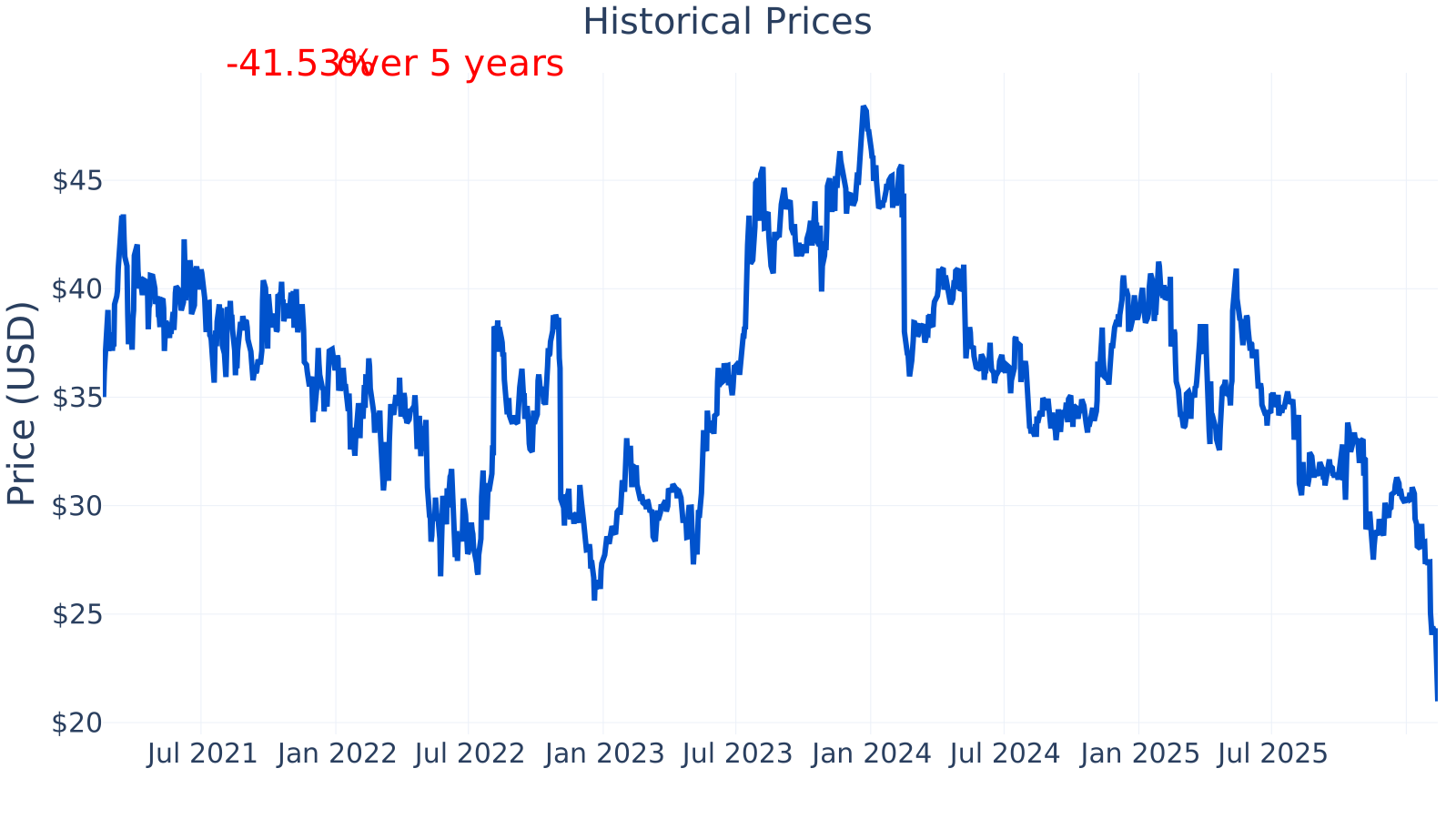
Overview
Yelp Inc. operates an online platform that helps people discover and connect with local businesses. The company is best known for its consumer website and mobile app, where users can search for places such as restaurants, home services providers, and other local merchants, read and write reviews, view photos, and request quotes or bookings depending on the category.
From a business model perspective, Yelp primarily monetizes the attention and purchase intent of its users by selling advertising and related services to local businesses. In practice, businesses pay to be promoted in search results or category pages, and Yelp also offers tools that help merchants manage their presence and generate leads.
Yelp’s revenue is largely tied to local advertising (often grouped as “services” and “restaurants/retail” in company reporting). A simple way to think about the mix is:
- Advertising and related services for local businesses (the dominant source of revenue, historically the large majority)
- Other services (smaller contributions, which can include transactions or miscellaneous revenue depending on the period and reporting)
Over the last several years, Yelp has shown rising revenue and profitability in aggregate, with operating income and net income improving versus earlier periods, suggesting a focus on running a more efficient business while still investing in product development and sales capacity.
Across the years shown, total revenue increased from about $1.03B (2021) to about $1.46B (2025). Over the same span, operating income rose from about $31.5M to about $204.0M, and net income increased from about $39.7M to about $145.6M. This combination (higher revenue alongside faster-growing profits) indicates that operating efficiency improved over time, even with continued spending on product development and sales/administrative functions.
Key Figures
| Metric | Value | Industry ⓘ |
|---|---|---|
| Date | Feb 16, 2026 | |
| Context | ||
| Sector | Communication Services | |
| Industry | Internet Content & Information | |
| Market Cap ⓘ | $1.32B | |
| Beta ⓘ | 0.53 | |
| Fundamental | ||
| P/E Ratio ⓘ | 9.37 | 18.89 |
| Profit Margin ⓘ | 9.94% | 9.94% |
| Revenue Growth ⓘ | -0.50% | 6.80% |
| Debt to Equity ⓘ | 3.50% | 10.16% |
| PEG ⓘ | 0.40 | |
| Free Cash Flow ⓘ | $323.68M | |
Yelp’s market capitalization is about $1.32B, and its beta of ~0.53 indicates the stock has historically moved less than the broader market on average (though that can change, and individual stocks can still be volatile). The company’s P/E ratio is ~9.37 versus an industry median of ~18.89, while its profit margin is ~9.94%, roughly in line with the industry median (~9.94%). Recent year-over-year revenue growth is about -0.54%, below the industry median (~6.8%). Balance-sheet leverage appears low with debt-to-equity of ~3.5% versus an industry median of ~10.2%. Free cash flow over the trailing twelve months is about $323.7M, which is notable relative to the company’s size.
Growth (Medium)
Yelp operates in local discovery and local advertising—areas supported by long-term consumer behavior (people search for nearby services and places) and by business demand for measurable marketing. However, this is not a “winner-takes-all” market, and growth tends to be shaped by competition for local ad budgets, changes in consumer search habits, and how effectively Yelp can convert traffic into paying advertiser relationships.
A core part of Yelp’s growth logic is that it can attract users who are relatively close to making a purchase decision (for example, finding a contractor, booking a service, or choosing where to eat). If Yelp continues improving lead quality, ad tools, and merchant outcomes, that can support pricing power and retention. Another practical catalyst can be operational: when revenue is stable, incremental efficiency improvements can still expand margins and cash generation.
The pattern shown indicates revenue growth cooled over time: from strong double-digit growth in 2021–2023, down to mid-single digits in 2024, and slightly negative (about -0.5%) by the most recent point shown. This suggests Yelp may be in a more mature phase, where growth is less driven by rapid expansion and more dependent on product improvements, category mix, and monetization.
Free cash flow has generally been positive and has stepped up meaningfully versus earlier years (roughly $158M in 2021 to around $271M–$279M in 2024–2025, with the latest metric table showing about $324M on a trailing basis). For long-term business durability, consistent cash generation can matter because it provides flexibility for reinvestment, share repurchases, or balance-sheet strengthening (depending on management decisions disclosed in filings).
Risks (Medium)
Yelp’s main risks are tied to competitive pressure and dependency on local advertising budgets. Local businesses can shift spending quickly when economic conditions change, and marketing budgets may migrate toward channels that show better return on investment. Yelp also depends on its ability to attract consumer traffic; if user behavior continues moving toward alternative discovery tools (including large search engines, map-based apps, and social platforms), it can affect lead volume and ad demand.
Competition is intense. Yelp faces large, well-capitalized platforms that bundle local discovery into broader ecosystems (for example, search-and-maps products) as well as vertical specialists (such as travel, food delivery, and home services marketplaces). In this landscape, Yelp’s competitive advantages often relate to brand recognition in reviews, a large base of user-generated content, and tools that connect consumers with local providers. Still, leadership is category-dependent: Yelp can be strong in certain local-intent queries, while other platforms may dominate navigation-based or search-engine-driven discovery.
Debt-to-equity has declined substantially over time, falling from roughly 24% in early 2021 to about 3.5% by the latest point shown. Lower leverage can reduce financial risk and interest cost sensitivity, though it does not remove operating risks such as competition or demand swings.
Profit margin improved markedly from around break-even/negative territory in early 2021 to about 9–10% more recently, finishing near 9.94%. That level is roughly in line with the industry median in the latest snapshot. Sustaining margins can be challenging in ad-driven models if traffic acquisition costs rise, if sales efficiency weakens, or if competitive pricing pressure increases.
Valuation
On earnings-based valuation, Yelp’s current P/E of ~9.37 is below the industry median of ~18.89 in the provided comparison set. Historically in the chart shown, Yelp’s P/E moved down substantially from much higher levels in 2021–2023 to the teens by 2024–2025, ending near the low teens in the most recent point shown. A lower P/E can reflect a combination of factors, such as slower expected growth, higher perceived competitive risk, or simply improved profitability (higher “E” in the P/E ratio).
Whether the current valuation appears “high” or “low” depends heavily on forward expectations. The context here includes: (1) cooling top-line growth to around flat in the most recent period, (2) improved margins and strong cash generation, and (3) a competitive market for local advertising and discovery. In other words, the valuation picture combines a more mature growth profile with better profitability than earlier years.
Conclusion
Yelp is a consumer internet company centered on local business discovery and monetization through advertising and related merchant services. Over the years shown, it expanded revenue and materially improved profitability, while maintaining low balance-sheet leverage and producing sizable free cash flow relative to its market capitalization.
The main long-term uncertainties are on the growth side: recent revenue growth has slowed to roughly flat, and the company competes against large platforms and specialized apps for both consumer attention and local ad budgets. From a fundamentals standpoint, the profile combines stronger operating performance and cash generation with a more mature growth trajectory and meaningful competitive pressure.
Sources:
- U.S. Securities and Exchange Commission (SEC) EDGAR — Yelp Inc. filings (10-K, 10-Q, 8-K)
- Yelp Investor Relations — Annual Report (Form 10-K) and quarterly reporting materials
- Wikipedia — “Yelp” (general background only)
This article is for informational purposes only and does not constitute financial advice. Some content is AI-generated. See Disclaimer


