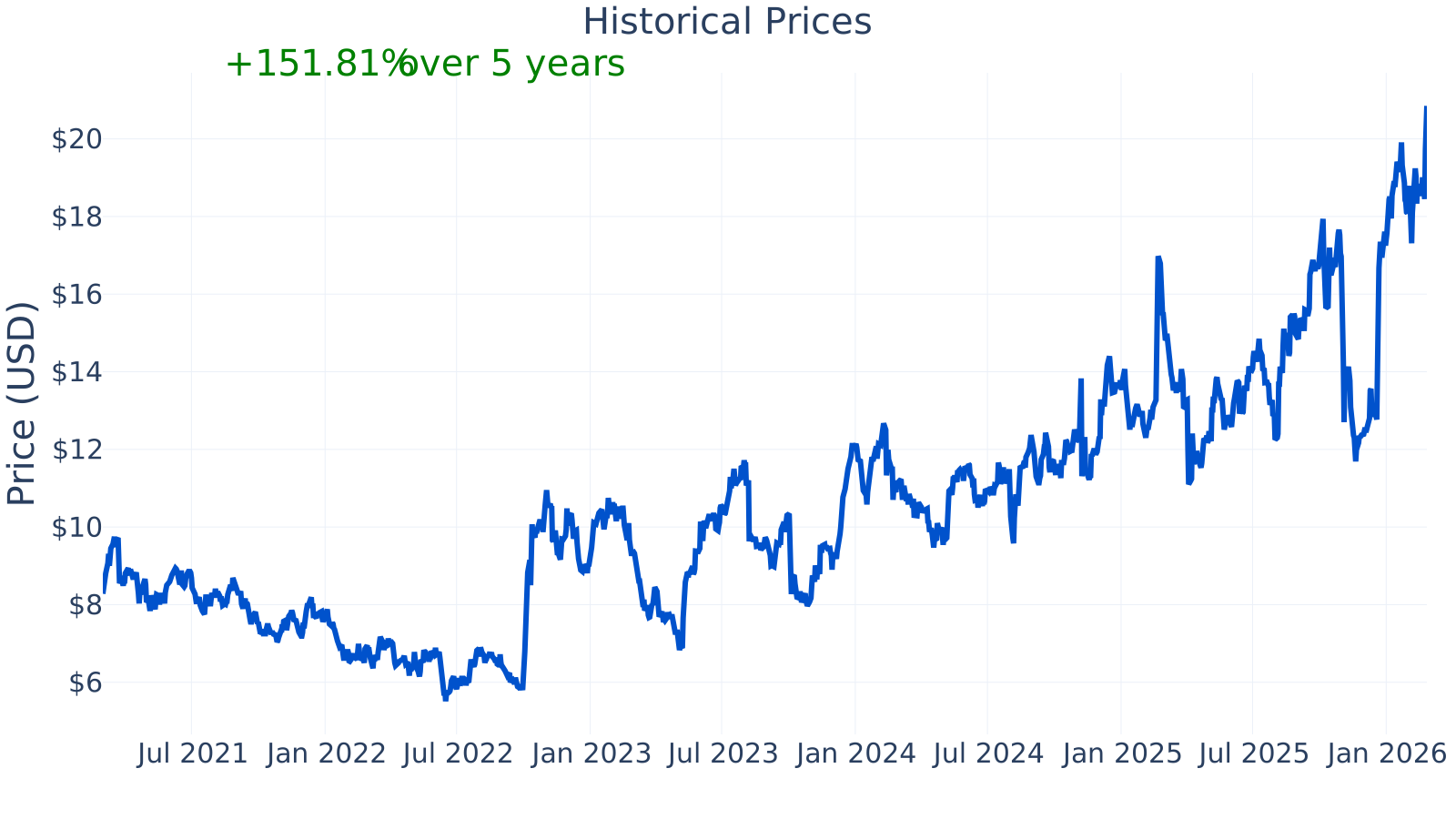
Stock Analysis · ADEIA CORP (ADEA)
Overview
Adeia Corp is a technology company whose business is primarily built around intellectual property (IP) licensing. In simple terms, it develops and holds patents and then signs agreements that allow other companies to use that technology in exchange for payments. This model tends to look different from a “typical software company” because revenue can be driven by contracts, renewals, and occasional one-time items tied to agreements, rather than by selling a subscription product to end users.
Based on the way the company describes its operations in its SEC filings, its activities revolve around creating, managing, and monetizing IP used in areas such as media, semiconductors, and broader digital technologies. The focus is usually on getting its technology adopted by large industry participants and turning that adoption into recurring license revenue and/or other contractual payments.
Main revenue sources are typically centered on licensing-related streams (exact split can vary by year and contract structure):
- License and royalty revenue (payments from companies that use Adeia’s patented technologies)
- Other IP-related revenue (may include items tied to agreements such as catch-up payments, renewals, or contract-related revenue recognized under accounting rules)
The company’s recent income structure also highlights a key feature of IP licensing businesses: revenue can be meaningful even with a relatively small cost of revenue, while operating expenses are driven more by legal, R&D, and corporate costs than by manufacturing or distribution.
One visible trend in the income breakdown over the last several years is that total revenue fell sharply from 2021 levels and then stabilized and improved more recently. At the same time, net income moved from losses (2021–2022) to profits (2023–2025), alongside lower cost of revenue and a leaner operating expense profile in the later period shown.
Key Figures
| Metric | Value | Industry ⓘ |
|---|---|---|
| Date | Feb 27, 2026 | |
| Context | ||
| Sector | Technology | |
| Industry | Software - Application | |
| Market Cap ⓘ | $2.28B | |
| Beta ⓘ | 0.97 | |
| Fundamental | ||
| P/E Ratio ⓘ | 21.06 | 24.39 |
| Profit Margin ⓘ | 25.05% | 7.59% |
| Revenue Growth ⓘ | 53.30% | 15.90% |
| Debt to Equity ⓘ | 90.71% | 25.08% |
| PEG ⓘ | N/A | |
| Free Cash Flow ⓘ | $156.28M | |
Adeia’s market capitalization is about $2.28B, placing it in the small-to-mid cap range. The stock’s beta of ~0.97 suggests its price has historically moved roughly in line with the broader market (though individual periods can differ). On profitability, the latest profit margin is ~25.1%, which is notably higher than the industry median shown (~7.6%). Growth is also elevated in the latest year-over-year comparison: revenue growth of ~53.3% versus an industry median of ~15.9%, reflecting a strong recent period (which may or may not be representative of a steady long-run trend for a licensing-driven model). Leverage is higher than the industry median: debt-to-equity is ~90.7% versus ~25.1% for the median peer group. Free cash flow over the trailing twelve months is about $156.3M.
Growth (Medium)
Adeia operates in and around long-running technology markets where innovation and IP are valuable—such as digital media experiences, connected devices, and semiconductor-related ecosystems. These markets have continued demand for new capabilities (higher performance, better compression, better user experiences, security, and interoperability), which helps support ongoing interest in licensing proven technology rather than reinventing it internally.
That said, the company’s growth pattern can be less “straight-line” than many product software companies. In IP licensing, results can depend on the timing of renewals, the mix of agreements, and accounting recognition. This is visible in the company’s history: after very strong growth earlier in the time series, revenue growth turned negative for multiple periods and then improved again more recently.
The year-over-year revenue growth line shows high variability, including extended negative periods followed by a more recent rebound, ending with a notably strong latest reading (about 53%). For long-term business assessment, this suggests that understanding contract duration, renewal cadence, and concentration of revenue sources matters at least as much as “typical” product adoption curves.
A key practical support for growth and resilience is cash generation. Free cash flow can help fund R&D, legal enforcement/defense of patents, and shareholder returns (if any), while also providing flexibility during weaker licensing cycles.
Trailing twelve-month free cash flow has remained positive across the period shown, ranging from roughly $141M to $363M, with the latest around $156M. Even though it declined from the higher levels seen earlier in the series, it indicates the business has continued to generate cash through different operating environments.
Risks (High)
This article is for informational purposes only and does not constitute financial advice. Some content is AI-generated. See Disclaimer