Stock Analysis · Wyndham Hotels & Resorts Inc (WH)
Overview
Wyndham Hotels & Resorts Inc. (WH) is a hotel franchising and hotel services company. In simple terms, many “Wyndham” branded hotels are owned by independent hotel owners, while Wyndham provides the brand, reservation systems, marketing, and operational standards. This “asset-light” approach typically requires less spending on owning real estate than a traditional hotel owner-operator model, and it tends to make results depend heavily on travel demand and the health of its franchise network.
The company’s revenue is primarily driven by fees paid by franchisees and, to a lesser extent, by properties the company manages or owns/leases. Based on the company’s segment reporting, revenue is mainly split between:
- Hotel franchising (largest): recurring royalties and other franchise-related fees tied to hotel room revenue and brand services
- Hotel management (smaller): management fees for operating hotels on behalf of owners
- Owned/leased hotels and other (typically smallest): revenue from any hotels the company owns or leases, plus other items
This mix generally means Wyndham’s top line is influenced by the number of hotels in its system, hotel occupancy and room rates at franchised properties, and the strength of its loyalty and distribution channels.
Across the years shown, total revenue is broadly in the same range (roughly $1.4–$1.6B), while profitability and below-the-line items (interest and taxes) play an important role in the amount that reaches net income. Interest expense is consistently meaningful, which aligns with the company’s use of debt financing.
Key Figures
| Metric | Value | Industry ⓘ |
|---|---|---|
| Date | May 04, 2026 | |
| Context | ||
| Sector | Consumer Cyclical | |
| Industry | Lodging | |
| Market Cap ⓘ | $6.05B | |
| Beta ⓘ | 0.71 | |
| Fundamental | ||
| P/E Ratio ⓘ | 32.08 | 29.60 |
| Profit Margin ⓘ | 13.40% | 16.56% |
| Revenue Growth ⓘ | 3.50% | 6.30% |
| Debt to Equity ⓘ | 847.20% | 42.44% |
| PEG ⓘ | 0.63 | |
| Free Cash Flow ⓘ | $304.00M | |
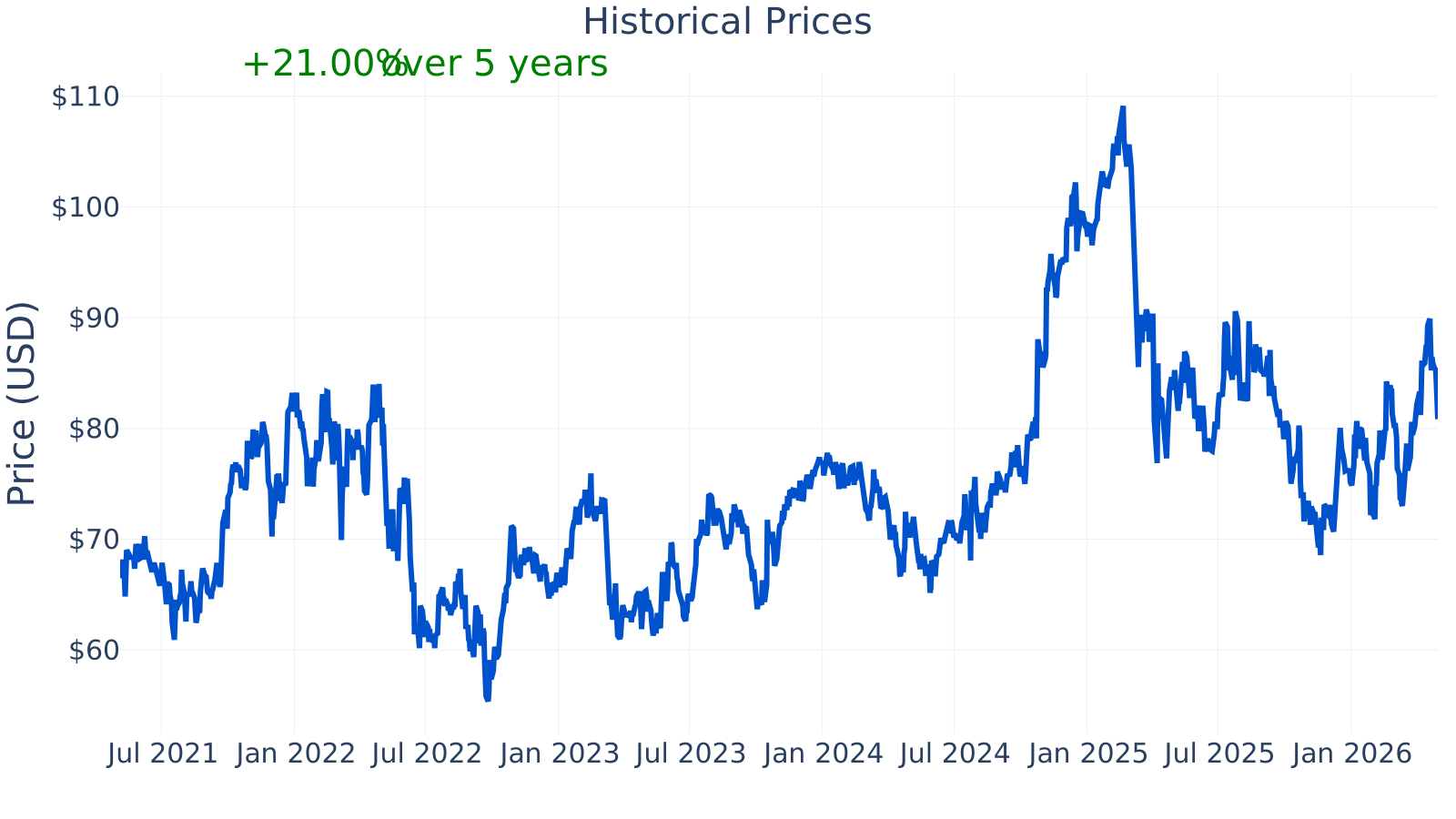
Wyndham’s market capitalization is about $6.1B, and the stock’s beta is about 0.71, which is often interpreted as lower volatility than the broader market. The company’s P/E ratio is ~32.1, slightly above the lodging industry median (~29.6). Profit margin is about 13.4% versus an industry median near 16.6%, while year-over-year revenue growth is about 3.5% versus an industry median near 6.3%. The most distinctive item in these figures is leverage: debt-to-equity is ~847%, far above the industry median (~42%), which can amplify outcomes in both favorable and unfavorable conditions. Trailing twelve-month free cash flow is about $304M.
Growth (Medium)
The lodging industry is cyclical, but it also has structural long-term drivers: population growth, rising middle-class travel in many regions, and the continued normalization of travel patterns. For a franchisor like Wyndham, growth is often less about building hotels with its own capital and more about expanding the number of franchised rooms, increasing fee-generating activity per room (for example via loyalty membership and direct booking channels), and maintaining brand relevance.
A strategy centered on franchising can support scalability: adding new hotels and keeping existing ones in the system can expand fees without requiring Wyndham to own the buildings. In that context, the company’s long-term growth profile tends to rely on (1) net unit growth (more hotels/rooms), (2) system-wide room revenue trends that influence royalties, and (3) the competitiveness of the brand portfolio and distribution platform.
The year-over-year revenue growth pattern shown is uneven: very strong growth earlier in the period (when travel demand rebounded) moderates into low single digits more recently, including some negative quarters. The latest value is about 3.5%, below the industry median (~6.3%), suggesting Wyndham’s recent top-line momentum has been more muted than peers on this measure.
Free cash flow remains positive across the period shown, moving from about $455M (2022) down to $226M (2025) and then back to about $304M (latest). For a franchising-heavy model, sustained free cash flow is an important indicator because it can be used for debt service, share repurchases, dividends, or reinvestment in technology and brand support.
Risks (High)
Wyndham’s results are exposed to travel cycles. In downturns, hotel owners can face pressure, occupancy and room rates can weaken, and franchise fees tied to hotel revenue can slow. Because franchising depends on the financial health and satisfaction of third-party hotel owners, reputational issues (brand standards, property quality, guest experience) can also affect the system over time.
A key company-specific risk is financial leverage. Higher leverage can increase sensitivity to interest rates and refinancing conditions, and it can limit flexibility if operating performance softens.
Debt-to-equity rises meaningfully over time and is currently about 847%. This is far from the industry median shown in the table (~42%). (Some industry median values in the time series are negative, which can happen when peers have negative equity, so comparisons require caution.) Even with that caveat, Wyndham’s leverage appears elevated and is a major factor to monitor for long-term resilience.
Profitability is another area to watch. While franchising can be high-margin, margins can still shift due to costs of supporting the network, technology spending, marketing, and financing costs (indirectly through net income).
Profit margin trends higher earlier in the period (peaking above 20%) and then declines materially in the most recent readings to about 13.4%. That latest level is above the industry median shown for the most recent point (~11.2%), but below the industry median listed in the key metrics table (~16.6%). The direction of travel—down from prior highs—may matter as much as the absolute level.
Competition is intense. Wyndham competes with other global hotel franchisors and operators that have large loyalty programs and extensive distribution. Major competitors commonly include Marriott International, Hilton, IHG Hotels & Resorts, Choice Hotels, and Hyatt. Wyndham is widely known for being strong in the economy and midscale segments and for operating a large global franchise system. Competitive advantages in this space typically come from brand breadth, scale, loyalty membership, distribution reach, and the ability to deliver value to franchisees (marketing, technology, and procurement support). The trade-off is that large competitors can also invest heavily in loyalty and technology, which can raise the bar for maintaining franchisee and guest engagement.
Valuation
The P/E ratio over time fluctuates, with the most recent point around 32.4, slightly above the lodging industry median shown at that time (~31.6) and also above the industry median in the latest snapshot (~29.6). In plain terms, that means the stock is priced at a somewhat higher multiple of earnings than the typical peer in the comparison set, based on these measures.
How justified that is depends on a few fundamentals discussed earlier: revenue growth has recently been in the low single digits (and below the industry median in the latest reading), profit margin is well below its earlier peak, and leverage is high. On the other hand, the business model can generate meaningful free cash flow, and an asset-light structure can support returns when travel conditions are healthy. A valuation above the peer median tends to require confidence that earnings and cash flow can be sustained or expanded without undue balance-sheet pressure.
Conclusion
Wyndham is a global hotel franchising-focused company whose results are driven mainly by franchise fees tied to the performance and size of its hotel system. The model can scale without heavy real-estate ownership, and it has produced positive free cash flow in the period shown.
At the same time, the company’s recent revenue growth appears modest, profit margin has come down from earlier highs, and leverage stands out as a central long-term risk factor. The current earnings multiple is slightly above the industry median in the comparisons shown, which places more weight on execution and stability. For long-term, fundamentals-focused readers, the key items to track over time are system growth, franchisee retention and brand strength, free cash flow consistency, and any progress (or deterioration) in leverage and financing costs.
Sources:
- U.S. SEC EDGAR — Wyndham Hotels & Resorts, Inc. filings (Form 10-K, Form 10-Q)
- Wyndham Hotels & Resorts — Investor Relations materials (annual report materials and SEC filing links)
- Wikipedia — “Wyndham Hotels & Resorts” (basic company background)
This article is for informational purposes only and does not constitute financial advice. Some content is AI-generated. See Disclaimer


