Stock Analysis · Wolverine World Wide Inc (WWW)
Overview
Wolverine World Wide, Inc. is a U.S.-based footwear and accessories company that designs, sources, markets, and sells branded products globally. Its business model is built around a portfolio of consumer brands and a mix of wholesale distribution (selling to third-party retailers) and direct-to-consumer channels (such as company-run e-commerce and, where applicable, brand stores). The company’s performance is therefore influenced by consumer demand for discretionary items, retailer order patterns, and its ability to manage inventory and pricing.
In its SEC filings, Wolverine describes revenue as coming primarily from the sale of footwear and related accessories across its brand portfolio, with revenue typically split by brands and by operating segments/geographies. Exact brand-by-brand revenue percentages vary by year and are disclosed in the company’s annual report (10-K) segment and brand information. In general terms, revenue is driven by:
- Wholesale (sales to retailers and distributors)
- Direct-to-consumer (e-commerce and brand-owned retail where applicable)
- Licensing and other income (typically smaller relative to product sales)
The income “bridge” over the last several years shows sizable swings: revenue peaked earlier in the period shown and then declined, while profitability moved from losses to positive net income more recently. It also shows that selling, general, and administrative costs represent a large portion of the cost structure—meaning execution on cost control and brand demand has an outsized effect on operating results.
Looking across the years displayed, total revenue fell meaningfully from 2022 to 2024 (about $2.68B down to about $1.76B), while net income improved from a large loss in 2022 to a profit in 2024 and further improvement in 2025. Interest expense also declined from 2023 to 2025, which can matter for a company that has used meaningful leverage.
Key Figures
| Metric | Value | Industry ⓘ |
|---|---|---|
| Date | Mar 02, 2026 | |
| Context | ||
| Sector | Consumer Cyclical | |
| Industry | Footwear & Accessories | |
| Market Cap ⓘ | $1.45B | |
| Beta ⓘ | 1.90 | |
| Fundamental | ||
| P/E Ratio ⓘ | 16.51 | 29.80 |
| Profit Margin ⓘ | 5.11% | 5.43% |
| Revenue Growth ⓘ | 4.60% | 7.10% |
| Debt to Equity ⓘ | 121.60% | 48.58% |
| PEG ⓘ | 1.72 | |
| Free Cash Flow ⓘ | $125.50M | |
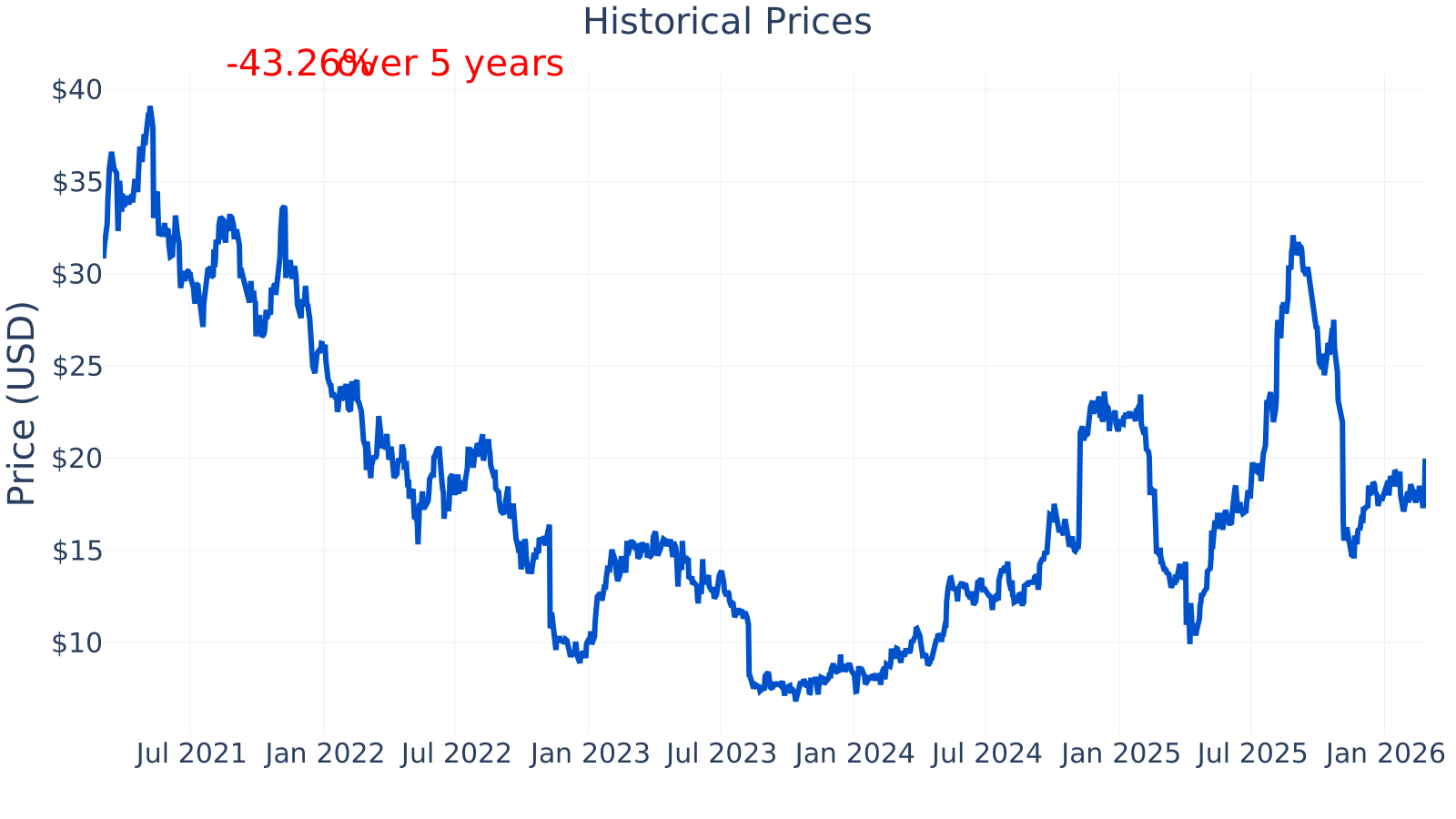
At the latest point shown, Wolverine’s market capitalization is about $1.45B, and the stock’s beta of ~1.90 suggests it has historically moved more than the broader market (higher volatility). The company’s P/E ratio is ~16.5, below the industry median shown (~29.8), while profit margin is ~5.1%, roughly in line with the industry median (~5.4%). Revenue growth year over year is ~4.6% versus an industry median of ~7.1%.
One notable figure is leverage: debt-to-equity is ~122%, materially higher than the industry median shown (~49%). Free cash flow over the trailing twelve months is shown at about $125.5M, indicating the business has recently generated cash after operating needs and capital spending.
Growth (Medium)
Wolverine operates in the global footwear and accessories space, which is broad and mature: long-run demand is tied to population, replacement cycles, fashion trends, and consumer spending power. Growth tends to come less from the overall category expanding rapidly and more from gaining market share, strengthening brand positioning, expanding direct-to-consumer reach, and improving product assortments and distribution. Because footwear is discretionary for many consumers, demand can soften quickly when macro conditions weaken, and then recover when conditions improve.
A practical way to read recent growth is that the company has been moving through a downcycle and restructuring period and then stabilizing. The year-over-year revenue trend shown swings from strong growth in 2021–2022 to deep declines in 2023–2024, followed by a return to positive growth in 2025. That pattern is consistent with a business working through inventory, channel resets, and portfolio changes, then regaining a more normal cadence.
Cash generation is an important “real-world” check for a consumer brand company, because it reflects not only accounting profits but also working-capital discipline (inventory and receivables). The free cash flow line shows a sharp deterioration into negative territory in 2022–2023 and then a return to positive levels in 2024–2025. Sustaining positive free cash flow can support reinvestment in brands, debt reduction, and flexibility through demand swings.
Potential catalysts (in a factual, non-predictive sense) generally include continued stabilization of wholesale orders, improving conversion and traffic in direct-to-consumer channels, better inventory turns, and incremental margin improvement from lower costs and less discounting. The extent to which these drivers materialize depends on brand execution and consumer demand.
Risks (High)
Wolverine’s main risks are typical of branded consumer discretionary companies, but they appear amplified by leverage and the company’s recent history of earnings volatility. Demand risk is significant: footwear purchases can be postponed, and retailers can reduce orders quickly when their own inventories rise. Brand risk also matters—consumer preference shifts can reduce pricing power and require higher marketing spend or deeper promotions.
Financial risk is another key item. Debt can increase vulnerability during downturns because interest expense and refinancing needs may constrain flexibility. While leverage has improved sharply from the peak shown in 2022–2024, the latest debt-to-equity ratio displayed is still higher than the industry median. That gap indicates the balance sheet has less room for error than many peers, even after improvement.
Profitability has been volatile. The profit margin series shows extended periods of negative margins through much of 2023–2024, followed by a return to positive margins in late 2024 and throughout 2025, ending around ~5.1%, roughly in line with the industry median displayed. The risk is that margins in footwear can compress quickly due to promotions, input costs, and unfavorable product mix, especially when inventories build across the retail channel.
Competitive positioning is challenging in footwear because the market is crowded with global athletic giants, lifestyle brands, and private-label products sold by major retailers. Competitors typically include large multi-brand footwear groups and major sportswear companies, as well as fast-moving fashion and outdoor brands depending on category focus. In this landscape, Wolverine’s competitive advantages generally come from brand recognition within its portfolio, established wholesale relationships, and the ability to operate multiple brands with shared sourcing and distribution capabilities. However, it is not a clear single-category “leader” across the entire footwear market; success tends to be brand-by-brand and channel-by-channel, and that makes execution quality and brand relevance especially important.
Valuation
Valuation is often discussed using ratios that compare the stock price to earnings, while keeping in mind that earnings can be unusually high or low in turnaround periods. The latest P/E ratio shown is ~16.5, below the industry median displayed (~29.8). On its own, a lower P/E can reflect either (1) a less expensive valuation relative to peers or (2) higher perceived risk, more uncertainty about future earnings, or a belief that current earnings are not sustainable.
The historical P/E series also reflects periods where the ratio is not meaningful (for example, when earnings are negative), which is common for companies that experienced losses. In those cases, investors often rely more on a combination of measures—profit margin stability, free cash flow consistency, and balance-sheet strength—to judge whether an earnings-based valuation is a solid reference point.
Given the company’s relatively high beta and the elevated (though improving) leverage compared with the industry median shown, a valuation discount versus peers can be interpreted as the market placing weight on volatility and financial risk. Whether the current valuation level is “justified” depends heavily on whether recent profitability and cash generation prove durable across a full demand cycle, and on continued balance-sheet strengthening.
Conclusion
Wolverine World Wide is a branded footwear company operating in a competitive, consumer-driven industry where results can change quickly with trends and retailer demand. The recent picture is mixed: revenue contracted sharply from earlier peaks, but profitability and free cash flow improved meaningfully into 2024–2025, indicating progress in operational performance.
The main counterweight is risk. Leverage remains higher than the industry median shown, and both margins and growth have been volatile in recent years. For a long-term, fundamentals-focused view, the most important items to track over time are (1) whether revenue growth stays consistently positive, (2) whether profit margins remain positive through normal retail cycles, and (3) whether debt metrics continue improving while free cash flow stays solid.
Sources:
- SEC EDGAR — Wolverine World Wide, Inc. Form 10-K (Annual Report)
- SEC EDGAR — Wolverine World Wide, Inc. Form 10-Q (Quarterly Reports)
- Wolverine World Wide Investor Relations — SEC Filings & Press Releases
- Wikipedia — “Wolverine World Wide” (basic company background)
This article is for informational purposes only and does not constitute financial advice. Some content is AI-generated. See Disclaimer