Stock Analysis · Winnebago Industries Inc (WGO)
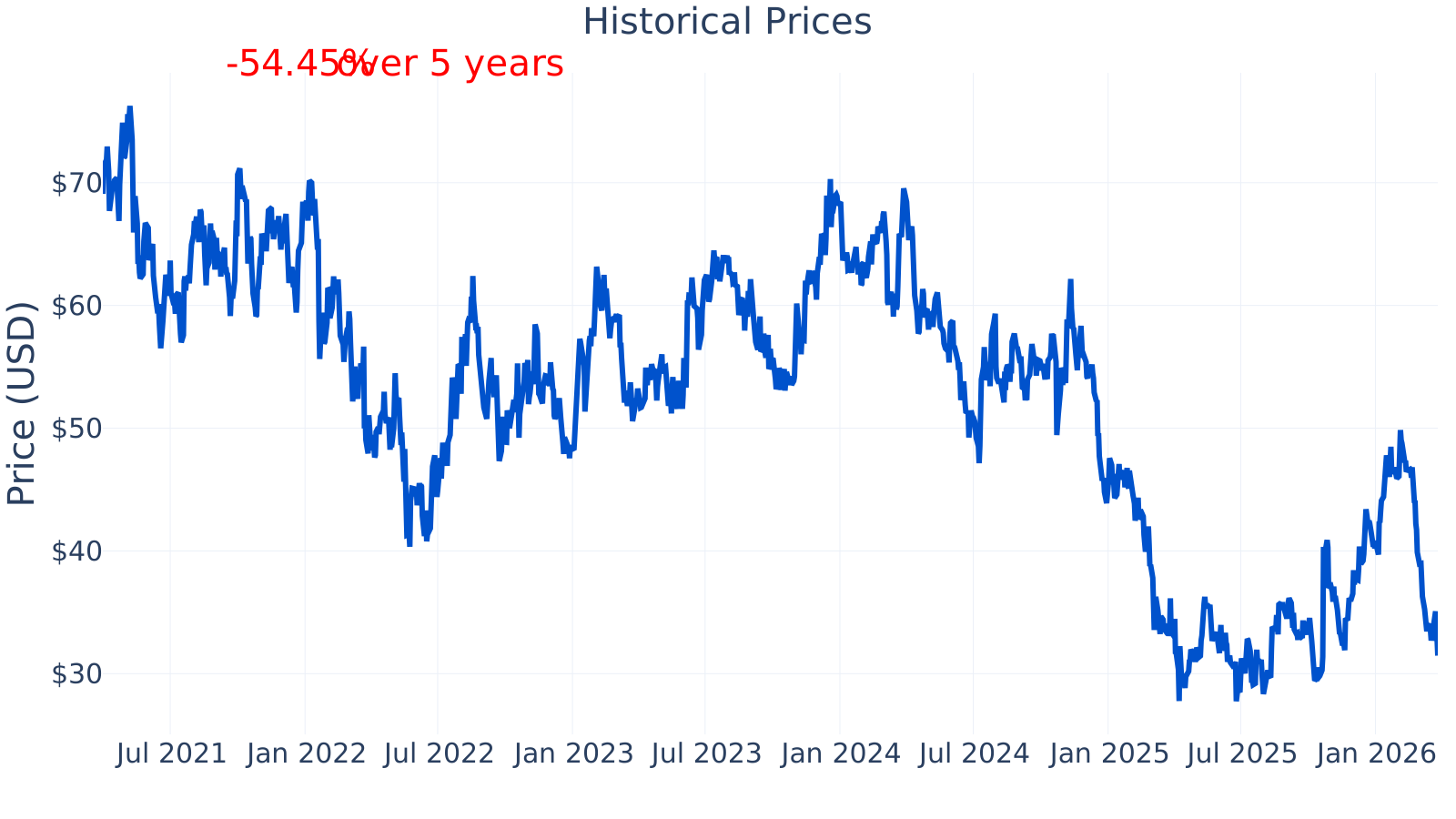
Overview
Winnebago Industries, Inc. (WGO) is a U.S. manufacturer of recreational vehicles (RVs) and marine products. The company is best known for motorhomes, but it also sells towable RVs (travel trailers and fifth wheels) and owns boat brands. Its products are typically sold through independent dealer networks rather than directly to most end customers, which means demand is influenced by dealer inventory levels, consumer financing conditions, and broader confidence in discretionary spending.
In its filings, Winnebago describes its business as operating through two reportable segments: RV and Marine. RV includes motorhomes and towable RVs under multiple brands; Marine is primarily the Barletta pontoon boat brand (and related offerings). Over time, the mix between these segments can shift depending on consumer demand, dealer ordering behavior, and production decisions.
Main revenue sources are organized by operating segment (exact percentages vary by fiscal year):
- RV segment (motorhomes and towable RVs) — typically the largest revenue contributor
- Marine segment (boats, primarily pontoons) — smaller than RV but meaningful to overall results
Across recent fiscal years, total revenue declined from the post-pandemic peak (FY2022) toward lower levels (FY2023–FY2025). Profitability also tightened materially: net income fell from hundreds of millions of dollars (FY2021–FY2023) to much smaller levels in FY2024–FY2025, showing how sensitive results can be when volumes soften and fixed costs (and pricing pressure) weigh on margins.
Key Figures
| Metric | Value | Industry ⓘ |
|---|---|---|
| Date | Mar 30, 2026 | |
| Context | ||
| Sector | Consumer Cyclical | |
| Industry | Recreational Vehicles | |
| Market Cap ⓘ | $889.52M | |
| Beta ⓘ | 1.13 | |
| Fundamental | ||
| P/E Ratio ⓘ | 21.41 | 17.87 |
| Profit Margin ⓘ | 1.43% | 3.22% |
| Revenue Growth ⓘ | 6.00% | 9.10% |
| Debt to Equity ⓘ | 38.72% | 117.93% |
| PEG ⓘ | 0.24 | |
| Free Cash Flow ⓘ | $125.80M | |
Winnebago’s market capitalization is about $0.89B, placing it in the small-to-mid cap range. The stock’s beta of ~1.13 signals somewhat higher-than-market volatility historically. Current valuation and fundamentals show a mixed picture: the P/E ratio is ~21.4 versus an industry median near 17.9, while profit margin is ~1.4% versus an industry median around 3.2%. Year-over-year revenue growth is roughly 6% compared with an industry median near 9.1%. Balance sheet leverage appears comparatively conservative with debt-to-equity ~39% versus an industry median around 118%. Trailing twelve-month free cash flow is ~$125.8M, and the PEG ratio (~0.24) is notably low (often influenced by how near-term earnings expectations are modeled, which can be especially unstable in cyclical industries).
Growth (Medium)
The RV and recreational boating markets are consumer-discretionary categories. Over the long run, demand is supported by lifestyle trends (travel, outdoor recreation, retirement and flexible work patterns), but year-to-year results can swing significantly because purchases are often financed and can be delayed when interest rates rise or consumer confidence weakens. In other words, the industry can grow over long periods, but it tends to be highly cyclical.
Winnebago’s strategy, as described in company filings, centers on managing a portfolio of brands across motorhomes, towables, and marine products while aligning production with dealer inventory and retail demand. This approach aims to reduce the risk of building excess inventory during slowdowns and to be positioned for rebounds when dealer restocking returns.
The revenue trend highlights this cyclicality clearly: after very strong growth in FY2021–FY2022, revenue growth turned negative through much of FY2023–FY2025 before returning to modestly positive territory most recently (about 6% year-over-year). A stabilization in retail demand and dealer ordering patterns is often a key swing factor for manufacturers like Winnebago.
Free cash flow has remained positive but uneven: roughly $277M (FY2023 trailing period) declined to about $72M (FY2025) and then improved to about $126M (FY2026 trailing period). For a manufacturer, sustained free cash flow matters because it helps fund operations through downturns and supports investments without relying solely on borrowing.
Potential catalysts in this type of business are usually macro and industry-driven rather than one-off events: easing interest rates, improved consumer sentiment, and dealer inventory restocking can all support a cyclical recovery. Company execution (cost control, product innovation, warranty quality, and maintaining brand strength with dealers) can influence how strongly it participates in an upswing.
Risks (High)
Winnebago’s results can change quickly because RVs and boats are big-ticket purchases. When borrowing costs rise, financing becomes less affordable and demand can fall. In slow periods, dealers may reduce orders to work down inventory, which can cause manufacturer revenues to drop faster than end-customer retail demand. This dynamic can amplify downturns.
Profitability is a key risk signal right now. Net profit margin has compressed substantially from mid-to-high single digits earlier in the period to about 1.4% most recently (and it was negative at points in the recent cycle). That suggests the company has had less pricing power and/or lower factory utilization and higher costs relative to sales. If margins remain thin, earnings can be more sensitive to small changes in volumes, discounting, and input costs.
On the balance sheet, debt-to-equity has improved to about 39%, notably below the industry median (about 97%). Lower leverage can reduce financial stress in downturns, but it does not remove the underlying demand cyclicality. It can, however, provide more flexibility to manage through a weaker market without needing to refinance aggressively.
Competition is meaningful across both RV and marine markets. In RVs, major competitors include manufacturers such as Thor Industries and Forest River (a Berkshire Hathaway company), along with other brands across motorhomes and towables. In marine, competition includes a wide set of boat makers that compete on brand, dealer relationships, features, and price. Winnebago is a well-known name in motorhomes and has a multi-brand portfolio, but the markets remain crowded and promotional pressures can increase when industry demand slows.
Competitive advantages in this industry often come from brand reputation, product quality, dealer relationships, manufacturing scale, and the ability to manage production efficiently across cycles. Winnebago’s brand recognition is an advantage, but the recent margin compression indicates that competitive and cycle pressures can still meaningfully affect results.
Valuation
At roughly 21.4x earnings, Winnebago’s current P/E is above the industry median (about 17.9x). On its own, a higher P/E can reflect expectations of improved earnings ahead, but in cyclical businesses it can also rise when earnings are temporarily depressed (because the “E” in P/E is smaller). The historical P/E pattern shown indicates significant variation over time, which is common for cyclical manufacturers and makes single-point valuation comparisons less straightforward.
Putting valuation next to fundamentals: revenue growth is positive most recently (about 6%), leverage looks moderate (debt-to-equity about 39%), and free cash flow is positive (about $126M TTM). At the same time, profit margins are currently thin (about 1.4%), which can make earnings-based valuation metrics more fragile if the cycle weakens again or if pricing remains pressured. In this context, whether the current price level is “high” or “low” depends heavily on the durability of margin recovery and the strength of the next demand cycle.
Conclusion
Winnebago Industries is a recognized manufacturer in the RV space with a broader portfolio that also includes marine products. The company operates in categories that can benefit from long-term outdoor recreation demand, but its financial performance has shown pronounced cyclicality: revenue and net income peaked earlier in the period and then declined sharply, with only recent signs of stabilization in growth and cash generation.
The main long-term elements to monitor are (1) whether profit margins recover from the currently low level, (2) whether revenue growth remains positive without relying on heavy discounting, (3) how consistently the business converts earnings into free cash flow across a full cycle, and (4) whether conservative leverage is maintained. These factors tend to matter more than any single quarter in industries where consumer financing conditions and dealer inventory cycles can rapidly change reported results.
Sources:
- SEC EDGAR — Winnebago Industries, Inc. Form 10-K (Annual Report) (Business, Segments, Risk Factors, MD&A)
- SEC EDGAR — Winnebago Industries, Inc. Form 10-Q (Quarterly Reports) (Updates on demand, margins, and liquidity)
- Winnebago Industries Investor Relations — SEC filings and investor materials (company-hosted)
- Wikipedia — “Winnebago Industries” (basic background)
This article is for informational purposes only and does not constitute financial advice. Some content is AI-generated. See Disclaimer


