Stock Analysis · Winmark Corporation (WINA)
Overview
Winmark Corporation (WINA) is a retail franchisor focused on resale (secondhand) and value-oriented specialty retail. Instead of operating a large chain of company-owned stores, Winmark primarily grows by franchising store concepts to independent operators. Its best-known brand is Plato’s Closet, with other concepts including Once Upon A Child, Play It Again Sports, Style Encore, and Music Go Round.
This “asset-light” model tends to emphasize recurring, royalty-like fees and support services rather than carrying large amounts of retail inventory at the corporate level. In plain terms: franchisees run the stores day-to-day, while Winmark provides the brand, systems, and ongoing support, and collects fees.
In its filings, Winmark describes revenue that largely comes from franchising activities. The main sources are typically:
- Ongoing franchise royalties (generally tied to franchisee sales)
- Franchise fees (such as initial fees for new stores and other franchise-related fees)
- Leasing-related income (Winmark has historically operated a small leasing segment, depending on the period and structure described in filings)
Exact percentages can shift by year and are detailed in the company’s annual report by revenue line items and segment disclosures.
From a high-level profitability view, the company’s recent annual revenue has been in a relatively narrow band (roughly the low-to-mid $80M range), while net income has remained sizable—suggesting a business with high margins and relatively low corporate overhead compared with many retailers.
Looking at the multi-year income flow (2021–2025), total revenue is fairly steady (about $78M–$86M), while net income stays around $39M–$42M. This stability is consistent with a franchise-style business where ongoing royalties can be more predictable than company-operated retail sales, although results still depend on franchisee performance and store network health.
Key Figures
| Metric | Value | Industry ⓘ |
|---|---|---|
| Date | Apr 27, 2026 | |
| Context | ||
| Sector | Consumer Cyclical | |
| Industry | Specialty Retail | |
| Market Cap ⓘ | $1.43B | |
| Beta ⓘ | 0.67 | |
| Fundamental | ||
| P/E Ratio ⓘ | 36.01 | 21.79 |
| Profit Margin ⓘ | 48.19% | 4.93% |
| Revenue Growth ⓘ | -4.90% | 3.60% |
| Debt to Equity ⓘ | -134.61% | 92.65% |
| PEG ⓘ | 1.41 | |
| Free Cash Flow ⓘ | $41.54M | |
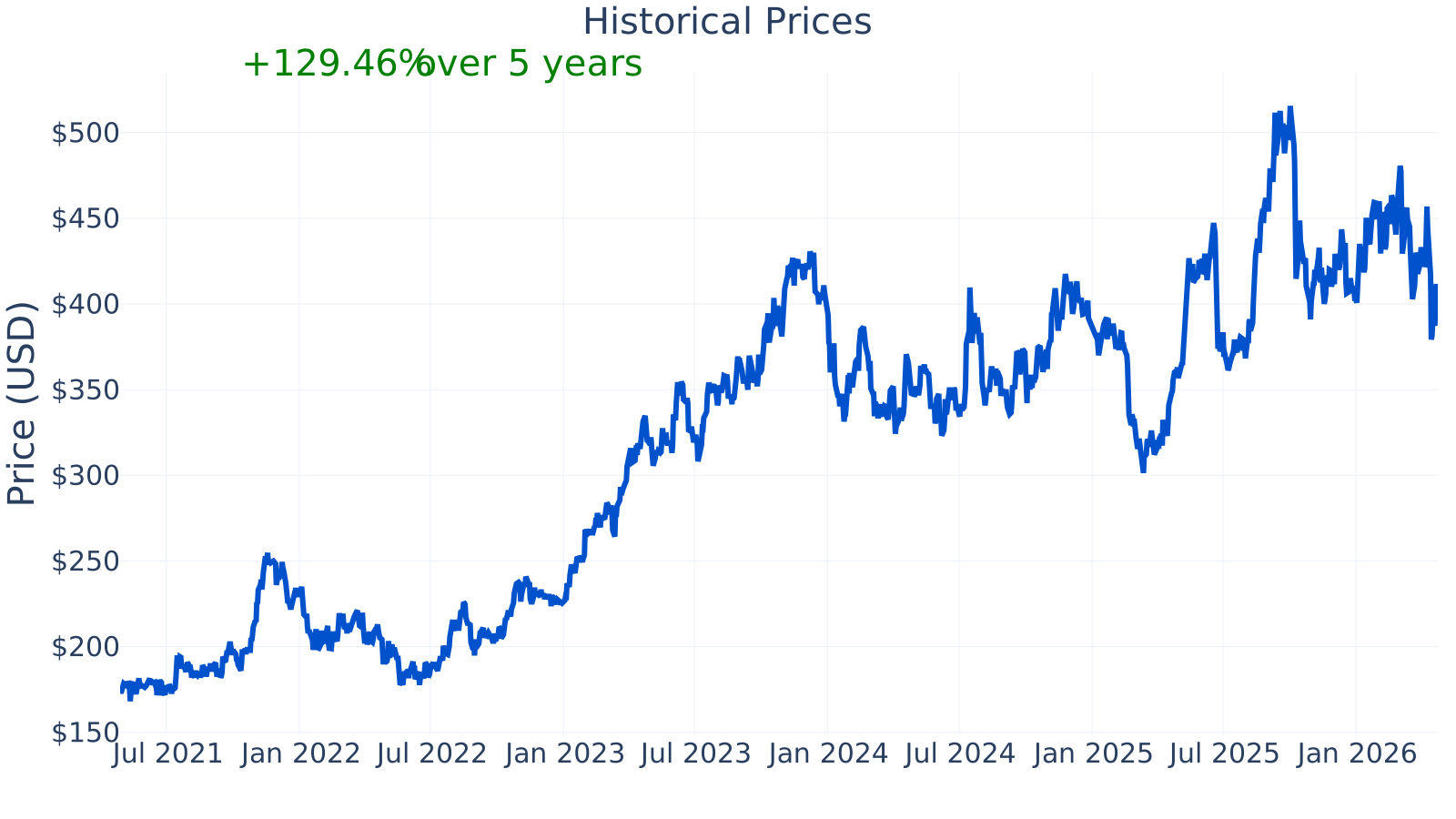
Winmark’s equity value is about $1.43B, and the stock has shown a lower-than-market sensitivity (beta around 0.67). Profitability stands out: a profit margin around 48% versus an industry median near 5%, which fits the economics of a franchisor compared with inventory-heavy retailers. Revenue growth is more mixed: the latest year-over-year reading is about -4.9% versus an industry median around +3.6%, indicating that recent top-line momentum has not been consistently positive. Free cash flow over the trailing twelve months is about $41.5M, reflecting meaningful cash generation relative to the company’s revenue scale.
Growth (Medium)
Winmark operates in areas tied to value-focused consumer spending and secondhand goods. Resale can benefit when consumers become more price-conscious, and it can also benefit structurally from long-term trends like thrifting culture and interest in reuse. However, demand is still cyclical in parts (consumer confidence, discretionary spending), and resale is also sensitive to the availability of quality used merchandise at the store level.
Strategically, franchising can support growth by expanding store count without requiring Winmark to fund most store build-outs or hold store inventory on its own balance sheet. That said, growth depends on the ability to:
- Maintain and refresh brand relevance (especially for apparel-focused concepts)
- Keep franchise economics attractive enough to recruit new operators
- Support existing franchisees so stores stay healthy and productive
Revenue growth has fluctuated over the last several years. After stronger growth periods earlier in the series, results turned modestly negative across multiple quarters in 2023–2024, improved in parts of 2025, and then dipped again to about -4.9% most recently. This pattern suggests that near-term growth is not simply “up and to the right,” and that the pace of new franchise activity and system-wide sales likely varies with consumer conditions and franchise development.
Free cash flow has been relatively steady over time, ranging from roughly $40M–$48M across the periods shown. Even when revenue growth is uneven, steady cash generation can matter because it can support dividends, share repurchases, or reinvestment in franchising support—subject to what management chooses to prioritize.
Risks (Medium)
A core risk is that Winmark’s results are tied to the health and behavior of franchisees. If franchisees struggle—because of weaker traffic, local competition, labor constraints, or store execution—system-wide sales and royalty revenue can be affected. Since franchisees are independent operators, Winmark has influence through standards and support, but not complete control over day-to-day performance.
Another risk is brand and fashion relevance, particularly for apparel resale concepts. Consumer tastes shift quickly, and resale stores rely on both demand and supply: customers must want the product, and stores must be able to acquire desirable secondhand merchandise at the right price.
Competition is meaningful. Winmark competes with:
- Other resale and consignment players (local consignment shops and regional chains)
- Large thrift/nonprofit channels and donation-based resale
- Online resale marketplaces that provide alternatives for both buying and selling used items
- Traditional discount retailers offering new products at low prices
Winmark’s competitive positioning is supported by its portfolio of established franchise brands and an operating model that can produce high margins. Its advantage is less about having the lowest price and more about brand recognition, franchise know-how, and replicable store systems. However, online platforms and local resale stores can still pressure traffic and sourcing.
The debt-to-equity ratio is shown as negative (most recently about -135%). This commonly happens when a company’s total shareholders’ equity is negative (often influenced by substantial share repurchases, dividend policy, or accounting impacts). A negative ratio can make simple leverage comparisons less intuitive than for companies with positive equity. It does not automatically mean the business is insolvent, but it does highlight that the balance-sheet structure and capital return policies should be read carefully in the annual report (including debt terms and liquidity discussion).
Profit margin has been consistently high—around 48%–51% across the periods shown—far above the industry median (generally mid-single digits). That is a strength, but it also creates a different risk: if royalties soften or costs rise, small changes in revenue or expenses can still matter, and very high margins can attract competitive responses over time.
Valuation
Winmark’s current price-to-earnings (P/E) ratio is around 36.0, compared with an industry median near 21.8. Historically in the period shown, Winmark’s P/E has often traded above the industry median, and it has generally risen from the high-teens/low-20s earlier in the series to the 30s more recently. In descriptive terms, that indicates the market has tended to assign Winmark a premium multiple relative to many specialty retail peers.
Whether that premium looks justified depends on factors that show up in the fundamentals discussed above:
- Profitability and cash generation: margins are unusually high and free cash flow is meaningful for the revenue base.
- Growth profile: revenue growth has been uneven, including a recent negative year-over-year period.
- Business model: franchising can be more stable and capital-light than store-operated retail, which can support higher valuation levels, but it still depends on franchise system performance.
Conclusion
Winmark is primarily a franchise-based resale retail company with a business model that has historically produced very high profit margins and steady free cash flow relative to its revenue size. The company’s recent revenue level appears relatively stable over several years, while growth has been inconsistent quarter-to-quarter, including periods of decline.
The main long-term questions for a reader evaluating the business are practical rather than technical: whether Winmark’s brands can remain relevant, whether franchisees can keep stores productive, and how competition from other resale channels (including online options) evolves. On valuation, the stock has commonly traded at a higher P/E than the industry median, which aligns with its distinctive margins and franchising economics, but also means expectations embedded in the price may be less forgiving during slower-growth periods.
Sources:
- SEC EDGAR — Winmark Corporation Form 10-K (Annual Report): “Item 1. Business” and “Item 7. Management’s Discussion and Analysis of Financial Condition and Results of Operations”
- SEC EDGAR — Winmark Corporation Form 10-Q (Quarterly Reports): “Management’s Discussion and Analysis”
- Winmark Corporation Investor Relations — Company filings and investor materials (as posted by the company)
- Wikipedia — “Winmark” (basic company background and brand list)
This article is for informational purposes only and does not constitute financial advice. Some content is AI-generated. See Disclaimer


