Stock Analysis · Winmark Corporation (WINA)
Overview
Winmark Corporation is a franchisor in the resale (“recommerce”) part of retail. Instead of owning and operating a large number of stores itself, Winmark primarily licenses its brands to franchisees who run the day-to-day locations. Its best-known concepts focus on secondhand goods, including children’s items (Once Upon A Child), women’s apparel (Plato’s Closet), sporting goods (Play It Again Sports), and music/media (Music Go Round). Winmark also has a leasing-related business that has historically been part of the company’s activities, though the franchising model is the central long-term driver described in company filings.
This business model tends to produce revenue that is more fee-based than inventory-based. In practice, that usually means the corporate office collects ongoing royalties and other fees from franchisees rather than taking on the cost of buying and selling used products itself. In its SEC filings, Winmark describes its revenue as coming largely from franchising-related sources (such as royalties) along with other franchise-related fees, and revenue tied to its leasing segment.
Main sources of revenue (in broad terms, as described in company filings):
- Franchise royalties (ongoing fees typically based on franchisee sales)
- Franchise-related fees (such as initial franchise fees and other franchise services)
- Leasing-related revenue (leasing segment activities described in filings)
The company’s recent income profile highlights how “asset-light” the franchising model can be: total revenue was about $81.3M in 2024, while cost of revenue was relatively small (about $3.4M), leaving a large gross profit base (about $77.9M). Net income stayed close to $40M across 2021–2024 even as revenue moved within a relatively tight range.
From 2021 to 2024, revenue stayed in a narrow band (roughly $78M–$83M). Over the same period, net income remained remarkably steady at around $40M each year, reflecting a model where a meaningful share of expenses does not scale linearly with systemwide store activity.
Key Figures
| Metric | Value | Industry ⓘ |
|---|---|---|
| Date | Feb 08, 2026 | |
| Context | ||
| Sector | Consumer Cyclical | |
| Industry | Specialty Retail | |
| Market Cap ⓘ | $1.61B | |
| Beta ⓘ | 0.65 | |
| Fundamental | ||
| P/E Ratio ⓘ | 40.35 | 23.78 |
| Profit Margin ⓘ | 48.84% | 6.27% |
| Revenue Growth ⓘ | 5.20% | 5.20% |
| Debt to Equity ⓘ | -237.46% | 103.28% |
| PEG ⓘ | N/A | |
| Free Cash Flow ⓘ | $44.46M | |
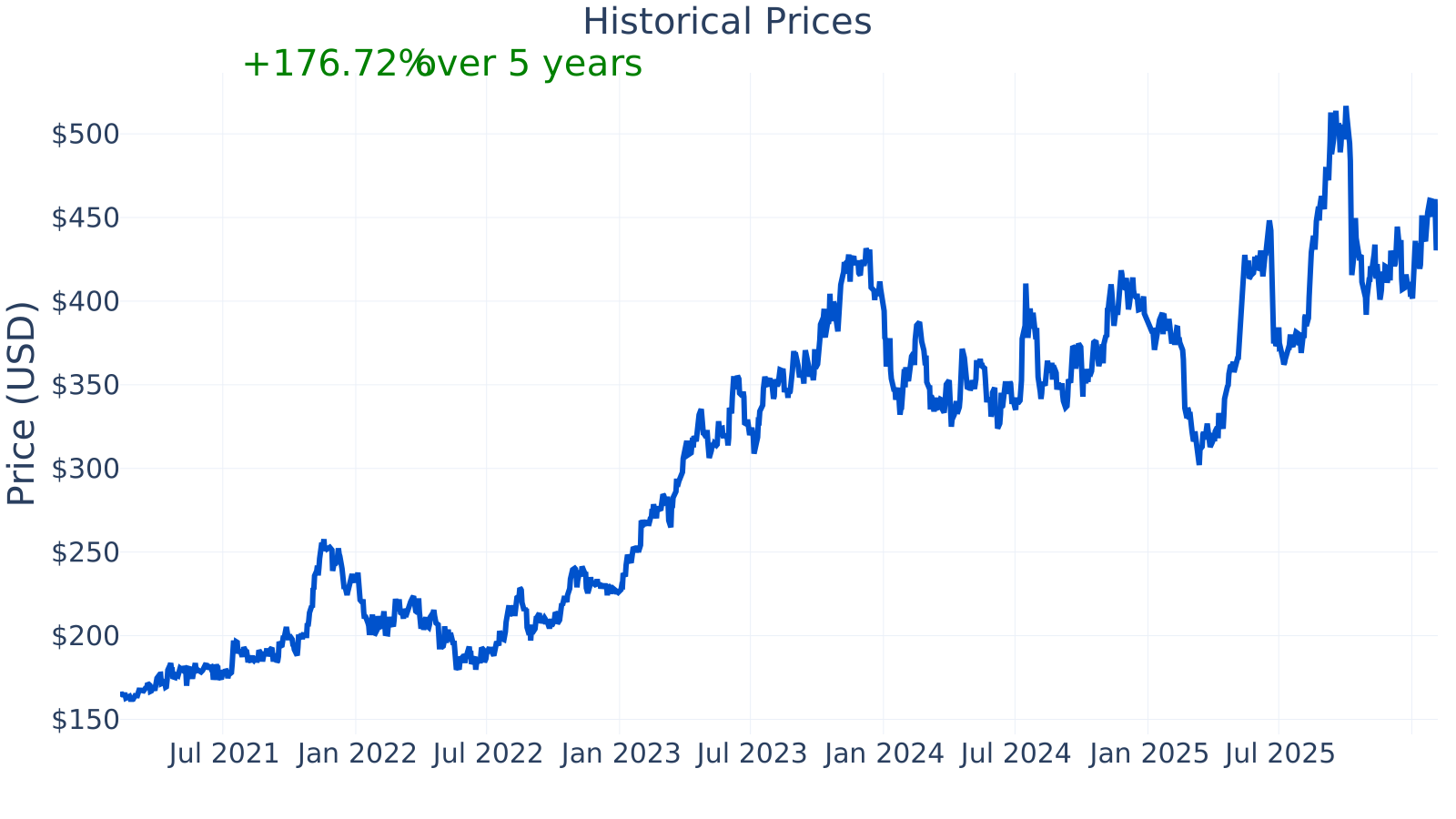
Winmark’s market capitalization is about $1.61B, and its beta (about 0.65) indicates the stock has historically moved less than the overall market. The company’s trailing P/E ratio is about 40.3 versus an industry median near 23.8. Profit margin is unusually high at about 48.8% versus an industry median around 6.3%, consistent with a franchisor structure. Year-over-year revenue growth is about 5.2%, roughly in line with the industry median. Trailing twelve-month free cash flow is about $44.5M.
Growth (Medium)
Winmark operates in a segment supported by long-running consumer trends: value-oriented shopping, reuse, and a preference for more sustainable consumption. Resale can also benefit from periods when household budgets are tighter, since secondhand goods often provide lower price points than buying new. At the same time, this is still retail-adjacent demand, which can fluctuate with employment levels, consumer confidence, and local competition.
The company’s growth strategy, as described in filings, is fundamentally about expanding and supporting its franchise system rather than building a large chain of company-owned stores. In an asset-light franchising model, growth can come from adding franchise locations, improving franchisee sales (which can lift royalty revenue), and maintaining strong franchisee economics so that store owners continue to invest in their locations.
Revenue growth has been uneven quarter to quarter: after stronger growth earlier in the period shown, several quarters turned slightly negative in 2023–2024 before returning to positive territory in 2025 (including a mid-single-digit reading most recently). This pattern suggests a business that can grow, but not in a straight line, and one that is sensitive to the pace of franchisee sales and system development.
Free cash flow over the trailing twelve months has been relatively stable across the last several annual points shown (roughly in the $40M–$48M range). For a franchisor, steady cash generation can matter because it supports ongoing corporate operations and potential capital returns without requiring large reinvestment in inventory or store build-outs at the corporate level.
Risks (Medium)
This article is for informational purposes only and does not constitute financial advice. Some content is AI-generated. See Disclaimer


