Stock Analysis · Williams-Sonoma Inc (WSM)
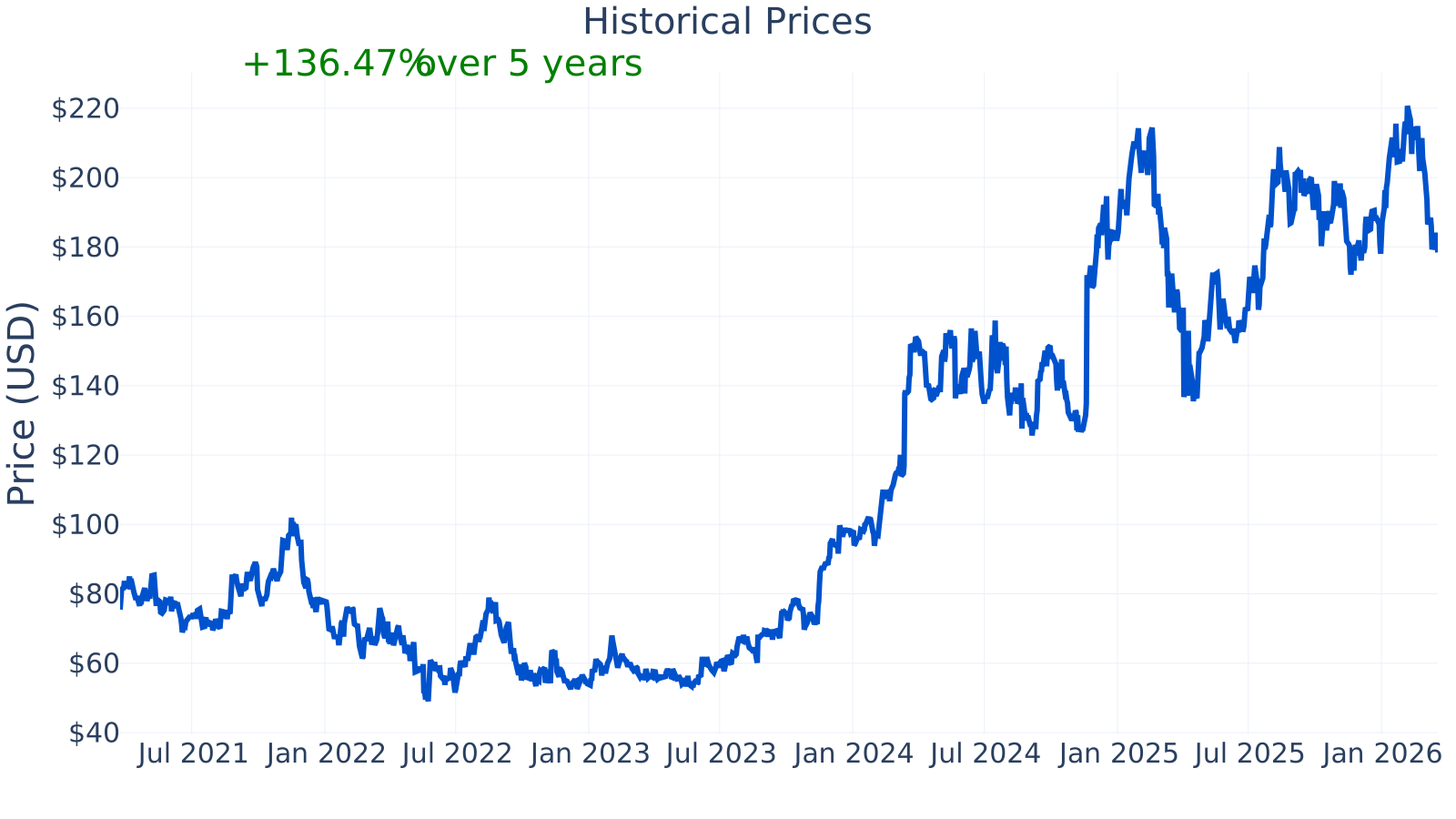
Overview
Williams-Sonoma, Inc. (WSM) is a specialty retailer focused on home-related products. Its brands sell cookware and kitchen tools, furniture, home furnishings, textiles, décor, and related items. The company operates through a mix of e-commerce and physical retail stores, with a strategy that has emphasized brand-led merchandising, a direct-to-customer shopping experience, and a presence in multiple home categories (cooking, furniture, décor, and home improvement).
Revenue is generated primarily from merchandise sales across its portfolio of retail brands, sold through websites, catalogs, and stores. The company reports sales by brand; the mix can shift over time with housing activity, consumer spending, and brand performance. (Brand-level percentages are available in the company’s annual report/10-K segment disclosures.)
Key revenue streams typically include the following brand families (ordered broadly by historical scale in company reporting, though exact ranking can vary by year):
- Pottery Barn (including Pottery Barn Kids and Pottery Barn Teen)
- West Elm
- Williams Sonoma
- Rejuvenation
- Mark and Graham
- Other/Eliminations (as applicable in financial reporting)
The business model relies on product design and sourcing, inventory management, marketing, distribution/fulfillment, and customer service—areas that directly influence profitability and cash generation.
Across recent fiscal years, total revenue has fluctuated around the high single-digit billions, while operating income and net income have remained substantial. A notable feature is that selling, general, and administrative costs are a large and relatively stable portion of the cost structure, which means small changes in demand, discounting, or freight costs can meaningfully affect profits.
Key Figures
| Metric | Value | Industry ⓘ |
|---|---|---|
| Date | Mar 23, 2026 | |
| Context | ||
| Sector | Consumer Cyclical | |
| Industry | Specialty Retail | |
| Market Cap ⓘ | $21.30B | |
| Beta ⓘ | 1.56 | |
| Fundamental | ||
| P/E Ratio ⓘ | 19.69 | 20.26 |
| Profit Margin ⓘ | 13.94% | 4.93% |
| Revenue Growth ⓘ | -4.30% | 4.30% |
| Debt to Equity ⓘ | 69.96% | 92.65% |
| PEG ⓘ | 2.27 | |
| Free Cash Flow ⓘ | $1.06B | |
Williams-Sonoma’s market capitalization is about $21.3B, and the stock’s beta of ~1.56 indicates it has historically moved more than the broader market (higher volatility). The company’s P/E ratio is ~19.7, close to the specialty retail industry median (~20.3). Profitability stands out: profit margin is ~13.9% versus an industry median around 4.9%. Recent sales momentum is weaker than the industry median: year-over-year revenue growth is about -4.3% versus an industry median near +4.3%. Leverage appears somewhat lower than peers: debt-to-equity is ~70% compared with an industry median around 93%. Trailing twelve-month free cash flow is about $1.06B, reflecting meaningful cash generation after operating needs and capital spending.
Growth (Medium)
Williams-Sonoma operates in consumer discretionary retail, specifically home furnishings and home-related categories. Over the long term, demand is influenced by household formation, housing turnover, renovation activity, and consumer confidence. This is not a “straight-line” growth industry: it tends to move in cycles, with stronger periods during housing booms and weaker periods when inflation, interest rates, or housing slowdowns pressure big-ticket purchases.
Within that context, the company’s growth strategy has generally centered on expanding and deepening its brand ecosystem, maintaining a large e-commerce presence, and using its scale in sourcing and logistics to support service levels and margins. Additional long-term growth drivers can include expanding business-to-business offerings (e.g., trade and contract channels), growing newer concepts, and selectively expanding internationally (all subject to what the company outlines in its filings).
The year-over-year revenue pattern shows a swing from very strong growth in 2021–2022 to declines through much of 2023–2024, followed by a return to modestly positive growth in parts of 2025, and then a more recent dip (about -4.3%). This highlights the cyclical nature of home-related spending and the impact of normalization after pandemic-era demand.
Free cash flow remains sizable but has varied over time: roughly $1.14B (2022), $0.70B (2023), $1.49B (2024), $1.14B (2025), and about $1.06B most recently. For a retailer, sustained free cash flow is an important indicator of operational resilience because it can support reinvestment (technology, stores, supply chain) and provide flexibility during weaker demand periods.
Risks (Medium)
The biggest risk is demand sensitivity. As a discretionary retailer, Williams-Sonoma is exposed to shifts in consumer spending, housing turnover, interest rates, and macroeconomic conditions. A slowdown can lead to higher promotions, elevated inventory risk, and pressure on margins. The company is also exposed to sourcing and logistics dynamics (supplier concentration, input costs, ocean freight, port disruptions), as well as foreign exchange and tariff-related uncertainty depending on where goods are produced.
Competition is intense. The company competes with a wide set of retailers and platforms across price points and styles. Key competitors commonly include large home-furnishings specialists and broad-line retailers with strong home categories, as well as online-first competitors and marketplaces. In practice, this means the company must continually invest in product differentiation, brand marketing, site/app experience, fulfillment speed, and customer service to defend share.
Competitive advantages, where present, tend to come from brand equity (recognizable banners with distinct positioning), merchandising and design capabilities, and a scaled direct-to-customer model supported by distribution infrastructure. These strengths can help the company maintain pricing power and repeat purchasing, but they are not permanent—brand relevance can fade if product assortment or customer experience slips.
Leverage, as measured by debt-to-equity, has generally trended below the industry median in recent periods. The most recent value is about 70% versus an industry median near 88%. While this can indicate comparatively moderate balance-sheet leverage, debt still matters in retail because earnings can swing with demand cycles.
Profitability is a notable strength versus peers. Profit margin has been consistently higher than the industry median across the period shown, most recently around 13.9% compared with an industry median near 4.9%. The main risk to monitor is whether these margins can hold through a tougher promotional environment or weaker big-ticket demand.
Valuation
For a simple valuation check, one commonly used metric is the price-to-earnings (P/E) ratio, which compares the stock price to the company’s earnings. A higher P/E often implies the market expects stronger growth or more durable earnings; a lower P/E may reflect lower expected growth or higher perceived risk.
Williams-Sonoma’s current P/E is about 19.7, close to the specialty retail industry median of roughly 20.3. Historically in the period shown, the company’s P/E moved from single digits in 2022–2023 to the high teens/low 20s more recently—generally in line with or sometimes below the industry median, depending on the date. Interpreting this alongside fundamentals: the company shows materially higher profit margins than the industry median, but also recently weaker year-over-year revenue growth. In other words, the valuation level appears to reflect a balance between strong profitability and the cyclical/variable growth profile typical of home-related retail.
Conclusion
Williams-Sonoma is a brand-led home retail company with a meaningful direct-to-customer presence and a multi-banner portfolio spanning cooking, furniture, and home furnishings. The financial profile highlighted here shows strong profitability relative to the industry median and substantial free cash flow generation, alongside revenue that can be uneven due to the cyclical nature of consumer discretionary spending in home categories.
The main long-term points to weigh are the durability of its brand positions and margins versus the realities of a highly competitive retail landscape and demand cycles tied to housing and consumer confidence. From a valuation perspective, the P/E ratio sits near the industry median, which aligns with a business that has demonstrated above-peer margins but faces variable growth rates across cycles.
Sources:
- SEC EDGAR — Williams-Sonoma, Inc. Form 10-K (Annual Report) (most recent filing)
- SEC EDGAR — Williams-Sonoma, Inc. Form 10-Q (Quarterly Reports) (most recent filings)
- Williams-Sonoma, Inc. Investor Relations — Annual Report materials and SEC filings repository
- Wikipedia — “Williams-Sonoma” (basic company background)
This article is for informational purposes only and does not constitute financial advice. Some content is AI-generated. See Disclaimer


