Stock Analysis · John Wiley & Sons B (WLYB)
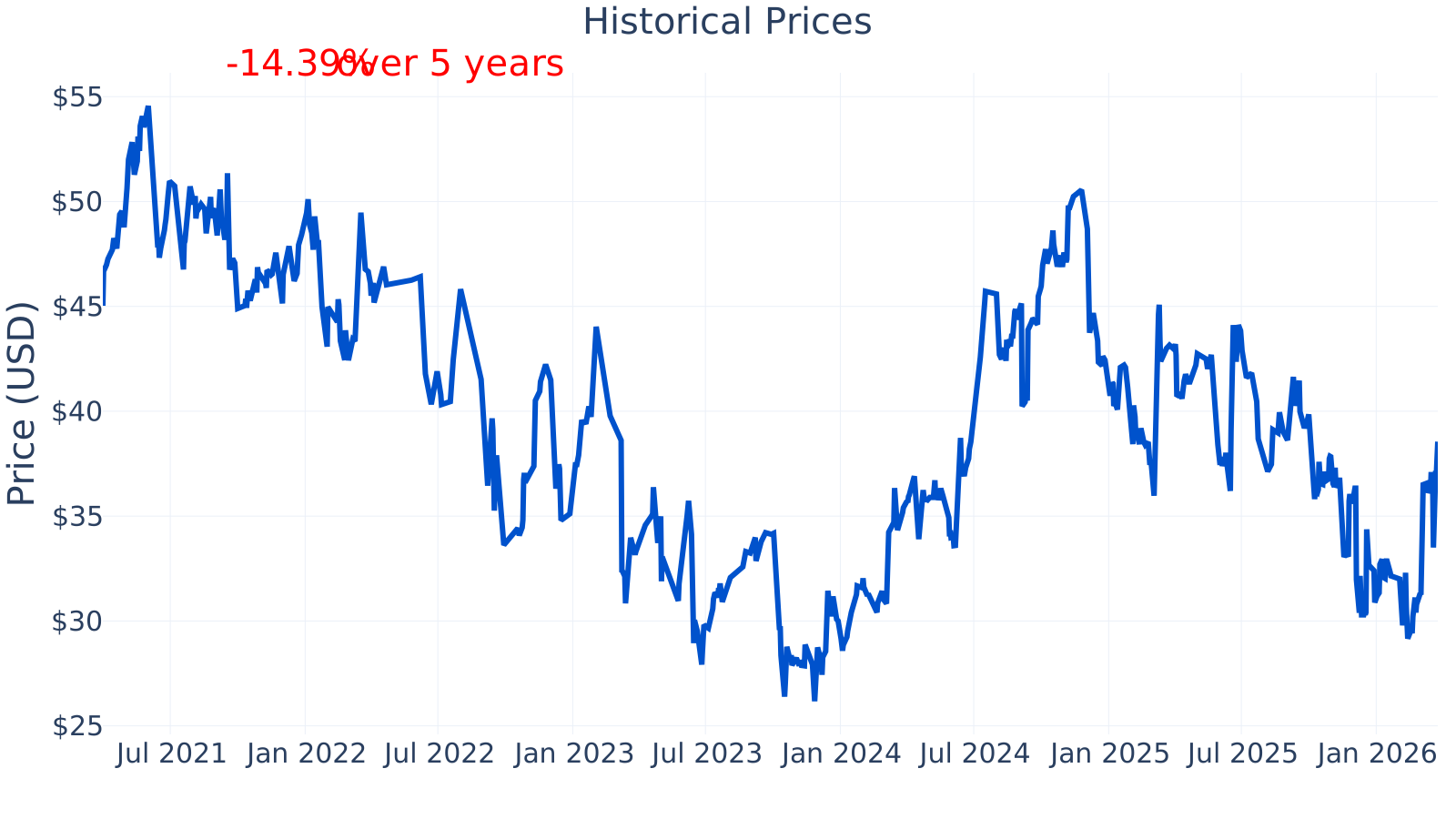
Overview
John Wiley & Sons (Class B shares: WLYB) is a long-established publishing and information services company. Its focus is on professional and academic content, delivered through journals, books, digital platforms, and related services. In practical terms, Wiley helps universities, researchers, libraries, companies, and professionals access and publish trusted knowledge, and it earns revenue through subscriptions, licensing, publishing fees, and content-enabled services.
Wiley generally reports its activity through two main operating segments, which shape how revenue is generated:
- Research: Primarily scientific, technical, and medical (STM) journals and related publishing services (including open access publishing options).
- Learning: Academic and professional learning content and course materials, increasingly delivered digitally.
Because segment-level percentages vary by year and depend on how the company reports certain lines, a simple way to understand the business is that recurring and contract-based revenue (subscriptions, licensing, and ongoing institutional relationships) has historically been important, while other revenue is more transactional (for example, certain courseware and print products).
Across the periods shown, total revenue trends down from about $2.08B (FY2022) toward about $1.68B (FY2025). Over the same span, operating profit and net income show large swings, including a loss in FY2024, followed by a return to profitability in FY2025. This pattern suggests that one-time items and cost structure changes can materially affect results, even when revenue changes are less dramatic.
Key Figures
| Metric | Value | Industry ⓘ |
|---|---|---|
| Date | Mar 30, 2026 | |
| Context | ||
| Sector | Communication Services | |
| Industry | Publishing | |
| Market Cap ⓘ | $1.98B | |
| Beta ⓘ | 0.95 | |
| Fundamental | ||
| P/E Ratio ⓘ | 13.48 | |
| Profit Margin ⓘ | 9.24% | |
| Revenue Growth ⓘ | 1.30% | |
| Debt to Equity ⓘ | 119.66% | |
| PEG ⓘ | 13.40 | |
| Free Cash Flow ⓘ | $190.44M | |
Based on the latest metrics shown, Wiley has a market capitalization of about $2.0B and a beta of ~0.96, which is close to overall market volatility in simple terms. The company’s profit margin is ~9.24% (about $9 of profit per $100 of revenue, using the period reflected by the metric), while year-over-year revenue growth is ~1.3%, indicating relatively modest top-line expansion in the latest period. The debt-to-equity ratio is ~120%, meaning debt is sizable relative to shareholders’ equity. Trailing twelve-month free cash flow is about $190M, which is an important support for debt service, reinvestment, and shareholder returns. The table also shows a P/E ratio of ~13.5 and a PEG ratio of ~13.4; a high PEG typically indicates that the market price is not low relative to the company’s expected growth rate (depending on how that growth estimate is calculated).
Growth (Low to Medium)
Wiley operates in mature parts of publishing (books and educational materials) and in more structurally supported areas (research publishing and digital access to academic content). Long-term demand for research dissemination is connected to global R&D spending, university activity, and the ongoing need to manage and validate scientific information. At the same time, the industry is evolving: library budgets are scrutinized, customers expect better digital tools, and open access publishing models continue to expand, changing how money flows through the system (for example, shifting from subscription payments to publishing-related fees in some cases).
Strategically, a long-term growth narrative for Wiley typically depends on (1) maintaining relevance and pricing power in research publishing, (2) expanding workflow tools and digital platforms around content, and (3) improving the mix toward more recurring and less print-dependent revenue. Execution matters, because even modest revenue changes can lead to larger profit swings when costs, technology investment, and restructuring are involved.
The year-over-year revenue growth trend shown is volatile and often negative across multiple periods, only turning slightly positive in the latest reading (~+1.3%). This points to a business that has faced several years of revenue pressure and stabilization efforts rather than consistent expansion.
Free cash flow improves from roughly $122M (FY2023) to about $190M (FY2026 period shown). For a content and services business, steady cash generation can be a meaningful “engine” for long-term flexibility, even when reported earnings fluctuate. Potential catalysts in this type of business typically include margin recovery from cost actions, successful product/platform improvements that support renewals, and better monetization of digital offerings.
Risks (Medium to High)
A key risk is that parts of Wiley’s markets are mature and competitive, with customer budget sensitivity (universities, libraries, and corporate learning departments). In research publishing, policy and funding shifts (including open access mandates and negotiations with large institutions) can affect pricing, contract structures, and volume. In learning, competition from lower-cost digital alternatives and changing course material adoption patterns can weigh on growth and margins.
Another notable risk area is financial leverage and earnings variability. When debt levels are meaningful, downturns or unexpected profit declines can reduce flexibility.
The debt-to-equity ratio generally trends around the 80%–144% range over the periods shown, with the latest value near 120%. That level does not automatically indicate distress, but it does mean capital structure is an important part of the overall risk profile, especially during periods of weaker profitability or higher interest costs.
Profitability shows a sharp cycle: margins turn negative for several periods (reaching roughly -10.7% at one point), then recover to about 9.24% in the latest period. This history signals that the company’s earnings can be sensitive to restructuring, impairments, demand shifts, pricing dynamics, and cost execution.
On competitive positioning, Wiley is a recognized brand in scholarly and professional publishing, but it is not the only major player. Large global competitors in research publishing include RELX (Elsevier) and Springer Nature, among others, with additional competition from society publishers and university presses. In learning content and course materials, competition comes from other education publishers and digital learning platforms. Competitive advantages in this industry often come from brand trust, journal and author relationships, editorial quality, scale in distribution, and integrated digital tools—but these advantages must be maintained through ongoing investment and customer value.
Valuation
The P/E ratio shown varies materially over time, with visible points around the high teens in 2021–2022, a spike above 50 in 2025 (often a sign that earnings were temporarily depressed or volatile), and a more recent level around 11. The latest metric table indicates a P/E of about 13.5. In plain terms, P/E is “price compared to annual profit,” and a lower number can indicate a cheaper price relative to current earnings, but it can also reflect higher uncertainty about future earnings.
For context, Wiley’s valuation needs to be interpreted alongside (1) relatively modest recent revenue growth, (2) recovering but historically volatile profit margins, (3) meaningful leverage, and (4) improved free cash flow. A single-number valuation measure is less informative when earnings have swung significantly; in those cases, it is common to look at multiple years of normalized profitability and cash generation (rather than one period) to judge how representative the current P/E is.
Conclusion
John Wiley & Sons is a well-known provider of research and learning content, with a business model that includes recurring institutional relationships and a continuing shift toward digital delivery. The recent picture is mixed: revenue has trended lower over several years and year-over-year growth has been inconsistent, while profitability has shown large swings but appears to have recovered in the latest period. Free cash flow has improved, which can support operational flexibility, but leverage remains a central consideration given the debt-to-equity levels shown.
From a long-term perspective, the main factual elements to weigh are Wiley’s ability to sustain relevance in research publishing as business models evolve, stabilize and grow its learning offerings in a competitive environment, and keep profitability resilient through cycles. The valuation metrics shown (including a recent P/E in the low teens) look meaningfully different depending on which earnings period is used, so understanding the drivers of past margin declines and the durability of the recovery is essential when interpreting the current multiple.
Sources:
- SEC EDGAR — John Wiley & Sons, Inc. filings (Form 10-K, Form 10-Q, Form 8-K)
- John Wiley & Sons, Inc. Investor Relations — Annual Reports and SEC filings
- Wikipedia — “John Wiley & Sons” (company background and general history)
This article is for informational purposes only and does not constitute financial advice. Some content is AI-generated. See Disclaimer


