Stock Analysis · Whirlpool Corporation (WHR)
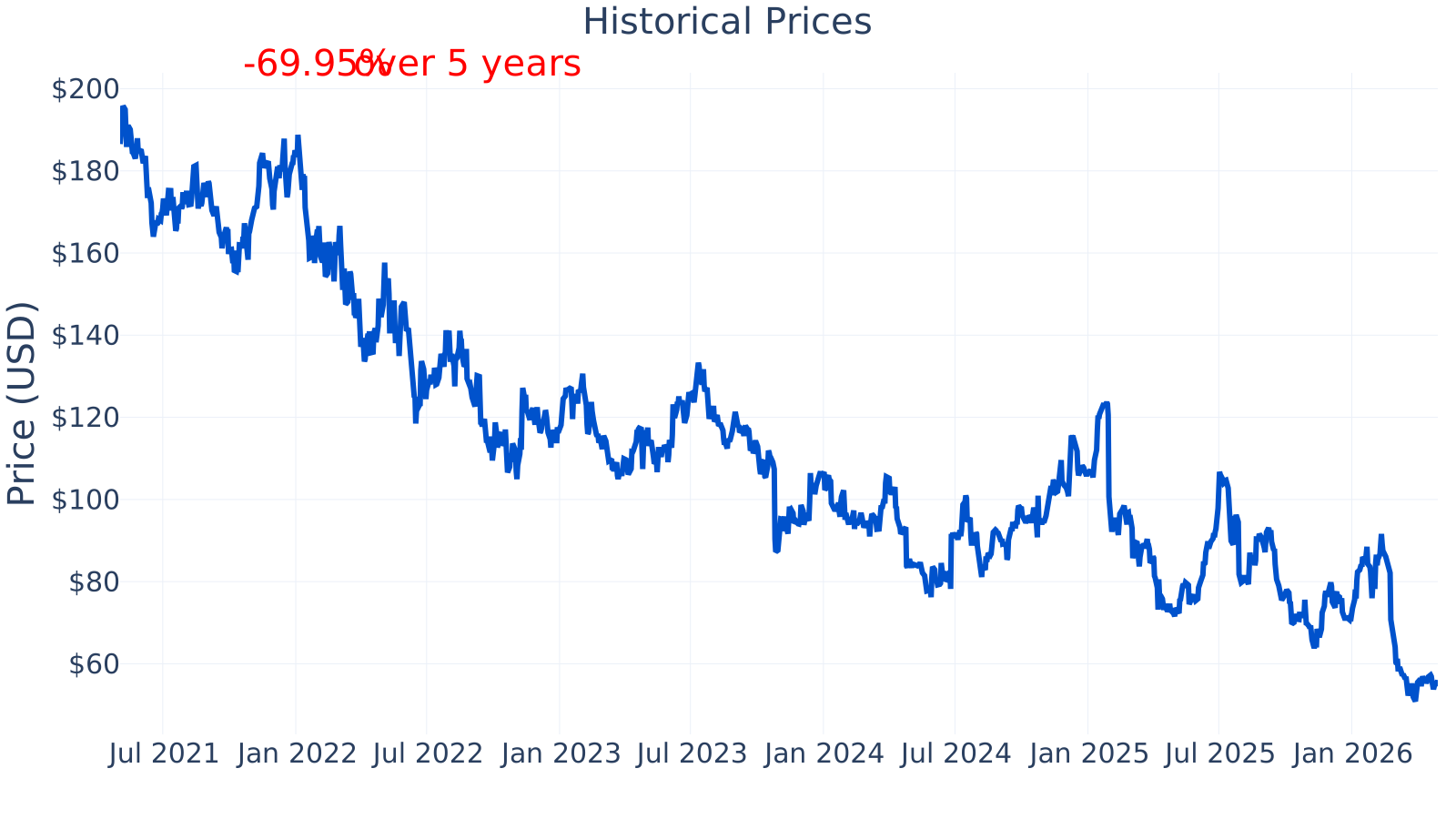
Overview
Whirlpool Corporation is a global home appliance manufacturer. In plain terms, it designs, makes, and sells major household appliances such as refrigerators, cooking products, dishwashers, laundry machines, and related parts and services. The company operates with a portfolio of well-known brands and sells through retailers, distributors, builders, and direct-to-consumer channels, depending on the region.
Its revenue primarily comes from selling major domestic appliances. Whirlpool reports revenue by geographic business segments in its filings (rather than by individual product line). In recent annual reports, the core segments have generally been:
- North America (typically the largest contributor)
- Latin America
- EMEA (Europe, Middle East, and Africa)
- Asia (often smaller; structure can change over time depending on portfolio actions)
Across these segments, demand is closely tied to household formation, housing turnover, remodeling activity, and replacement cycles for appliances. A meaningful portion of the economics also depends on product mix (premium vs. mass market), input costs (steel, resins, freight), and pricing.
Over the last several years, Whirlpool’s revenue base has trended lower versus earlier periods, while profitability has been more volatile. The operating line items also highlight that interest expense has remained a noticeable cost, which can matter more when operating income is under pressure.
Key Figures
| Metric | Value | Industry ⓘ |
|---|---|---|
| Date | May 01, 2026 | |
| Context | ||
| Sector | Consumer Cyclical | |
| Industry | Furnishings, Fixtures & Appliances | |
| Market Cap ⓘ | $3.61B | |
| Beta ⓘ | 1.26 | |
| Fundamental | ||
| P/E Ratio ⓘ | 9.90 | 23.43 |
| Profit Margin ⓘ | 2.05% | 3.93% |
| Revenue Growth ⓘ | -0.90% | 4.30% |
| Debt to Equity ⓘ | 288.26% | 100.56% |
| PEG ⓘ | 1.04 | |
| Free Cash Flow ⓘ | $92.00M | |
Whirlpool’s market capitalization is about $3.6B, and the stock has shown above-market volatility (beta about 1.26). The latest P/E ratio is ~9.9, which is below the industry median shown (~23.4), while the latest profit margin is ~2.1% versus an industry median of ~3.9%. Recent year-over-year revenue growth is slightly negative (-0.9%) compared with a positive industry median (~4.3%). Leverage stands out: debt-to-equity is ~288% versus an industry median of ~101%. Trailing twelve-month free cash flow is about $92M in the latest snapshot, and the PEG ratio is about 1.04 (a metric that relates valuation to expected earnings growth).
Growth (Low)
Major home appliances are generally considered a mature, replacement-driven category. Over long periods, unit demand tends to track household growth and replacement cycles rather than rapid structural expansion. That said, the industry can experience strong upswings and downswings based on housing conditions, consumer confidence, and interest rates (because large appliance purchases are often tied to moving, remodeling, or financing availability).
A practical way to think about Whirlpool’s growth outlook is that it often depends on (1) stabilizing or improving industry demand in its biggest regions, (2) maintaining pricing and product mix, and (3) executing cost and supply-chain improvements to defend margins in a competitive market.
The pattern of revenue growth has been choppy, with multiple periods of negative year-over-year comparisons. Most recently, the year-over-year change is close to flat but slightly negative (-0.9%), which is below the industry median shown on the table. For a mature category, sustained positive growth often requires either share gains, product mix improvement, or expansion into adjacent services and parts—otherwise results can track end-market cycles.
Free cash flow has also fluctuated significantly: it was very strong in some periods (for example, over $1.1B at 2022-03-31) and much weaker in others (slightly negative around 2024-03-31), before recovering again (about $579M at 2025-03-31). This variability matters for a long-term view because it affects the company’s flexibility to invest in products, fund restructuring, service debt, and return capital to shareholders across a full cycle.
Risks (High)
Whirlpool’s business has several important risk drivers. First, it is highly exposed to economic cycles: big-ticket durable goods tend to see demand fall when consumers postpone discretionary replacements, when housing activity slows, or when financing costs rise. Second, input costs and logistics can move quickly; even with pricing actions, there can be a lag before margins adjust. Third, the category is highly competitive, with frequent promotions and retailer bargaining power, which can pressure pricing and market share.
Leverage is a key financial risk indicator here. Whirlpool’s debt-to-equity has been materially above the industry median for an extended period, and the latest level is about 288% (vs. an industry median near 101%). Higher leverage can amplify outcomes: it may help returns in strong periods but can reduce flexibility when profits weaken, especially because interest expense remains an ongoing cost.
Profitability has been volatile. The profit margin series shows periods of healthy profitability earlier (for example, around 8–9% in parts of 2021) followed by a sharp deterioration including negative margins across much of 2022–2023, and then a partial recovery more recently (latest around 2.1%). Compared with the industry median shown on the table (~3.9%), the latest margin is lower, suggesting Whirlpool has recently been converting sales into profit less efficiently than the median peer group represented in the industry comparison.
On competitive positioning, Whirlpool is a long-established global appliance company with recognized brands and large-scale manufacturing and distribution. Those can be advantages in sourcing, manufacturing efficiency, and retail relationships. However, “competitive advantage” in major appliances is often hard to sustain because products can be similar across brands, promotions are common, and competitors can invest heavily in features and design.
Major competitors in home appliances include large global manufacturers and strong regional players (commonly cited in company and industry discussions) such as Electrolux, LG Electronics, Samsung Electronics, and Haier (including GE Appliances). Competitive intensity can vary by region and product category, and it can show up through pricing pressure, higher marketing expense, or the need for ongoing product investment.
Valuation
Whirlpool’s latest P/E ratio is about 9.9, which is lower than the industry median displayed (~23.4). A lower P/E can reflect many things, including lower expected growth, higher perceived risk, or temporarily depressed or volatile earnings. In Whirlpool’s case, the broader context includes (1) uneven revenue growth, (2) margin volatility over recent years, and (3) higher-than-median leverage. Those factors can contribute to a lower valuation multiple versus peers.
Another practical point is that P/E ratios can become less informative when earnings are unusually volatile or impacted by large one-time items. The historical P/E series includes periods where the ratio is not shown (set to 0 on the chart to exclude non-meaningful values), which can happen when earnings are very low or negative. That history reinforces that valuation should be interpreted alongside balance sheet risk and normalized profitability, not as a single definitive indicator.
Conclusion
Whirlpool is a well-known, scaled manufacturer in a mature appliance category where demand is closely tied to the housing and consumer cycle. The company’s recent financial picture shows modestly negative year-over-year revenue change, a relatively low current profit margin versus the industry median, and meaningful variability in both margins and free cash flow over time. Leverage is a notable factor, with debt-to-equity well above the industry median, which can reduce flexibility during weaker operating environments.
From a long-term perspective, the central issues to track are whether Whirlpool can stabilize demand in its key regions, defend or improve margins through product mix and cost actions, and manage leverage while maintaining consistent cash generation across cycles. The current valuation multiples are lower than the industry median shown, which appears consistent with the combination of cyclicality, competitive pressure, and balance-sheet risk described above.
Sources:
- Whirlpool Corporation — Annual Report on Form 10-K (Business, Segment Information, Risk Factors, MD&A)
- SEC EDGAR — Whirlpool Corporation filings (10-K, 10-Q, 8-K)
- Whirlpool Corporation Investor Relations — Earnings materials and press releases (company-hosted)
- Wikipedia — “Whirlpool Corporation” (general background only)
This article is for informational purposes only and does not constitute financial advice. Some content is AI-generated. See Disclaimer


