Stock Analysis · Whirlpool Corporation (WHR)
Overview
Whirlpool Corporation is a home appliance manufacturer. It designs, produces, and sells major household appliances such as refrigerators, laundry machines, dishwashers, cooking appliances, and related products and services. Its business is closely tied to household formation, home remodeling, and housing activity because large appliances are often purchased when people move, renovate kitchens and laundry rooms, or replace aging products.
Whirlpool reports revenue largely through geographic business segments (rather than by individual product line), with sales generally coming from a mix of retail channels, builders, and distributors. Based on how the company presents its financial reporting in SEC filings, the main revenue sources are typically organized as:
- North America (largest segment in many years)
- Latin America
- EMEA (Europe, Middle East, and Africa)
- Asia (smaller contribution versus other regions in recent years)
Across these regions, Whirlpool sells under a portfolio of appliance brands and competes on a combination of product features, energy efficiency, reliability, distribution relationships, and manufacturing scale.
Over the 2021–2025 period shown, total revenue trends downward (from about $22.0B in 2021 to about $15.5B in 2025). Profitability also appears cyclical and sensitive to costs: operating income and net income swing meaningfully across years, highlighting how changes in demand, pricing, and input costs can materially affect results.
Key Figures
| Metric | Value | Industry ⓘ |
|---|---|---|
| Date | Feb 07, 2026 | |
| Context | ||
| Sector | Consumer Cyclical | |
| Industry | Furnishings, Fixtures & Appliances | |
| Market Cap ⓘ | $4.86B | |
| Beta ⓘ | 1.22 | |
| Fundamental | ||
| P/E Ratio ⓘ | 15.05 | 18.82 |
| Profit Margin ⓘ | 2.05% | 4.29% |
| Revenue Growth ⓘ | -0.90% | 0.30% |
| Debt to Equity ⓘ | 288.26% | 77.79% |
| PEG ⓘ | 1.65 | |
| Free Cash Flow ⓘ | $92.00M | |
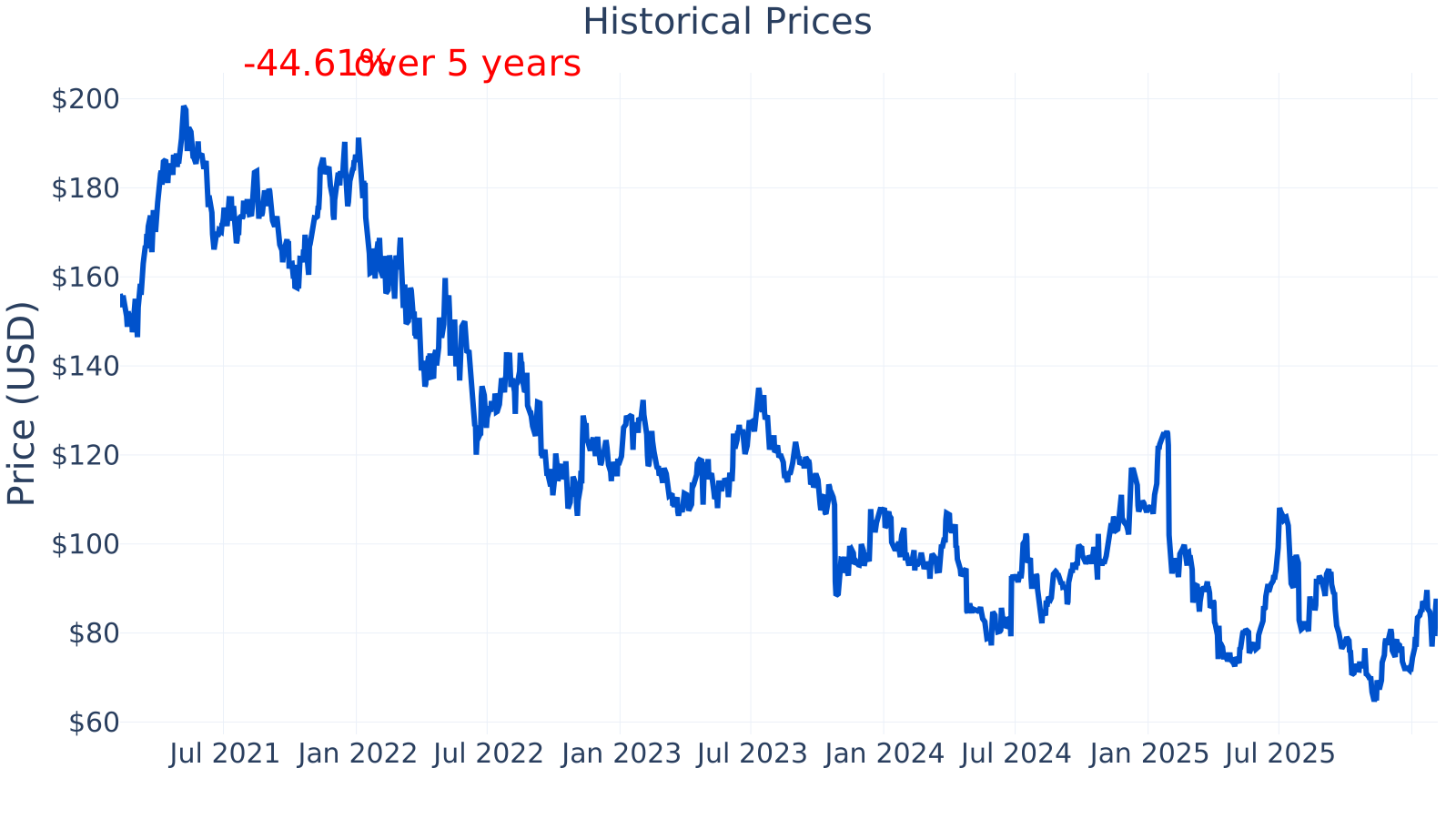
Whirlpool’s market capitalization is about $4.86B, placing it in the mid-cap range. The stock’s beta of ~1.22 suggests it has tended to move somewhat more than the broader market. The latest P/E ratio is ~15.0 versus an industry median around 18.8, while the latest profit margin is ~2.05% versus an industry median around 4.29%. Year-over-year revenue growth is slightly negative (about -0.94%) compared with an industry median that is roughly flat to slightly positive. Leverage stands out: debt-to-equity is ~288% versus an industry median near 78%. Trailing twelve-month free cash flow is about $92M, indicating positive cash generation, though at a modest level relative to the company’s scale.
Growth (Low)
The large home appliance industry is generally mature. Long-run demand is often driven more by replacement cycles, housing turnover, renovation activity, and incremental innovation (efficiency, design, connectivity) than by rapid unit growth. This kind of industry can still produce durable companies, but it typically experiences cyclical ups and downs tied to consumer confidence, interest rates, and housing markets.
The pattern shown suggests Whirlpool has faced multiple periods of negative year-over-year revenue growth since 2022, with only brief returns to slightly positive growth. This is consistent with a business exposed to macroeconomic cycles and shifting retail demand. In a mature category, sustained growth often depends on taking share, premium product mix, cost reductions, and expanding service/aftermarket opportunities rather than relying on broad market expansion.
Free cash flow swings are notable. After very strong cash generation in 2021 (about $2.10B), free cash flow stepped down in 2022 and 2023, turned slightly negative around early 2024 (about -$49M), and then recovered by early 2025 (about $579M). For long-term business resilience, the key question is whether Whirlpool can produce consistently positive free cash flow through a full cycle, because cash flow is what supports reinvestment, debt service, and shareholder returns.
Potential long-term catalysts commonly highlighted in appliance manufacturing include product refresh cycles, higher-efficiency standards that push replacement demand, premiumization (consumers choosing higher-feature products), and operational initiatives (simplifying product platforms, optimizing factories and logistics). The company’s reported R&D spending in the period shown (hundreds of millions of dollars annually) indicates ongoing investment, but the financial results also show that execution and market conditions matter significantly.
Risks (High)
This article is for informational purposes only and does not constitute financial advice. Some content is AI-generated. See Disclaimer