Stock Analysis · Wex Inc (WEX)
Overview
WEX Inc. is a payments company focused on helping businesses manage and pay for everyday operating expenses. In practical terms, it provides payment products (often cards or embedded payment tools) plus software and reporting that help customers control spending, reduce manual work, and track transactions. WEX is best known for fleet and fuel payments, but it also operates in corporate payments and in benefits-related payments (for example, accounts used to pay eligible healthcare or commuter expenses).
Its activities are typically described through three operating segments:
- Fleet Solutions (fuel and maintenance payments and related services for commercial vehicle fleets)
- Benefits Solutions (payments and administration tied to employee benefit accounts)
- Corporate Payments (virtual payments and spend management tools for businesses, including travel-related use cases)
Across these segments, revenue generally comes from a mix of payment-related fees (such as transaction and account fees), services and software features, and (for certain products) revenue linked to the spread between amounts charged and amounts paid to partners. The exact mix and percentages can change over time and are detailed in the company’s annual report by segment.
Over the last several years, total revenue has expanded (from about $1.85B in 2021 to about $2.66B in 2025). Operating income also improved markedly in 2024 and 2025 versus earlier years, while interest expense became a more meaningful cost line item by 2024–2025, which is consistent with a more leveraged balance sheet and/or higher interest rates.
Key Figures
| Metric | Value | Industry ⓘ |
|---|---|---|
| Date | Apr 27, 2026 | |
| Context | ||
| Sector | Technology | |
| Industry | Software - Infrastructure | |
| Market Cap ⓘ | $5.22B | |
| Beta ⓘ | 0.93 | |
| Fundamental | ||
| P/E Ratio ⓘ | 17.76 | 29.35 |
| Profit Margin ⓘ | 11.50% | 6.83% |
| Revenue Growth ⓘ | 5.80% | 14.85% |
| Debt to Equity ⓘ | 128.01% | 24.49% |
| PEG ⓘ | 0.87 | |
| Free Cash Flow ⓘ | $459.60M | |
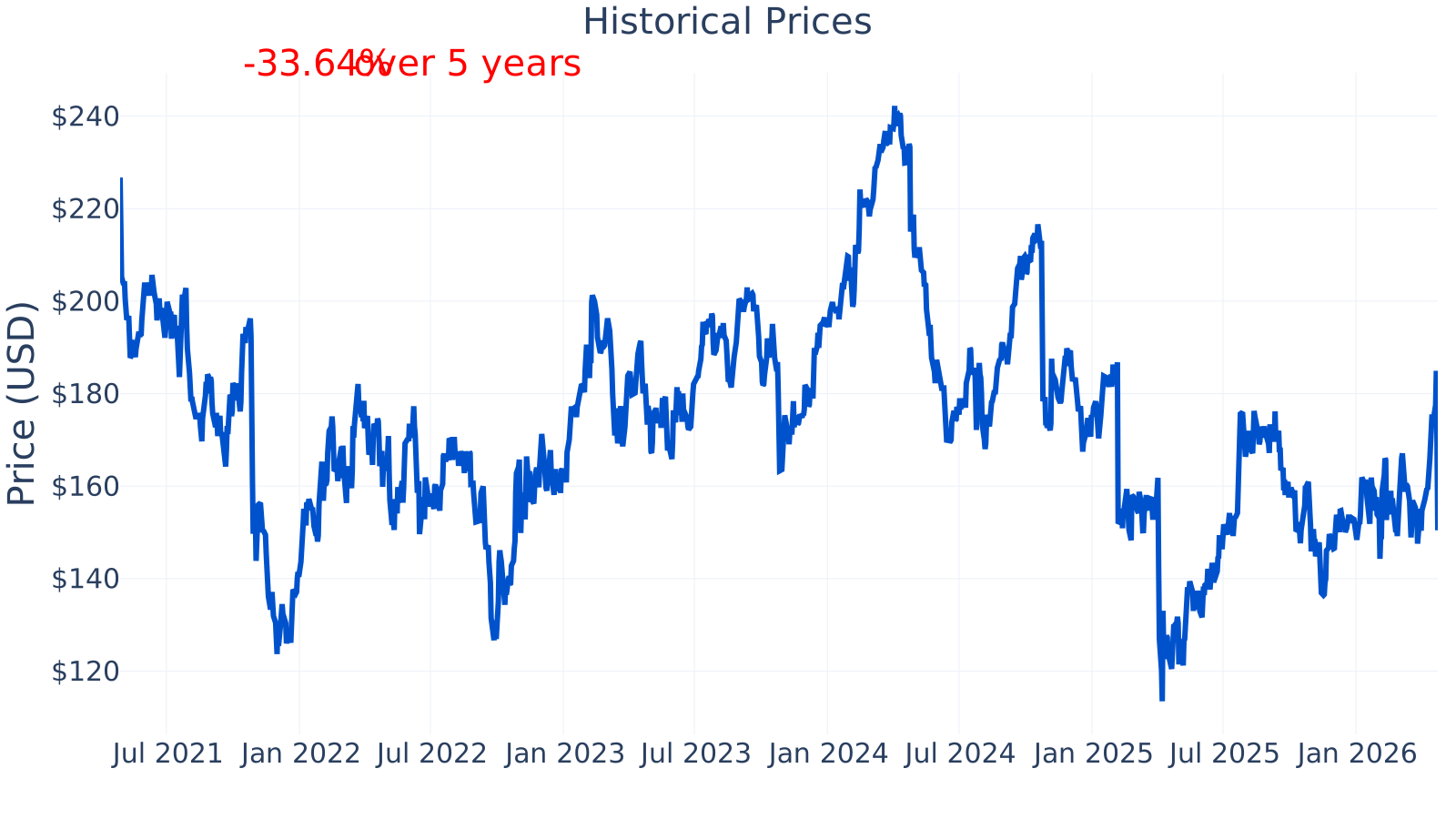
WEX’s market capitalization is about $5.22B, and its beta of 0.93 suggests the stock has recently moved somewhat in line with (or slightly less than) the overall market. The current P/E ratio is ~17.8, below the median shown for its listed industry peers (~29.3). Profitability appears comparatively solid versus the industry median, with a net profit margin of ~11.5% versus an industry median of ~6.8%. Revenue growth is positive but more modest: ~5.8% year-over-year versus an industry median of ~14.9%.
Balance sheet leverage is a key point to notice: debt-to-equity is ~128%, much higher than the industry median shown (~24%). Free cash flow over the trailing twelve months is ~$459.6M, indicating meaningful cash generation in the most recent period.
Growth (Medium)
WEX participates in long-running trends such as digitizing business-to-business payments, replacing manual processes with software, and tightening spend controls through data and reporting. These themes tend to support continued adoption of modern payment platforms, especially in areas where customers want better visibility and policy controls rather than just a “card.”
At the same time, recent growth has been uneven. Year-over-year revenue growth was much higher in 2021–2022 (often above 20%), then slowed materially during 2023–2025, turning slightly negative in a few quarters before returning to modest positive growth most recently.
The pattern above matters for long-term owners because it suggests WEX may be in a phase where growth depends more on execution (new customer wins, retention, product expansion, and pricing discipline) than on a broad-based surge in demand. A practical “catalyst” to watch in this kind of business is whether management can consistently expand payment volumes and accounts while keeping credit losses and operating costs controlled, since both can move results meaningfully.
Cash generation is another important part of the long-term story. Trailing twelve-month free cash flow has swung significantly (strong in 2023–2024, negative around early 2025 in this series, and strong again most recently at about $459.6M). For a payments-focused company, sustained free cash flow can help fund product investment, acquisitions, and debt reduction—but variability can also signal working-capital swings, one-time items, or periods of heavier investment.
Risks (High)
A central risk for WEX is that parts of its business are sensitive to the health of commercial activity (fleet usage, travel activity, and general business spending). If customers drive less, travel less, or reduce spend, payment volumes and certain fee streams can be pressured. Competitive pressure is also persistent: large payment networks, banks, and specialized fintech firms all target corporate spend and expense workflows, and pricing power can weaken if competing offerings become more similar.
Leverage is a key financial risk to track because it can reduce flexibility during downturns and can make earnings more sensitive to interest rates and refinancing conditions.
Debt-to-equity has been well above the industry median throughout this period and reached very elevated levels in some quarters. While the most recent reading is around 128%, the path has been volatile, which makes the balance sheet an area that typically warrants close monitoring in the filings (debt maturities, covenants, and interest-rate exposure).
Profitability is a relative strength in the recent numbers, but margins have not been stable over the full period. That matters because payments businesses can be affected by credit performance, partner economics, and operating cost discipline.
In this history, WEX moved from losses in 2021 to sustained positive net margins in later periods, reaching about 11.5% most recently, above the industry median shown. Even with that improvement, margins can face pressure from higher funding costs, changes in partner terms, or increased competition (for example, having to spend more on sales, product, or incentives to win and keep customers).
On competitive positioning, WEX’s advantages tend to come from long-standing relationships in fleet payments, specialized acceptance networks and integrations, and the switching costs created by reporting, controls, and back-office workflows. However, it is not operating in a “winner-take-all” market. Key competitors vary by segment and can include large card issuers and networks, specialized fleet card providers, expense-management platforms, and benefits administrators. The practical takeaway is that WEX’s position depends on continued product relevance and service quality, not just scale.
Valuation
On an earnings multiple basis, WEX is currently priced at about 17.8x earnings, which is below the industry median shown in the same series (roughly around the high 20s to ~30x in the displayed periods). The historical P/E range on the chart also shows that WEX has traded at much higher earnings multiples in parts of 2022–2024, followed by a move down into the teens more recently.
A lower P/E can reflect several things at once: the market may be assigning more weight to slower revenue growth, higher leverage, or execution risk, even while current profitability is comparatively solid. In that context, valuation interpretation is tightly linked to whether WEX can sustain margins and cash flow while keeping debt and interest expense manageable.
Conclusion
WEX is a business payments company with recognizable positions in fleet-related payments and additional platforms in corporate and benefits-focused payments. The company has shown improved profitability in recent periods and meaningful trailing free cash flow, while revenue growth has moderated compared with earlier years.
The main long-term points to balance are (1) the durability of its specialized payment workflows and customer relationships, (2) the ability to re-accelerate or at least sustain steady growth, and (3) financial flexibility given leverage and interest expense. Taken together, the publicly visible metrics paint a picture of a profitable payments platform with moderate recent growth and a higher-risk balance sheet profile that can meaningfully influence outcomes across cycles.
Sources:
- SEC EDGAR — WEX Inc. Form 10-K (Annual Report)
- SEC EDGAR — WEX Inc. Form 10-Q (Quarterly Reports)
- WEX Investor Relations — Earnings releases and supplemental materials
- Wikipedia — “WEX Inc.” (company background overview)
This article is for informational purposes only and does not constitute financial advice. Some content is AI-generated. See Disclaimer


