Stock Analysis · Wex Inc (WEX)
Overview
WEX Inc. is a payments company focused on “closed-loop” and specialized payment solutions—meaning it runs payment networks designed for specific use cases rather than trying to be a general consumer card brand. Its products are commonly used to manage and control business spending where tracking, rules, and reporting matter (for example, fuel programs for fleets, corporate payments, and healthcare benefit payments).
In its public filings, WEX describes three main operating segments:
- Mobility: Fleet and fueling-related payment solutions and related services.
- Benefits: Payments and software tied to employee benefits (such as healthcare-related accounts) and benefit administration ecosystems.
- Corporate Payments: Virtual payments and other business-to-business payment products that help companies pay suppliers and manage spend.
Across these segments, revenue typically comes from a mix of payment-related fees (including transaction and account fees), program and network fees, and in some cases interest and other financial income associated with payment balances and receivables (the exact mix can vary by segment and period, and is detailed in the company’s filings).
From 2021 to 2025, total revenue rises from about $1.85B to about $2.66B. Operating income is much higher in 2024–2025 (roughly $654M–$664M) than in 2022–2023, while interest expense increases materially by 2024–2025 (about $236M–$241M), which highlights the importance of financing costs in overall profitability.
Key Figures
| Metric | Value | Industry ⓘ |
|---|---|---|
| Date | Feb 08, 2026 | |
| Context | ||
| Sector | Technology | |
| Industry | Software - Infrastructure | |
| Market Cap ⓘ | $5.45B | |
| Beta ⓘ | 0.97 | |
| Fundamental | ||
| P/E Ratio ⓘ | 18.77 | 25.66 |
| Profit Margin ⓘ | 11.43% | 6.68% |
| Revenue Growth ⓘ | 5.70% | 15.20% |
| Debt to Equity ⓘ | 393.55% | 19.82% |
| PEG ⓘ | 1.51 | |
| Free Cash Flow ⓘ | $299.20M | |
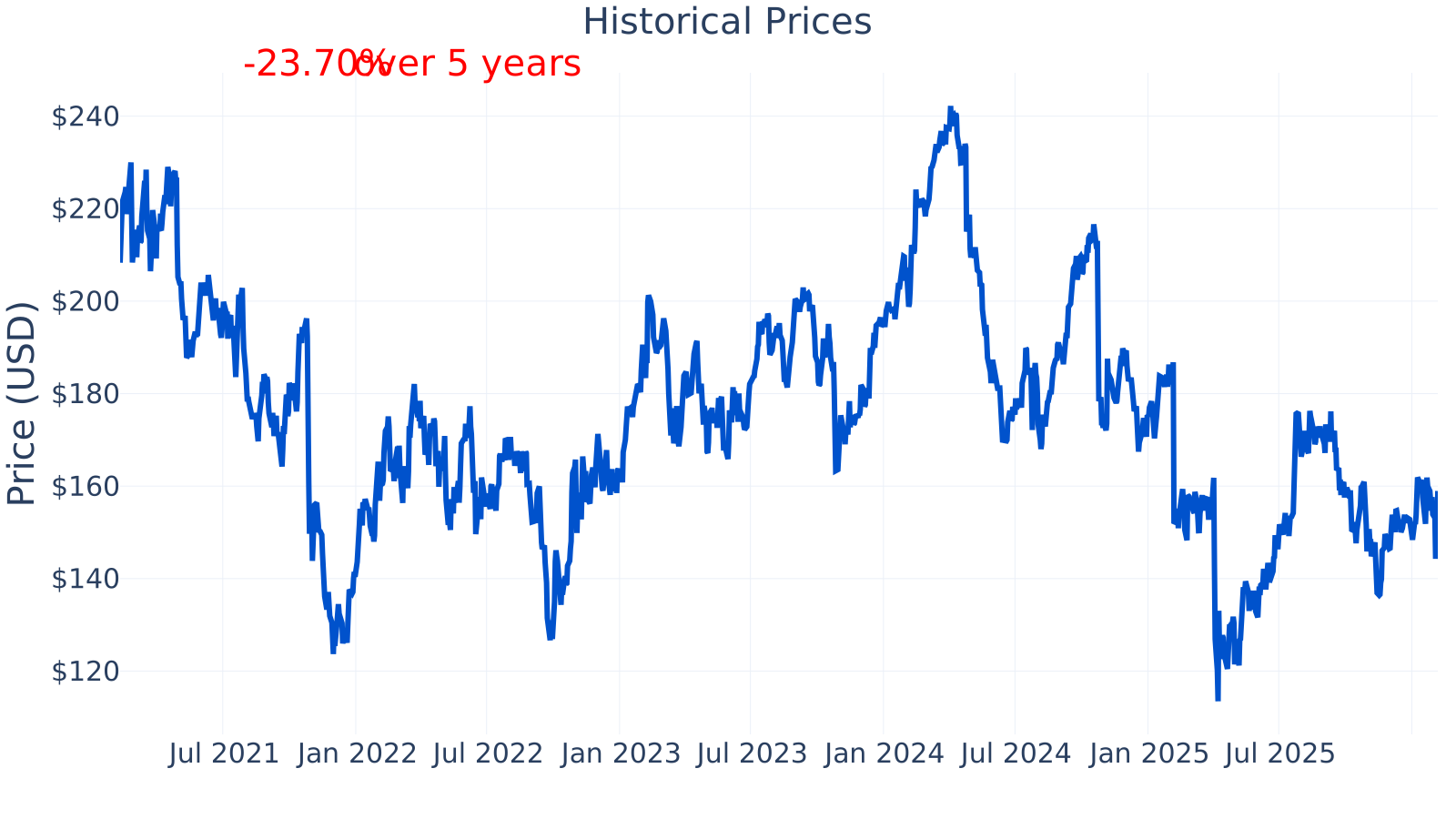
WEX’s market capitalization is about $5.45B and its beta is close to 1.0, which indicates price moves that have often been broadly in line with the overall stock market. The company’s profit margin is about 11.43%, above the industry median of about 6.68%. Year-over-year revenue growth is about 5.7%, below the industry median of about 15.2%. Leverage stands out: debt-to-equity is about 393.6%, far above the industry median of about 19.8%. The P/E ratio is about 18.8, below the industry median of about 25.7, and the PEG ratio is about 1.51. Trailing twelve-month free cash flow is about $299M.
Growth (medium)
WEX operates in long-running themes: digitizing business payments, improving expense controls, and integrating payments with software workflows. These trends can support steady demand because companies often want tighter controls, better reporting, and simpler reconciliation—especially at scale (fleet operators, HR/benefits ecosystems, and finance teams managing many suppliers).
Recent revenue growth appears more moderate than many software-infrastructure peers, based on the company’s year-over-year growth rate compared with the industry median. That said, WEX’s business model is not purely software subscription; parts of it can be tied to transaction volumes, customer activity levels, and (depending on product/segment structure) the interest-rate environment.
The year-over-year revenue growth rate was strong in parts of 2021–2022 (often above 20%), then cooled substantially in 2023–2025, including some slightly negative periods before returning to mid-single-digit growth (about 5.7% most recently). This pattern suggests growth has become more incremental recently rather than consistently high.
Free cash flow has been uneven across the period shown: it was strong in 2023–2024 (around $574M–$581M) but dropped sharply by 2025 (near breakeven/negative on the chart) before the latest trailing figure listed in the table shows about $299M. For long-term business quality, the ability to convert earnings into cash over a full cycle is important, because cash ultimately supports reinvestment, debt servicing, and flexibility during downturns.
Risks (high)
This article is for informational purposes only and does not constitute financial advice. Some content is AI-generated. See Disclaimer