Stock Analysis · Western Digital Corporation (WDC)
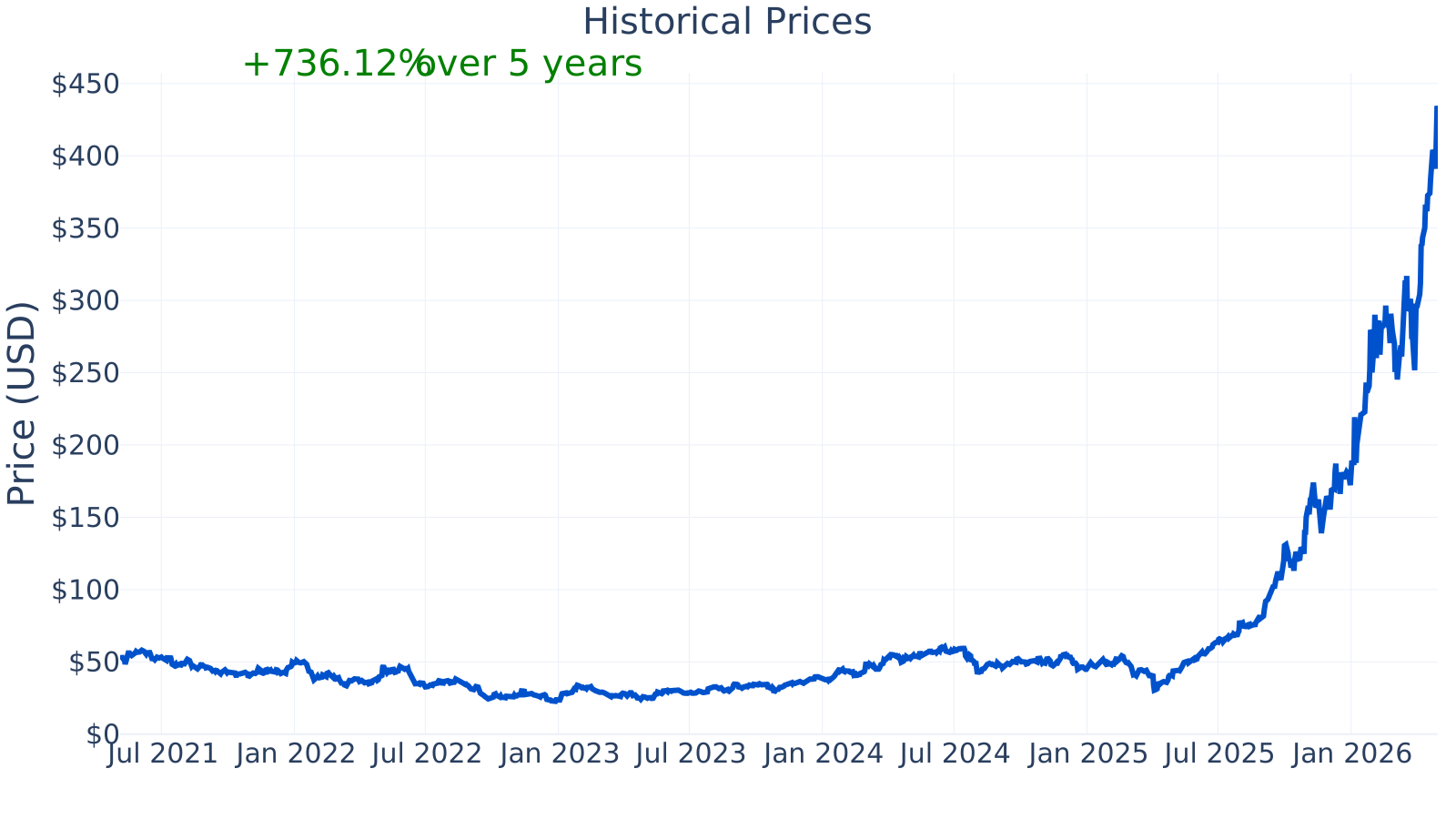
Overview
Western Digital Corporation (WDC) designs and sells data storage products used in computers, data centers, and consumer devices. In simple terms, it helps people and organizations store, protect, and access digital information. The company’s portfolio is mainly built around two core technologies: hard disk drives (HDDs), typically used for high-capacity storage (especially in data centers), and flash-based storage, often used for faster performance needs (such as solid-state drives and embedded storage).
Western Digital generally reports its business through two main operating segments, which are commonly described as:
- Cloud: storage products (largely HDD-focused) sold for data center and cloud infrastructure customers.
- Client: storage products sold into PCs, gaming systems, consumer devices, and other end markets (often including SSDs and removable storage products).
Percentages by segment can shift meaningfully over time because storage demand tends to move in cycles (periods of tight supply and strong pricing can be followed by weaker demand and price declines). For a precise revenue split by segment for the most recent reporting period, the company’s latest Form 10-K and 10-Q filings are the most reliable reference.
Across the periods shown, revenue and profitability vary substantially, which is typical for the storage industry. For example, total revenue is much higher in some years than others (about $18.8B in FY2022 versus about $6.3B in FY2024 and about $9.5B in FY2025 in the figures shown), and net income swings from profit to loss and back to profit, reflecting changing demand, pricing, and cost structure.
Key Figures
| Metric | Value | Industry ⓘ |
|---|---|---|
| Date | May 04, 2026 | |
| Context | ||
| Sector | Technology | |
| Industry | Computer Hardware | |
| Market Cap ⓘ | $147.54B | |
| Beta ⓘ | 1.83 | |
| Fundamental | ||
| P/E Ratio ⓘ | 25.84 | 25.84 |
| Profit Margin ⓘ | 55.29% | 5.14% |
| Revenue Growth ⓘ | 45.50% | 39.50% |
| Debt to Equity ⓘ | 16.33% | 5.83% |
| PEG ⓘ | 0.87 | |
| Free Cash Flow ⓘ | $2.90B | |
Western Digital’s market capitalization is about $147.5B, and the stock’s beta of ~1.83 indicates it has historically moved more than the broader market (higher volatility). The latest P/E ratio is ~25.84, which is shown as in line with the industry median in the table. The latest profit margin is ~55.29%, which is far above the listed industry median (~5.14%), suggesting the company’s most recent profitability is unusually strong relative to typical levels in its peer group and also relative to its own recent history (as shown later in the margin trend). Latest year-over-year revenue growth is ~45.5%, and trailing twelve-month free cash flow is about $2.905B. The latest debt-to-equity is ~16.33%, above the listed industry median (~5.83%), but much lower than the company’s own levels in several prior periods.
Growth (Medium)
Data storage demand is supported by long-term trends that are easy to understand: more digital content, more cloud services, more business data, and more data-hungry applications. That said, storage hardware is also known for being cyclical. Customers (especially large cloud and enterprise buyers) can swing between building inventory aggressively and then pausing orders, which can produce sharp revenue and profit changes from year to year.
In that context, Western Digital’s strategy is closely tied to keeping its products competitive on cost per unit of storage, capacity, performance, and reliability—particularly in data center use cases where buyers focus on total cost and large-scale deployment. Another important growth lever is the mix between higher-value products and commodity-like products, since pricing and margins can change quickly across product categories and market conditions.
The year-over-year revenue growth pattern illustrates how pronounced the cycle can be: growth was positive in parts of 2021, turned sharply negative through much of 2022–2024, and then rebounded strongly in late 2024 and into 2026 (with the latest value around +45.5%). This type of swing is common in storage hardware when pricing and customer spending rotate from contraction to recovery.
Free cash flow also shows a cycle: it moved from about +$1.446B (2022-03-31) to negative levels in 2023 and 2024 (around -$1.011B and -$1.218B), then recovered to about +$854M in 2025 and about +$2.905B by 2026-03-31. For long-term business resilience, sustained positive free cash flow matters because it helps fund operations, investment in product development, and balance sheet flexibility without relying as heavily on external financing.
Risks (High)
Western Digital operates in a part of the technology sector where results can change quickly. A central risk is industry cyclicality: demand and pricing for HDDs and flash products can rise and fall sharply depending on customer spending, capacity additions across the industry, and inventory corrections. This cyclicality can affect revenue, margins, and cash generation even if long-term data growth remains intact.
Another risk is competitive pressure. Storage is a global, scale-driven market where large competitors can invest heavily in manufacturing efficiency and technology. Western Digital competes with major industry players such as Seagate (notably in HDDs) and Samsung, SK hynix, and Micron (notably in NAND flash and SSD-related markets). In many product categories, customers can qualify multiple suppliers, which can pressure pricing and reduce switching costs. Western Digital’s competitive advantages tend to come from engineering know-how, product reliability track record, customer relationships, and scale, but it is not a “winner-takes-all” market.
Leverage is another area to monitor. Western Digital’s debt-to-equity ratio has moved dramatically over time (peaking near or above 100% in parts of the period shown), then falling to about 16.33% most recently. Even with the recent improvement, the company’s latest level is still above the listed industry median (~3.94% in the most recent comparison point shown on the chart). Large swings can happen because equity can change with profitability and accounting impacts, while debt can change with refinancing, repayments, or funding needs during downturns.
Profitability has also been volatile. The profit margin fell into negative territory across multiple quarters in 2022–2024, then turned positive and accelerated to about 55.07% in the latest period shown, far above the industry median (~4.46%). A margin that high can reflect a particularly favorable part of the cycle, cost actions, mix shift, or one-time items; the key risk is that margins in this industry often normalize as supply and demand rebalance.
Valuation
The P/E ratio shown most recently is about 25.69–25.84 (depending on the point in time referenced), and the latest table indicates it is similar to the industry median. Historically, Western Digital’s displayed P/E moved from higher levels in 2021 to single-digit levels in 2022. Several later points show as 0 on the chart, which typically occurs when earnings are negative or otherwise not meaningful for a P/E calculation. This matters because in cyclical businesses, valuation metrics that depend on current earnings can look very different depending on whether the company is in a downturn or a recovery.
Interpreting the current valuation therefore depends heavily on how durable recent improvements are. The company’s recent period shows very strong margin and a rebound in revenue growth, which can make earnings-based multiples appear more “normal.” At the same time, the historical pattern shows that earnings and margins have not been steady, so a single-period P/E may not capture the full cycle.
Conclusion
Western Digital is a major player in data storage, supplying products that support both everyday computing and large-scale cloud infrastructure. The long-term backdrop—more data being created and stored—supports continued demand for storage, but the company’s financial results have historically been shaped by pronounced industry cycles.
The recent period shown reflects a strong recovery in revenue growth, free cash flow, and profit margin, alongside a much lower debt-to-equity level than in several prior periods. At the same time, the historical trends highlight key uncertainties: earnings and margins can swing significantly, and competitive dynamics can quickly change pricing and profitability. The valuation picture also depends on where the company is in the cycle, since P/E ratios can become less informative during loss-making periods and can shift quickly as profitability returns.
Sources:
- U.S. SEC EDGAR — Western Digital Corporation filings (Form 10-K, Form 10-Q)
- Western Digital — Investor Relations materials (Quarterly results and shareholder information)
- Wikipedia — “Western Digital” (company overview and basic background)
This article is for informational purposes only and does not constitute financial advice. Some content is AI-generated. See Disclaimer


