Stock Analysis · Western Digital Corporation (WDC)
Overview
Western Digital Corporation (WDC) designs and sells data storage products. In simple terms, it makes the hardware that stores digital information for cloud data centers, businesses, and consumers. Its portfolio includes hard disk drives (HDDs) typically used for large-scale, cost-efficient storage (common in data centers) and flash-based storage (often called NAND “flash memory”), which is used in solid-state drives (SSDs) and embedded storage for faster performance.
Western Digital’s revenue is mainly driven by the volume of storage units sold and the average selling prices in each storage category. Like many semiconductor- and hardware-related businesses, results can vary significantly depending on customer demand cycles and industry supply conditions.
The company reports its business in two main segments, which are the most practical way to understand where revenue comes from:
- Cloud (storage shipped to large data center customers, directly or through partners)
- Client (PC and consumer devices, including retail and OEM channels)
In addition, Western Digital’s product mix is often described through two technology families:
- HDD (high-capacity disk drives)
- Flash (NAND-based products such as SSDs and embedded storage)
Percentages by segment and product mix can change meaningfully by quarter and year; the company details these in its latest annual report (Form 10‑K) and quarterly filings (Form 10‑Q).
The company’s results show sizable swings across years: periods of higher revenue and operating income can be followed by sharp downturns. This pattern is consistent with a storage industry that tends to move in cycles (pricing, inventory levels, and customer buying patterns), while operating expenses such as research and development remain significant.
Key Figures
| Metric | Value | Industry ⓘ |
|---|---|---|
| Date | Feb 07, 2026 | |
| Context | ||
| Sector | Technology | |
| Industry | Computer Hardware | |
| Market Cap ⓘ | $96.61B | |
| Beta ⓘ | 1.84 | |
| Fundamental | ||
| P/E Ratio ⓘ | 26.73 | 25.91 |
| Profit Margin ⓘ | 35.64% | 3.74% |
| Revenue Growth ⓘ | -41.00% | 21.50% |
| Debt to Equity ⓘ | 63.42% | 4.92% |
| PEG ⓘ | 0.84 | |
| Free Cash Flow ⓘ | $2.31B | |
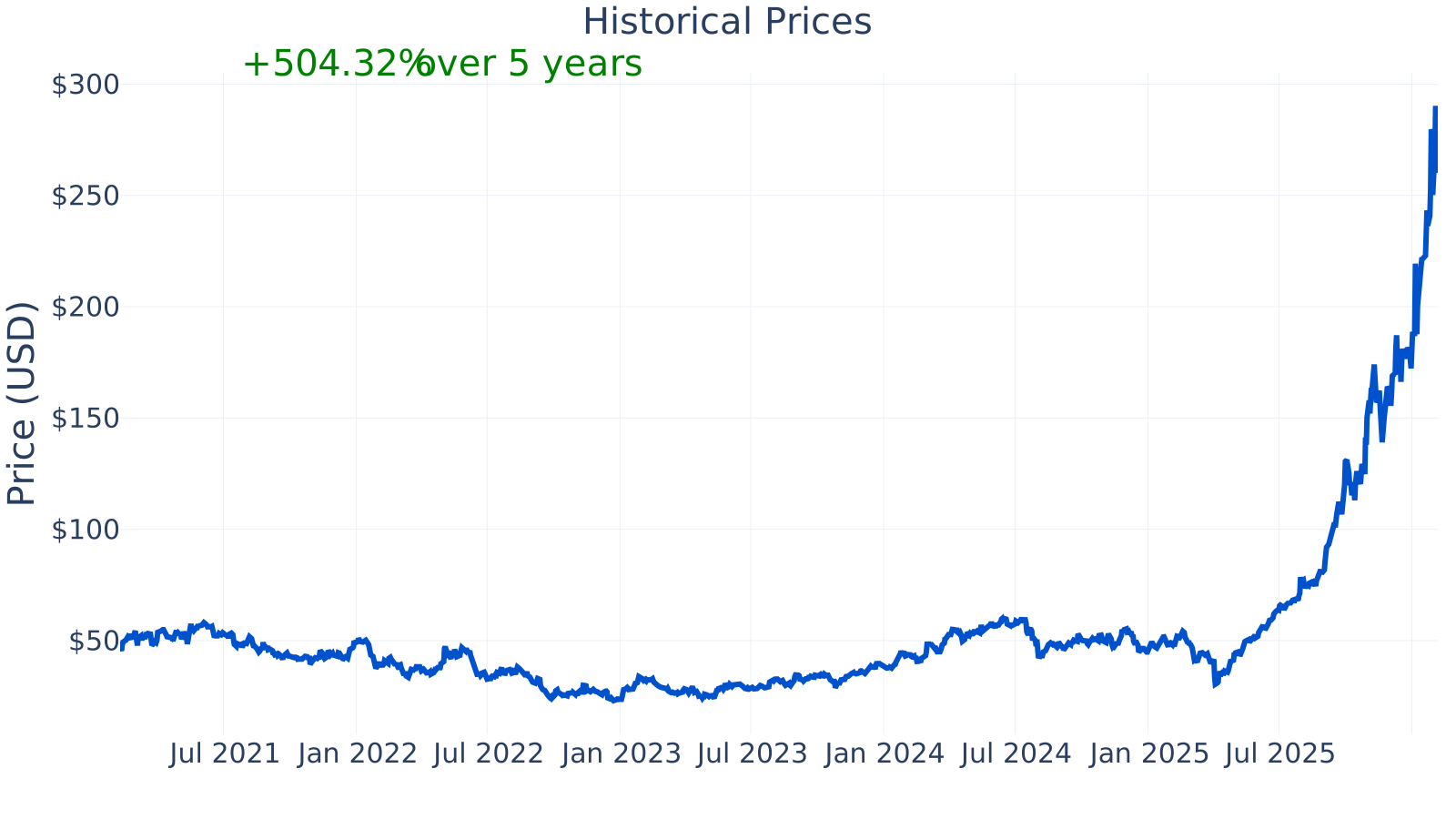
Western Digital’s market capitalization is about $96.6B, and the stock has a relatively high beta (1.84), meaning it has historically moved more than the overall market. The latest P/E ratio is ~26.7, close to the industry median (~25.9). Profitability and growth indicators show a mixed picture: the latest profit margin is ~35.6% versus an industry median near 3.7%, while the latest year-over-year revenue growth is about -41% versus an industry median near +21.5%. Leverage is also higher than typical for peers: debt-to-equity is ~63% versus an industry median near 5%. Over the trailing twelve months, free cash flow is about $2.31B.
Growth (Medium)
Western Digital operates in the long-term growth trend of global data creation: cloud services, enterprise IT, and data-intensive workloads require large amounts of storage. This is a supportive backdrop, but it does not remove the industry’s cyclical nature—storage demand and pricing can rise and fall quickly depending on customer inventory, capital spending, and supply additions across the industry.
The company’s strategy is centered on serving two distinct needs: capacity storage (where HDDs often compete strongly on cost per terabyte for large datasets) and performance storage (where flash solutions are favored for speed and power efficiency). Future growth depends on executing product roadmaps, capturing large customer programs (especially in cloud), and navigating industry supply/demand cycles without losing competitive position.
Revenue growth has been volatile. The chart shows a period of steep declines followed by a rebound in several quarters, and then another negative reading most recently. For long-term owners, this reinforces that revenue may not move in a smooth upward line; it can be heavily influenced by industry upcycles and downcycles.
Free cash flow also illustrates cyclicality: it moved from positive to negative and then back to positive (around $0.85B in the period shown for 2025-03-31), while the latest metrics indicate a higher trailing figure ($2.31B). In hardware businesses, free cash flow can change quickly with profitability, inventory levels, and capital spending needs.
Potential catalysts (in the neutral, factual sense) typically include: an industry-wide recovery in storage pricing, stronger cloud customer demand for high-capacity storage, successful transitions to newer generations of HDD/flash technology, and improved operating discipline during upcycles and downcycles.
Risks (High)
This article is for informational purposes only and does not constitute financial advice. Some content is AI-generated. See Disclaimer