Stock Analysis · The Wendys Co (WEN)
Overview
The Wendy’s Company (WEN) is a quick-service restaurant (fast-food) brand best known for hamburgers and chicken sandwiches, with a large portion of its restaurants operated by franchisees. In a franchise-heavy model, the company typically earns money not only from restaurants it operates directly, but also from fees and royalties paid by franchisees who run Wendy’s locations under the brand.
In broad terms, Wendy’s business combines (1) brand management and marketing, (2) franchise support and restaurant standards, and (3) a smaller set of company-operated restaurants. This structure can produce steadier, fee-based income from franchising, while still keeping exposure to day-to-day restaurant operations where the company runs its own locations.
Main sources of revenue generally include (exact mix can vary by year):
- Sales at company-operated restaurants
- Franchise royalties and fees (typically based on a percentage of franchisee sales plus certain fees)
- Rental income (in cases where the company controls a site and leases it to a franchisee)
Across 2021–2024, total revenue increased from about $1.90B to about $2.25B. Over the same period, operating income stayed in a relatively tight band (roughly $350M–$403M), while interest expense remained meaningful (about $109M–$124M each year), showing that financing costs are an ongoing factor in overall profitability.
Key Figures
| Metric | Value | Industry ⓘ |
|---|---|---|
| Date | Feb 17, 2026 | |
| Context | ||
| Sector | Consumer Cyclical | |
| Industry | Restaurants | |
| Market Cap ⓘ | $1.42B | |
| Beta ⓘ | 0.38 | |
| Fundamental | ||
| P/E Ratio ⓘ | 8.80 | 27.62 |
| Profit Margin ⓘ | 7.58% | 7.88% |
| Revenue Growth ⓘ | -5.50% | 7.40% |
| Debt to Equity ⓘ | 3531.19% | 59.83% |
| PEG ⓘ | 0.85 | |
| Free Cash Flow ⓘ | $237.82M | |
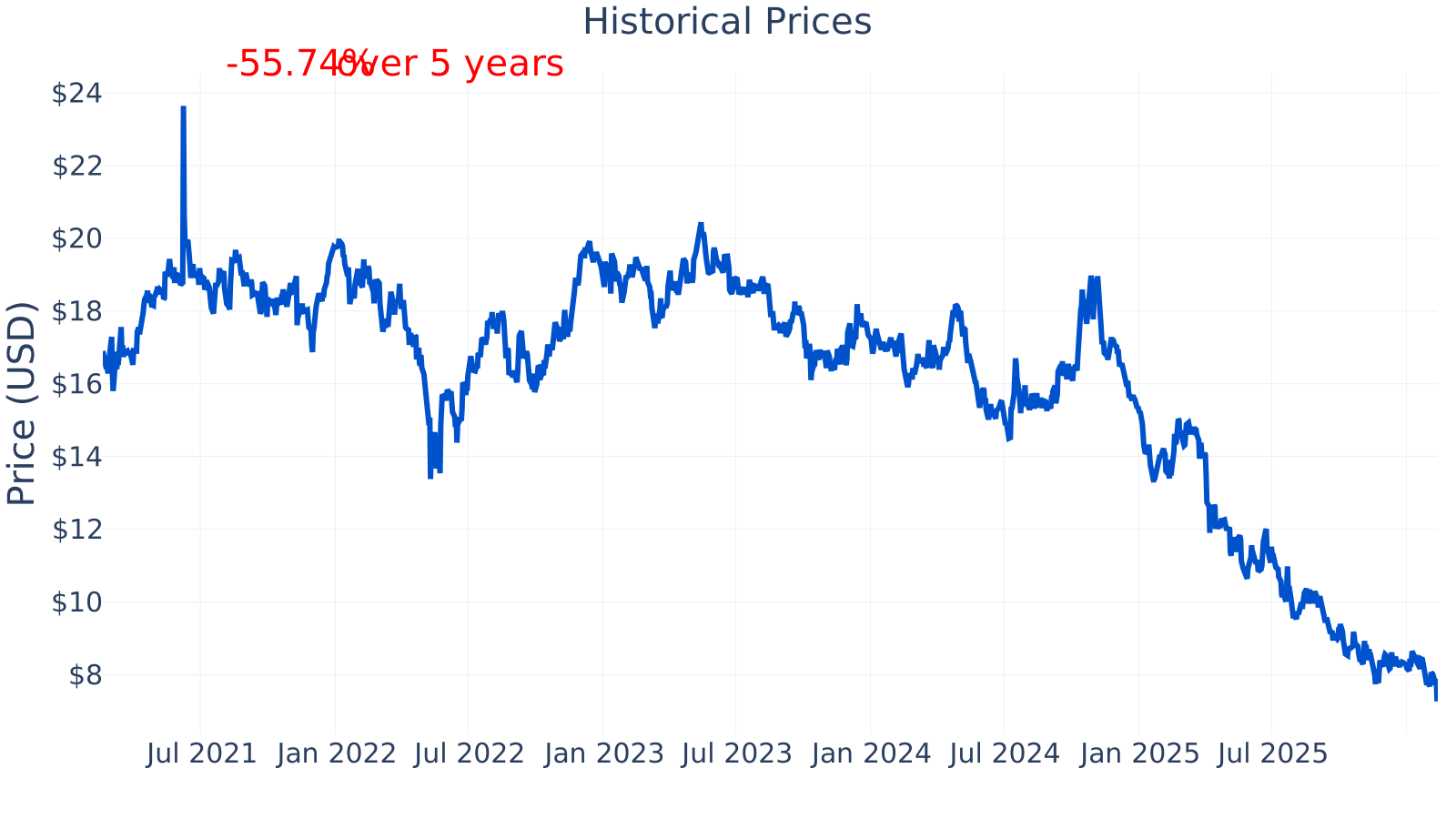
At the latest point shown, Wendy’s market capitalization is about $1.42B and its beta is about 0.38 (historically less volatile than the broader market). The company’s P/E ratio is 8.8, below the industry median of 27.6. Profit margin is about 7.6%, close to the industry median near 7.9%. The latest year-over-year revenue growth shown is -5.5% versus an industry median of +7.4%. Trailing twelve-month free cash flow is about $238M. A major outlier is leverage: debt-to-equity is about 3,531%, far above the industry median near 60%, which can materially shape risk and equity valuation.
Growth (Low to Medium)
Quick-service restaurants are a mature industry in the U.S., typically characterized by intense competition, frequent promotions, and steady (but not explosive) long-term demand. Over time, growth often comes from a mix of menu innovation, brand marketing, pricing power, improved restaurant-level execution, and unit expansion (especially through franchising, which can be less capital-intensive than building and operating company-owned stores).
The year-over-year revenue growth pattern shown is uneven: strong growth in parts of 2021–2022, followed by a clear slowdown through 2023–2024, and then negative readings in 2025 (as displayed). This type of deceleration can happen in mature restaurant categories where traffic is sensitive to consumer budgets, and where price increases eventually become harder to sustain without affecting volumes.
Free cash flow (money left after operating costs and capital spending) appears positive across the period shown, ranging from roughly $201M (2022) up to roughly $322.9M (2021), with about $246.0M shown for 2025. Consistent positive free cash flow can support reinvestment in the brand (marketing, technology, restaurant upgrades) and shareholder returns, but its stability matters—especially when financing costs are significant.
Potential catalysts in a franchise-led restaurant model typically include improved same-restaurant sales (sales at existing locations), net new restaurant openings (often led by franchisees), better digital and loyalty engagement, and productivity improvements in restaurant operations. The practical impact of these catalysts shows up in sustained revenue growth and stable-to-improving margins over multiple quarters.
Risks (High)
Wendy’s operates in a highly competitive segment where large rivals have scale advantages in advertising, supply chain, and technology. Consumer spending shifts can quickly affect traffic, particularly for lower-income diners, and the industry faces persistent cost pressures (labor, food commodities, packaging). Franchise systems also have a unique risk: even when the brand is strong, franchisee economics (their profitability and access to financing) can affect restaurant reinvestment and new unit growth.
The leverage profile shown is the clearest balance-sheet risk signal. Debt-to-equity rises dramatically over time, reaching roughly 3,531% in the latest period displayed, versus an industry median around 109%. Very high leverage can make results more sensitive to interest rates, refinancing conditions, and periods of weaker sales. It also helps explain why interest expense remains a sizable, recurring cost in the income statement.
Profit margins shown are fairly steady in the high single digits (roughly 8%–10% over much of the period, and about 8.4% in the latest point displayed). That consistency suggests the core business has maintained profitability despite inflation and competition, but it also highlights that the company operates with limited margin “buffer” if a downturn, heavy discounting, or cost spikes occur.
Competitive positioning is shaped by brand strength, menu relevance, convenience (drive-thru and delivery), and marketing effectiveness. Wendy’s is a major U.S. burger chain, but it competes against significantly larger platforms such as McDonald’s and Restaurant Brands International (Burger King), as well as strong category peers like Yum! Brands (Taco Bell) and Jack in the Box. In this landscape, competitive advantages tend to be relative rather than absolute: brand recognition and franchise scale help, but sustained differentiation requires ongoing menu and customer-experience execution.
Valuation
The P/E ratio shown declines substantially from the low 30s in 2021 to about 8.7–8.8 in late 2025, while the industry median trends higher and sits around 30.4 at the latest point displayed. A lower P/E can reflect market expectations of slower growth, higher financial risk, or company-specific uncertainty; it can also reflect differences in business mix and balance-sheet structure versus peers.
In Wendy’s case, the valuation picture should be interpreted alongside two counterbalancing fundamentals shown elsewhere in the figures: (1) revenue growth weakening into negative territory in 2025, and (2) very high leverage. At the same time, (3) profitability remains in line with industry medians and (4) free cash flow is positive. In other words, the multiple appears to embed caution about growth and balance-sheet risk, while still recognizing ongoing earnings generation.
Conclusion
Wendy’s is a well-known quick-service restaurant brand with a business model that typically combines franchise-driven fees with a smaller base of company-operated restaurants. Financially, the figures shown point to steady profitability and continued positive free cash flow, but also to slowing (and recently negative) revenue growth.
The most prominent long-term consideration from the metrics is leverage: debt relative to equity is extremely high compared with industry norms, and interest expense is a recurring drag on net results. In valuation terms, the stock trades at a markedly lower P/E than the restaurant industry median in the period shown, which appears consistent with the combination of weaker recent growth and higher balance-sheet risk.
Sources:
- The Wendy’s Company — Form 10-K (Annual Report)
- The Wendy’s Company — Form 10-Q (Quarterly Report)
- SEC EDGAR — Company filings for The Wendy’s Company (WEN)
- The Wendy’s Company — Investor Relations materials (including press releases and company-hosted transcripts, when available)
- Wikipedia — “Wendy’s” (company overview and basic history)
This article is for informational purposes only and does not constitute financial advice. Some content is AI-generated. See Disclaimer