Stock Analysis · WEBTOON Entertainment Inc (WBTN)
Overview
WEBTOON Entertainment Inc (WBTN) operates digital storytelling platforms focused on webcomics and related entertainment. Its services connect a large community of creators and readers, distributing serialized comic-style content designed for mobile-first consumption. The company is part of the broader online content market, where audience attention is monetized through a mix of direct spending and advertising.
In simple terms, WEBTOON’s business model centers on publishing and recommending content, helping creators reach audiences, and turning popular intellectual property (IP) into revenue—either directly on its platforms or through broader licensing opportunities. Like many internet-content companies, results depend on maintaining user engagement, bringing in new readers, and converting a portion of usage into paying activity.
Main revenue sources typically described in company filings include the following (exact shares can vary by period, and percentages depend on the company’s reported breakdown):
- Paid content / in-app purchases (reader spending on episodes or early access)
- Advertising (brand and performance ads displayed in the apps/services)
- IP licensing and other content-related revenue (monetization of stories beyond the core app experience, where applicable)
From the income flow shown above (across the years displayed), revenue rose overall from about $1.08B (2022) to about $1.38B (2025). Costs of delivering the content and running the platforms remain large relative to gross profit, and operating income stayed negative in each year shown—although 2025 shows a meaningfully smaller operating loss than prior years, while net income is still negative.
Key Figures
| Metric | Value | Industry ⓘ |
|---|---|---|
| Date | Mar 09, 2026 | |
| Context | ||
| Sector | Communication Services | |
| Industry | Internet Content & Information | |
| Market Cap ⓘ | $1.30B | |
| Beta ⓘ | N/A | |
| Fundamental | ||
| P/E Ratio ⓘ | N/A | 19.67 |
| Profit Margin ⓘ | -25.02% | 9.94% |
| Revenue Growth ⓘ | -6.30% | 6.80% |
| Debt to Equity ⓘ | 2.02% | 10.97% |
| PEG ⓘ | N/A | |
| Free Cash Flow ⓘ | $3.60M | |
WEBTOON’s market capitalization is about $1.30B. Profitability is currently a key issue: the latest profit margin shown is about -25.0%, compared with an industry median of about +9.9%, meaning the company is losing money while many peers are profitable on average.
Revenue growth is mixed. The latest year-over-year revenue growth shown is about -6.3%, versus an industry median of about +6.8%. On leverage, the company’s debt-to-equity is about 2.0%, below the industry median of about 11.0%, indicating relatively low balance-sheet leverage compared with typical peers.
Free cash flow (trailing twelve months) is shown at about +$3.6M in the table, but the quarterly trend provided elsewhere shows that free cash flow can swing significantly, which matters for a company still working toward consistent profitability.
Growth (Medium)
WEBTOON operates in the internet content and digital entertainment space, where long-term growth is often driven by mobile usage, global distribution, and monetization of engaged communities. A large addressable audience can exist for serialized storytelling, and successful titles can sometimes expand beyond the original format into broader IP opportunities (adaptations, partnerships, and licensing). In this kind of business, scale and strong recommendation systems can help surface content that keeps users returning frequently.
The company’s recent revenue trajectory suggests growth has not been steady in every period. After stronger growth periods, the latest year-over-year figure shown is negative, which signals that maintaining momentum may require improvements in monetization, content performance, pricing/packaging, advertising demand, or geographic mix.
The year-over-year revenue growth line shows a move from roughly flat to mid-single-digit positive growth in 2025 (in the quarters shown), which can be consistent with a stabilization phase. However, this needs to be weighed against the latest negative year-over-year figure listed in the table, which indicates performance can vary depending on the specific measurement date and period.
Cash generation is another potential catalyst if it becomes consistent. A business that can fund content investment and platform development with internally generated cash generally has more flexibility than one that relies on external funding.
The free cash flow trend shown swings from slightly positive (late 2024) to meaningfully negative (early 2025). That volatility matters because it can reflect changes in working capital, spending levels, or timing effects—factors that can obscure underlying progress unless sustained over multiple periods.
Risks (High)
The most important risk is that profitability remains negative. Even with revenue above $1B, WEBTOON’s operating results (in the years shown) indicate that costs to deliver content, pay creators/partners, and operate the platform are substantial. If the company cannot improve margins through higher monetization or tighter cost control, losses could persist.
The margin line remains negative across the quarters shown (roughly between -7% and -13% in 2024–2025 on the chart), while the industry median is positive in most of the same period. This gap suggests WEBTOON is currently less efficient at turning revenue into profit than the typical peer in its industry group.
Competitive pressure is another major factor. Digital entertainment is crowded, and attention is fragmented across short-form video, games, streaming, social platforms, and other comic/manga services. Competition can raise content costs (to attract and retain creators), increase marketing spending, and limit pricing power with readers and advertisers.
Competitive advantages—if durable—often come from network effects (many creators and readers), strong brands, and data-driven discovery. Whether those advantages hold depends on continued user engagement, creator economics, and the ability to consistently produce breakout titles. Leadership can be difficult to assess from financial metrics alone; the company’s filings typically provide more detail on market positioning, user metrics, and geography, which are central in evaluating scale versus rivals.
Balance-sheet leverage appears relatively low, which can reduce financial risk, but it does not eliminate the business risk of ongoing losses.
The debt-to-equity series stays low (roughly 0.5% to 1.9% in the quarters shown) and below the industry median. This suggests the company has used comparatively little debt financing, which can be helpful if operating performance remains under pressure—though equity dilution and cash needs can still be considerations for unprofitable companies.
Valuation
Traditional valuation tools such as the price-to-earnings (P/E) ratio are often less informative when a company is unprofitable, because earnings are negative and the ratio can become not meaningful. That appears to be the case here.
The P/E chart shows WEBTOON’s P/E as 0 (not meaningful) across the periods displayed, while the industry median remains in a more typical range (roughly the mid-teens to mid-20s). In practice, this means valuation discussions often shift toward revenue multiples, gross profit trends, cash flow consistency, and the credibility of a path to sustainable profitability—rather than relying on earnings-based ratios.
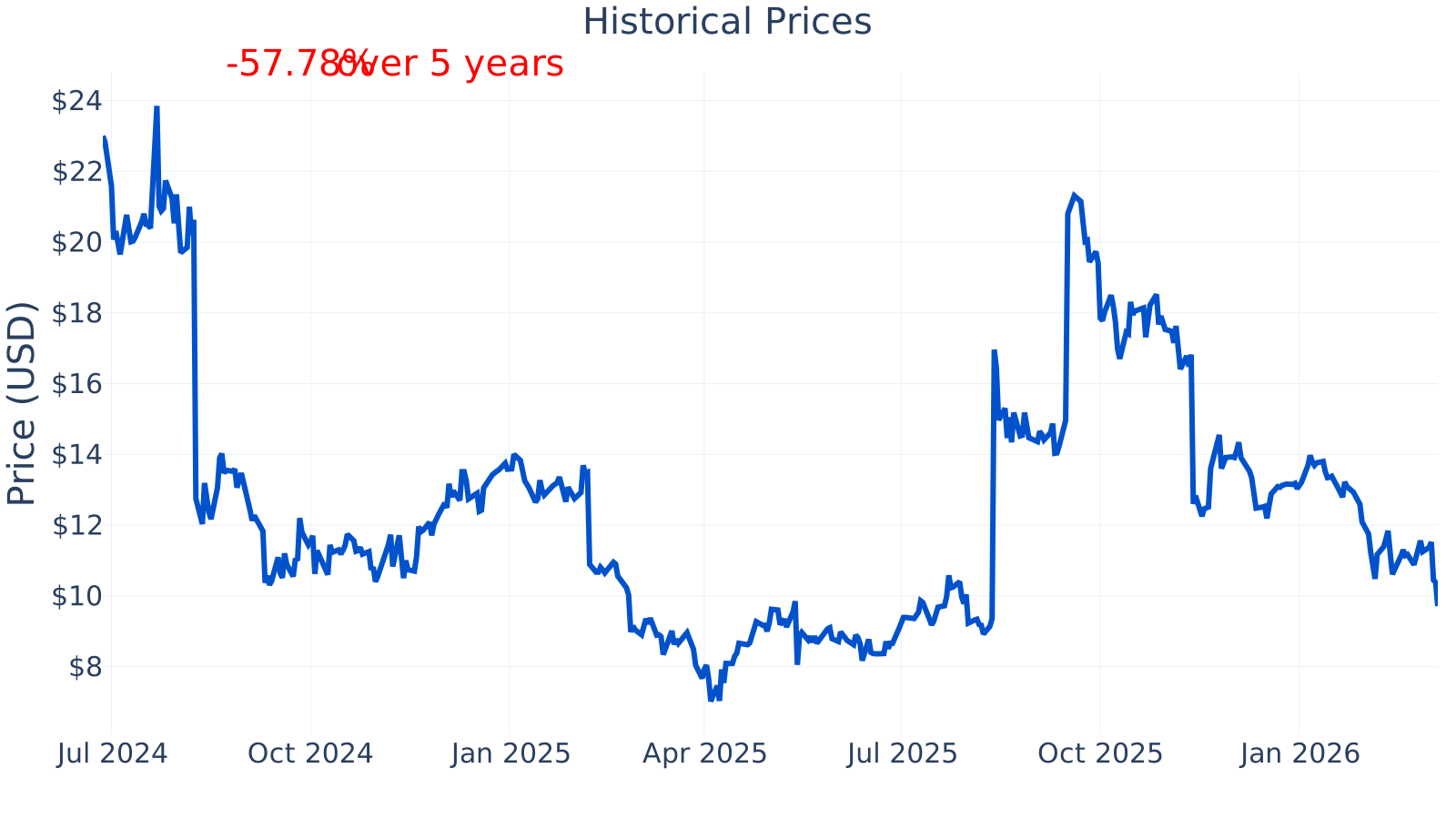
Given the combination of (1) negative profit margins, (2) mixed revenue growth, and (3) volatile free cash flow, the stock price is difficult to judge using simple single-number comparisons to profitable peers. For many companies in this stage, how the market prices the shares tends to be tightly linked to expectations about margin improvement and durable growth rather than current earnings power.
Conclusion
WEBTOON Entertainment Inc operates a scaled digital content platform in a large and competitive segment of online entertainment. Financially, the company has achieved billion-dollar revenue levels in the years shown and appears to carry relatively low debt compared with peers, which can reduce balance-sheet strain.
At the same time, the most significant constraints visible in the fundamentals are persistent losses, negative margins versus the industry median, and signs that revenue growth can be uneven. As a result, the long-term picture depends heavily on whether the company can translate platform scale and content/IP into sustained growth with improving profitability and steadier cash generation.
Sources:
- SEC EDGAR — WEBTOON Entertainment Inc filings (Form 10-K, Form 10-Q, Form 8-K)
- WEBTOON Entertainment Inc — Investor Relations materials and press releases
- Wikipedia — “Webtoon Entertainment” (basic company background)
This article is for informational purposes only and does not constitute financial advice. Some content is AI-generated. See Disclaimer