Stock Analysis · Climb Global Solutions (CLMB)
Overview
Climb Global Solutions (CLMB) is a technology distributor. In plain terms, it helps software and IT vendors reach business customers by working with a network of resellers and service providers. Climb’s role is often described as “value-added distribution”: beyond simply moving products, it can support partners with services like enablement, technical support, and go-to-market assistance, depending on the vendor and offering.
Its revenue is primarily generated from reselling third-party technology products and services (often software, cloud-related offerings, and other IT solutions) through a channel model. Like many distributors, a large share of reported revenue typically comes from product pass-through (the sale price of what it resells), while profitability depends on the margin it earns and on operating discipline.
A simple way to think about the business model is:
- Revenue base: sales of third-party software and IT solutions via channel partners (the largest component)
- Profit drivers: gross margin on what it distributes + the company’s ability to keep operating costs (like sales and administration) under control
From the company’s income statement pattern (high cost of revenue relative to revenue), Climb’s economics resemble a classic distribution model: large revenue numbers, relatively thin net margins, and an emphasis on scale, partner relationships, and efficient operations.
Over recent years, total revenue increased from about $282.6M (2021) to about $652.5M (2025). Over the same period, net income rose from about $9.2M to about $21.3M, showing that profits expanded alongside the business, even as operating expenses also grew with scale.
Key Figures
| Metric | Value | Industry ⓘ |
|---|---|---|
| Date | Mar 23, 2026 | |
| Context | ||
| Sector | Technology | |
| Industry | Electronics & Computer Distribution | |
| Market Cap ⓘ | $1.45B | |
| Beta ⓘ | 1.13 | |
| Fundamental | ||
| P/E Ratio ⓘ | 67.72 | 16.40 |
| Profit Margin ⓘ | 3.27% | 1.88% |
| Revenue Growth ⓘ | 19.80% | 10.65% |
| Debt to Equity ⓘ | 2.93% | 50.71% |
| PEG ⓘ | 1.23 | |
| Free Cash Flow ⓘ | $14.61M | |
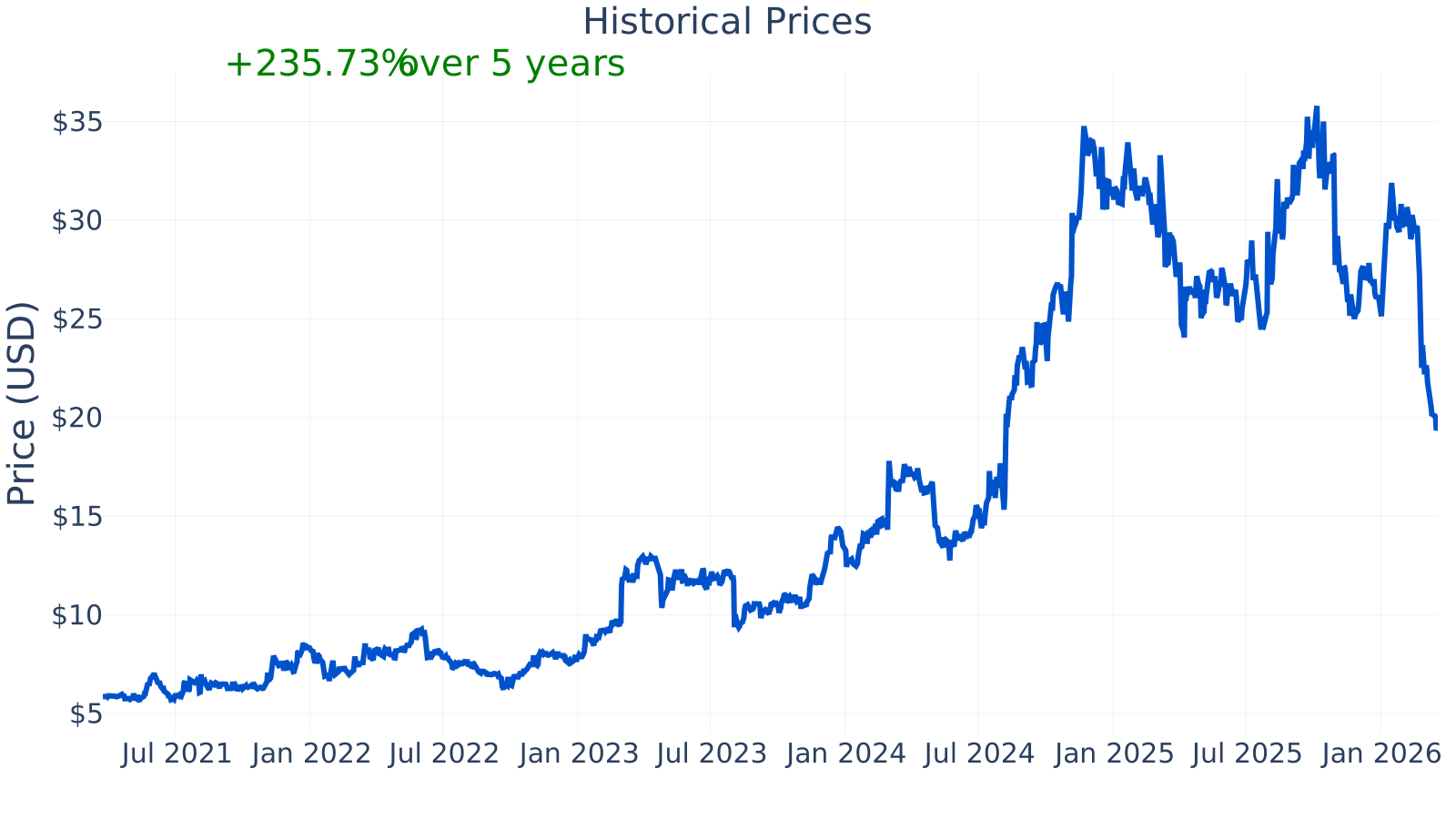
Climb Global Solutions’ market capitalization is about $1.45B, placing it in the smaller-public-company range. The stock’s beta of ~1.13 suggests it has historically moved somewhat more than the overall market (though beta can change over time).
On profitability, the latest profit margin is ~3.27%, which is higher than the industry median shown (~1.88%). For a distributor, low single-digit net margins are common, so being above the displayed industry midpoint can be meaningful if it proves durable.
Growth has been notable: the latest year-over-year revenue growth is ~19.8% versus an industry median of ~10.65%. Debt looks low, with debt-to-equity of ~2.93% versus an industry median of ~50.71%. Free cash flow (trailing twelve months) is about $14.6M. Finally, the current P/E ratio is ~67.7, well above the industry median shown (~16.4), which matters when discussing valuation expectations.
Growth (medium)
Climb operates in technology distribution, which is tied to long-run IT spending trends such as cloud adoption, cybersecurity, and ongoing software modernization. While distribution is not always a “hyper-growth” business by itself, it can grow steadily when (1) vendors add new offerings that gain adoption, (2) channel partners expand, and (3) the distributor increases its share of wallet with existing partners and vendors.
Revenue growth has been uneven quarter-to-quarter (including at least one period of contraction), but the more recent quarters show strong positive growth rates. This pattern is consistent with a business that can accelerate when product demand is strong, when it broadens its portfolio, or when acquisitions contribute—while still being exposed to the ups and downs of IT purchasing cycles.
Free cash flow has fluctuated meaningfully across the periods shown, ranging from about $5.4M (2022) to about $48.4M (2021), with about $23.1M (2025) on the chart and $14.6M as the latest trailing figure in the table. For long-term monitoring, this variability is important: in distribution businesses, cash flow can swing due to working capital needs (inventory and receivables) even when reported earnings look stable.
Potential catalysts generally come from (a) adding or expanding vendor relationships, (b) scaling higher-margin services alongside distribution, and (c) acquisition-led expansion. Whether these translate into sustained results typically shows up in gross margin stability, operating expense control, and consistent cash generation over multiple years.
Risks (medium)
A key risk is that distribution is a competitive, margin-sensitive business. Even small changes in gross margin, pricing, or vendor terms can materially affect profits because net margins are thin in absolute terms. Customer and reseller demand can also shift with the IT spending cycle, which can create periods of slower growth.
Another structural risk is concentration: distributors can be exposed if a major vendor changes strategy (for example, altering channel programs or shifting to direct sales) or if a small set of products drives an outsized portion of gross profit. Operationally, the business depends on strong execution in credit management, collections, and partner support—problems in these areas can show up quickly in cash flow and working capital needs.
Financial leverage appears low. The latest debt-to-equity is about 2.93%, which is far below the industry median shown (about 50.71%). This can reduce the risk of debt-related stress during downturns, though it does not remove business-cycle risk.
Profit margin has generally been above the industry median in the periods shown. The latest net profit margin is about 3.27% versus an industry median near 2.12% at the end of 2025 on the chart. This relative profitability may indicate operational strengths such as a favorable vendor mix, disciplined cost control, or better margins than peers. Still, the margin line does move over time, which is typical for distributors and worth tracking.
On competitive position, the “Electronics & Computer Distribution” space includes much larger players, and scale can be an advantage in logistics, vendor access, and purchasing terms. Climb’s differentiation is more likely to come from focus (specific vendor portfolio, partner relationships, and execution) rather than being the largest distributor overall. In practice, competition can include broadline distributors and other specialized value-added distributors, with positioning depending heavily on the vendor lines carried and the quality of channel support.
Valuation
Valuation stands out as a key point to understand. The latest P/E ratio is about 67.7, compared with an industry median around 16.4 in the table. A higher P/E typically implies the market is assigning a premium based on expectations—often continued above-average growth, sustained margins, or a belief that earnings will rise meaningfully over time.
The historical P/E chart shows that the company’s P/E has varied across the years displayed and has often been below the industry median during that period, while the current point-in-time P/E in the table is much higher than the industry median. Differences like this can happen when earnings (the “E” in P/E) fluctuate, when the stock price re-rates, or when the comparison windows differ. For interpretation, it helps to pair the P/E discussion with (1) whether revenue growth remains strong, (2) whether profit margins stay above peers, and (3) whether free cash flow becomes more consistent.
In short, the current valuation level embeds relatively optimistic expectations compared with the industry median shown, while the company’s recent growth and profitability metrics provide some context for why the market might apply a premium.
Conclusion
Climb Global Solutions is a technology distributor whose results show meaningful expansion in revenue and net income over the last several years. Its latest profitability and growth metrics are above the industry medians shown, and balance-sheet leverage appears low relative to peers, which can be a stabilizing factor.
At the same time, the business model is inherently sensitive to competitive dynamics and small changes in margins, and cash generation can fluctuate due to working capital needs. The current valuation (as reflected by the P/E ratio) is elevated versus the displayed industry median, which increases the importance of sustained execution to support the expectations embedded in the stock’s pricing.
Sources:
- SEC EDGAR — Climb Global Solutions, Inc. filings (Form 10-K, Form 10-Q, Form 8-K)
- Climb Global Solutions — Investor Relations materials and press releases
- Wikipedia — “Climb Global Solutions” (basic company background)
This article is for informational purposes only and does not constitute financial advice. Some content is AI-generated. See Disclaimer