Stock Analysis · Wayfair Inc (W)
Overview
Wayfair Inc. is an online retailer focused on home goods. Through its websites and mobile apps, it connects customers with a wide assortment of furniture, décor, housewares, appliances, and related products, shipped either directly from suppliers to customers or through Wayfair-supported logistics and delivery networks. The company operates primarily in the U.S. and also serves international markets, with brands that include Wayfair, Joss & Main, AllModern, Birch Lane, and Perigold (a higher-end offering).
Wayfair’s revenue is primarily generated from product sales made to customers on its platforms (recorded as “net revenue” after certain reductions such as returns and allowances, as described in its filings). In addition to retail sales, Wayfair also earns revenue from supplier and advertising-type services tied to its marketplace model (for example, programs that support product placement and visibility), but these are generally smaller than core product revenue.
Main sources of revenue (highest to lowest, based on how the business is described in company filings):
- Net revenue from customer orders (core retail sales) (majority of total revenue)
- Supplier-related and other service revenues (smaller portion; varies over time)
In recent years, the company’s overall revenue level has been relatively stable compared with earlier periods of rapid expansion, while management has emphasized cost control and improved cash generation.
Across the years shown, revenue has been broadly in the $11.9B–$13.7B range, while operating losses have narrowed materially versus 2022. Selling, general, and administrative costs remain the largest operating cost category beyond cost of revenue, and interest expense increases in 2025 stand out as an additional drag on bottom-line results.
Key Figures
| Metric | Value | Industry ⓘ |
|---|---|---|
| Date | May 04, 2026 | |
| Context | ||
| Sector | Consumer Cyclical | |
| Industry | Internet Retail | |
| Market Cap ⓘ | $8.62B | |
| Beta ⓘ | 3.02 | |
| Fundamental | ||
| P/E Ratio ⓘ | N/A | 29.05 |
| Profit Margin ⓘ | -2.41% | 6.82% |
| Revenue Growth ⓘ | 7.40% | 12.30% |
| Debt to Equity ⓘ | -127.90% | 26.59% |
| PEG ⓘ | 23.50 | |
| Free Cash Flow ⓘ | $456.00M | |
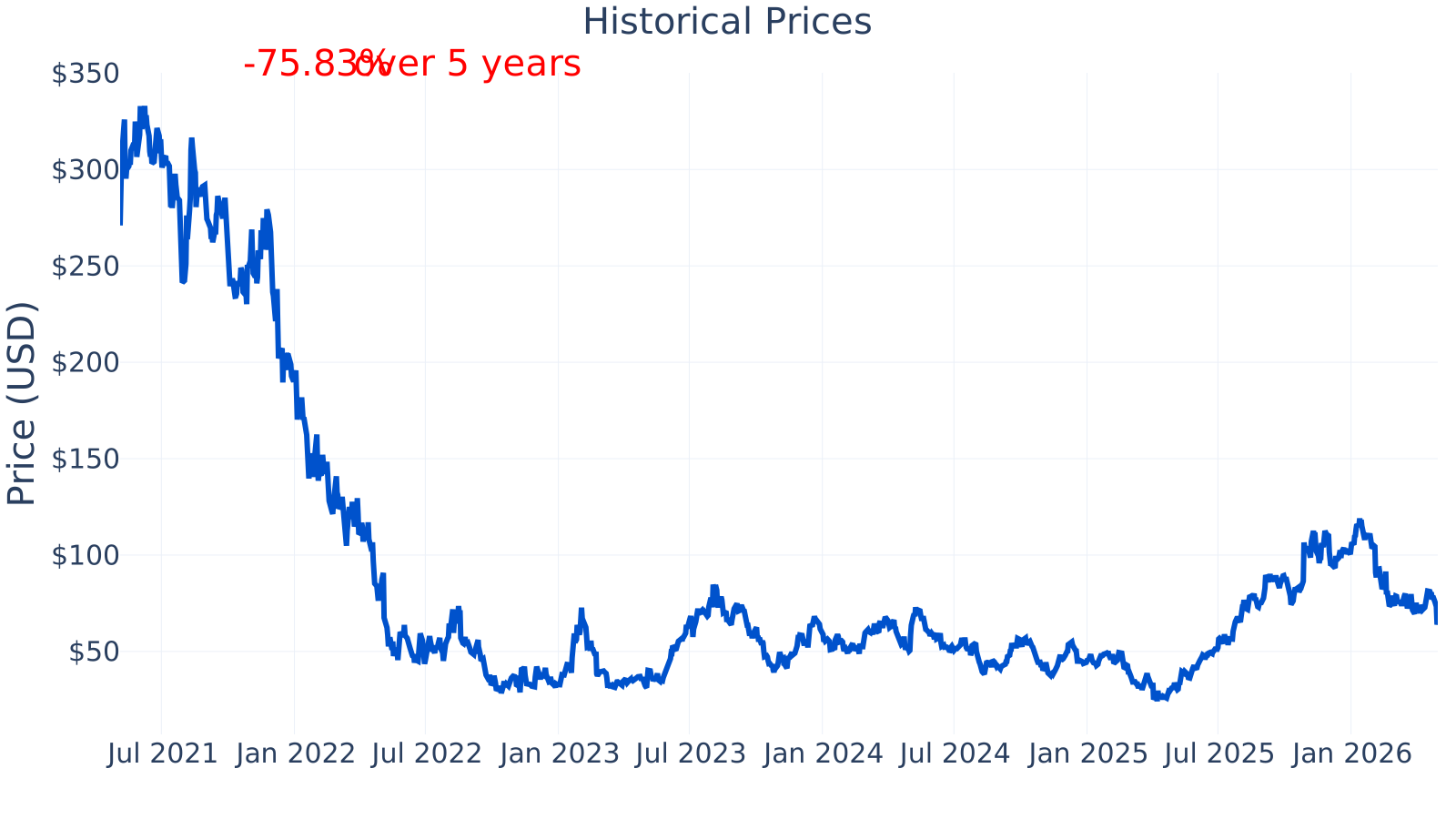
Wayfair’s market capitalization is about $8.6B. The stock’s beta (~3.0) indicates it has historically moved much more than the broader market, which can matter for long-term holders because large drawdowns may occur even when the business is improving. The company’s latest profit margin is about -2.4%, below the industry median (about +6.8%), showing profitability is still a key gap versus many peers.
Revenue growth most recently is about +7.4% year over year, below the industry median (about +12.3%). Free cash flow over the trailing twelve months is about $456M, a notable improvement versus earlier negative periods. The debt-to-equity ratio is negative, which usually reflects negative shareholders’ equity rather than “negative debt,” and can make leverage comparisons less straightforward than for companies with positive equity. The PEG ratio (~23.5) is high, but PEG ratios can be less informative when earnings are volatile or depressed.
Growth (Medium)
Wayfair operates in e-commerce for home goods, an area shaped by long-term shifts toward online shopping, but also heavily influenced by housing turnover, consumer confidence, and big-ticket discretionary spending cycles. Demand for furniture and home items tends to be cyclical: it can rise when households move and spend on home upgrades, and soften when budgets tighten.
Wayfair’s strategy centers on breadth of selection, a specialized home-focused shopping experience, and operational improvements (logistics efficiency, delivery speed/quality, and cost discipline). In a category where many items are bulky and expensive to ship, execution in delivery and customer experience can be a meaningful differentiator, especially for repeat purchases and higher-ticket categories.
The year-over-year revenue growth trend shows a long period of contraction through 2021–2023, followed by stabilization and a shift back to positive growth more recently (roughly mid-single digits to high-single digits in the latest periods shown). That pattern suggests the business has been moving from contraction toward modest expansion, though it has not returned to sustained high growth.
Free cash flow has improved substantially—from deeply negative levels in 2022–2023 to positive in 2024 and rising further into 2026 (about $456M on a trailing twelve-month basis). For long-term analysis, this shift matters because consistent free cash flow can improve financial flexibility, even if accounting earnings remain negative.
Potential catalysts that may influence future results include continued normalization of home goods demand, further logistics and cost efficiencies, and improved conversion/retention through merchandising and customer experience enhancements. That said, the magnitude and durability of these effects depend on competitive pressure and the broader consumer spending environment.
Risks (High)
Wayfair’s key risk is that it has not yet produced consistent net profitability in the periods shown, despite meaningful improvement from the 2022 low point. The business is exposed to consumer discretionary spending swings, and home goods demand can weaken quickly during downturns or when housing activity slows. Because many products are large and heavy, shipping, returns, and damage-related costs can meaningfully impact margins.
Competitive intensity is another major factor. Wayfair competes with broad-based e-commerce platforms and large retailers that can bundle home goods with other categories, potentially lowering customer acquisition costs and improving delivery density. The company’s category focus and curated experience can be a strength, but it operates in a market where switching costs for customers are generally low and price comparison is easy.
In terms of competitive positioning, Wayfair is a well-known online destination for home goods, but it competes against much larger players with extensive logistics networks and broader ecosystems. Major competitors include:
- Amazon (broad marketplace with significant logistics scale)
- Walmart and Target (large omnichannel retailers with home categories)
- IKEA (strong brand in furniture and home furnishings, increasingly omnichannel)
- Home Depot and Lowe’s (home improvement retailers with overlapping categories)
- Specialty/home retailers (varies by category and price point)
The debt-to-equity ratio is negative (latest about -128%, versus an industry median around 37%). A negative value commonly indicates negative equity, which can happen when cumulative losses and/or certain balance sheet dynamics exceed the accounting value of assets minus liabilities. This does not automatically mean short-term insolvency, but it can signal a thinner accounting cushion and may increase sensitivity to shocks or refinancing needs.
Profit margin has improved from very weak levels in 2022–2023 (roughly -8% to -11%) to around -2% to -3% more recently, but it remains below the industry median (generally positive in the periods shown). This indicates progress, yet also highlights that the business still needs further margin expansion to match many peers’ profitability levels.
Valuation
For many companies, the price-to-earnings (P/E) ratio is a common valuation tool. In Wayfair’s case, the P/E ratio is frequently not meaningful in the later periods shown (displayed as 0), which typically occurs when earnings are negative or otherwise make the metric unusable. Earlier in the timeline, the P/E was visible and at times elevated, reflecting how sensitive the ratio can be when earnings are small or volatile.
Given this, valuation discussions often rely more heavily on a combination of factors such as revenue trends, progress toward sustainable operating profitability, cash flow generation, and balance sheet structure rather than a single earnings-based multiple. The company’s positive trailing free cash flow is a constructive data point, while the combination of ongoing net losses and negative equity increases uncertainty around how durable current improvements may be across a full demand cycle.
Conclusion
Wayfair is a major online home goods retailer whose recent story has been less about rapid expansion and more about stabilizing revenue, improving efficiency, and rebuilding cash generation. The latest trend shows a return to modest year-over-year revenue growth and a significant swing to positive trailing free cash flow, while profit margins remain negative but have improved markedly from prior lows.
The main long-term uncertainties center on whether Wayfair can achieve consistent profitability in a highly competitive retail landscape, and how resilient its results will be through cycles in consumer discretionary spending and housing-related demand. Balance sheet signals such as negative shareholders’ equity add another layer of complexity to risk assessment, even as cash flow has improved.
Sources:
- SEC EDGAR — Wayfair Inc. Form 10-K (Annual Report): “Wayfair Inc. 2025 Form 10-K”
- SEC EDGAR — Wayfair Inc. Form 10-Q (Quarterly Report): “Wayfair Inc. Quarterly Reports (most recent filings)”
- Wayfair Investor Relations — “Quarterly Results and Shareholder Materials”
- Wikipedia — “Wayfair” (basic company background)
This article is for informational purposes only and does not constitute financial advice. Some content is AI-generated. See Disclaimer


