Stock Analysis · Wayfair Inc (W)
Overview
Wayfair Inc. is an online retailer focused on home goods. It sells furniture, décor, housewares, and related products through its e-commerce platforms, acting mainly as a marketplace that connects shoppers with a large network of suppliers. A key part of the business is handling “big and bulky” items (like sofas and beds), which requires specialized delivery, returns handling, and customer service.
Wayfair’s revenue is primarily generated from selling products to customers online. The company reports revenue mainly by geography rather than by product category, and it generally describes its business as a single operating segment.
Main revenue sources (from largest to smallest) are typically presented as:
- U.S. net revenue (largest share)
- International net revenue (smaller share; includes markets outside the U.S.)
In practice, the business model depends on driving traffic to its sites, converting that traffic into orders, and managing fulfillment and customer experience efficiently—especially because shipping costs and returns can meaningfully influence profitability in home furnishings.
Over the last several years, total revenue has been roughly in the $12–$14B range, while profitability has been pressured by operating costs. Operating losses narrowed substantially by 2025 (operating income close to break-even), even though net income remained negative, reflecting that cost control and efficiency improvements have been important themes.
Key Figures
| Metric | Value | Industry ⓘ |
|---|---|---|
| Date | Feb 23, 2026 | |
| Context | ||
| Sector | Consumer Cyclical | |
| Industry | Internet Retail | |
| Market Cap ⓘ | $10.61B | |
| Beta ⓘ | 3.37 | |
| Fundamental | ||
| P/E Ratio ⓘ | N/A | 32.68 |
| Profit Margin ⓘ | -2.51% | 6.46% |
| Revenue Growth ⓘ | 6.90% | 13.05% |
| Debt to Equity ⓘ | -146.23% | 32.25% |
| PEG ⓘ | 23.50 | |
| Free Cash Flow ⓘ | $432.00M | |
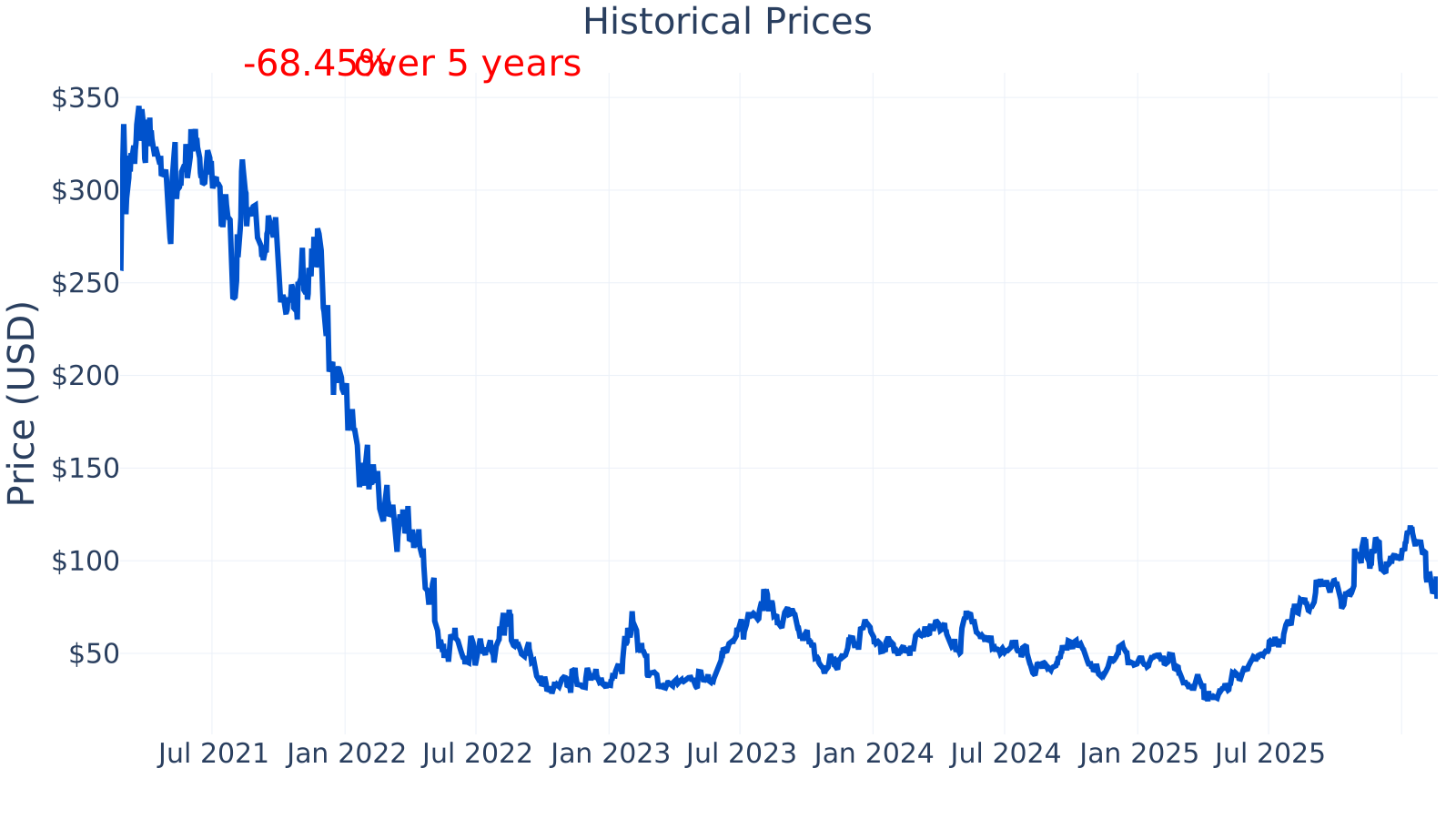
Wayfair’s market capitalization is about $10.6B, and the stock has shown high volatility (beta around 3.37). Recent profitability remains negative (profit margin about -2.5% versus an industry median near 6.5%), while revenue growth most recently appears positive (about 6.9% year over year, below the industry median near 13.1%). Free cash flow over the trailing twelve months is positive at roughly $432M, which can matter for resilience because it indicates the business generated cash after operating needs and capital spending. The debt-to-equity figure is negative, which commonly happens when accounting equity is negative; in that situation, the ratio becomes less intuitive to interpret than it is for companies with positive equity.
Growth (Medium)
Wayfair operates in e-commerce and home retail, an area that benefits from long-term consumer comfort with online shopping. However, home furnishings demand is also cyclical: it often moves with housing activity, consumer confidence, and big-ticket discretionary spending. That means the industry can grow over time, but it can also experience multi-quarter slowdowns.
Strategically, Wayfair’s path to growth is closely tied to improving the efficiency of its platform (marketing efficiency, repeat customer behavior, merchandising, and delivery economics) while keeping service levels strong for large-item delivery. Because shipping and returns can be expensive in this category, operational execution can make a large difference in outcomes even if revenue grows modestly.
The year-over-year revenue pattern shows a sharp surge in early 2021, followed by an extended period of declines through much of 2021–2023, and then stabilization and a return to positive growth by late 2025 (around 6.9% year over year). This shift suggests demand conditions and/or execution improved compared with the earlier contraction period, though growth has recently been below the industry median shown alongside it.
Free cash flow has swung significantly over time: strongly positive in 2021, negative in 2022 and 2023, then turning positive again in 2024 and improving into 2025 (about $175M at the March 2025 point shown, and about $432M on a trailing-twelve-month basis in the latest metrics). For long-term company building, sustained positive free cash flow can support flexibility (for example, funding operations through weaker demand periods), but the history also highlights that cash generation has not been steady across cycles.
Risks (High)
This article is for informational purposes only and does not constitute financial advice. Some content is AI-generated. See Disclaimer