Stock Analysis · Warner Music Group (WMG)
Overview
Warner Music Group (WMG) is a global music company that works with recording artists and songwriters. Its activities generally fall into two complementary areas: (1) recorded music, which covers discovering and developing artists, producing and marketing music, and collecting money when that music is streamed, downloaded, bought, or used; and (2) music publishing, which represents songwriters and owns/controls rights to musical compositions, collecting royalties when songs are streamed, performed publicly, broadcast, synchronized with video (film/TV/ads/games), or otherwise licensed.
In simple terms, WMG earns money when people listen to music on streaming services, when music is sold or licensed, and when WMG-managed songs are used in media or performed.
Main revenue sources (largest to smaller, based on how major music groups typically report and describe their businesses in annual filings):
- Streaming and other digital consumption (paid subscriptions and ad-supported streaming)
- Music publishing royalties and licenses (the underlying songs/compositions)
- Physical sales (for example, vinyl and CDs)
- Licensing/synchronization and other artist-related income (music used in film/TV/ads/games and other uses)
The company’s cost structure is largely driven by royalties and revenue share paid to artists and songwriters, plus operating expenses such as marketing and administration. Over the past several fiscal years, total revenue has increased, while operating income and net income have fluctuated, showing that profitability can move around even when the top line trends upward.
Across the periods shown, total revenue rises from about $5.3B (FY2021) to about $6.7B (FY2025). Costs tied to generating revenue (often driven by royalties) also rise, and operating income does not increase in a straight line (roughly $578M → $865M → $750M → $762M → $652M). This pattern highlights an important feature of the music business: revenue growth is meaningful, but margins can be influenced by royalty rates, product mix, and spending levels.
Key Figures
| Metric | Value | Industry ⓘ |
|---|---|---|
| Date | Feb 07, 2026 | |
| Context | ||
| Sector | Communication Services | |
| Industry | Entertainment | |
| Market Cap ⓘ | $15.18B | |
| Beta ⓘ | 1.24 | |
| Fundamental | ||
| P/E Ratio ⓘ | 50.96 | 50.96 |
| Profit Margin ⓘ | 5.44% | 4.93% |
| Revenue Growth ⓘ | 14.60% | 5.20% |
| Debt to Equity ⓘ | 32.64% | 80.15% |
| PEG ⓘ | 0.78 | |
| Free Cash Flow ⓘ | $572.00M | |
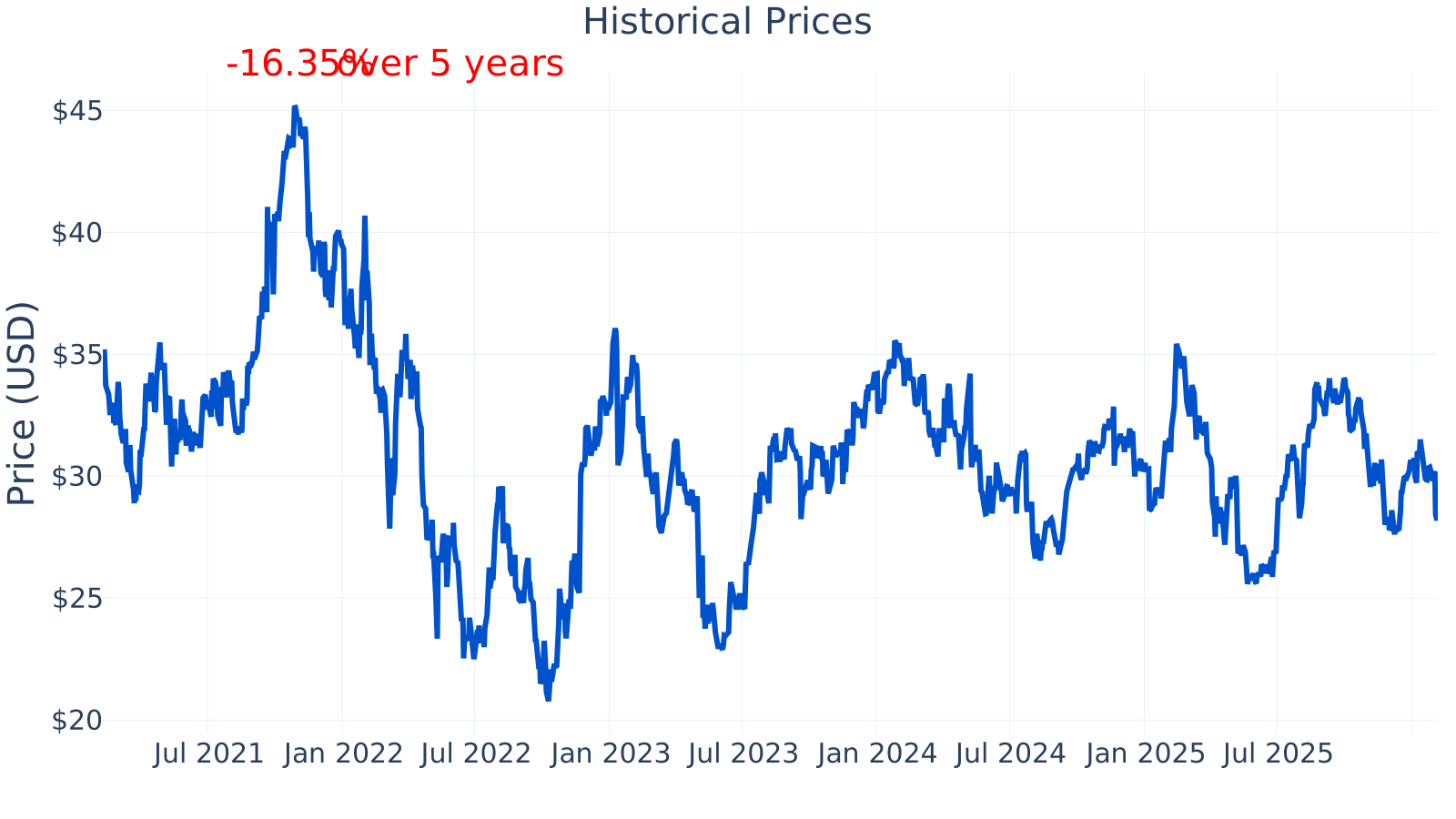
WMG’s market capitalization is about $15.2B. The stock’s beta (~1.24) indicates it has tended to move somewhat more than the broader market. The P/E ratio (~51.0) is in line with the industry median shown. Recent profit margin (~5.44%) is slightly above the industry median (~4.93%). Year-over-year revenue growth (~14.6%) is notably above the industry median (~5.2%) in the latest snapshot. Debt-to-equity (~32.6%) is below the industry median (~80.1%), and trailing twelve-month free cash flow is about $572M.
Growth (Medium)
The recorded music and publishing businesses are closely tied to the shift toward streaming and the long-run global growth in paid subscriptions. For large rightsholders, streaming can support a more recurring revenue profile than one-time album purchases, although pricing, platform terms, and consumer trends still matter. Music publishing can also benefit from a broad set of uses (streaming, public performance, and licensing into video and social formats).
WMG’s strategy (as described in company filings) generally centers on: expanding and monetizing its catalog, investing in artist development, growing publishing, and improving monetization across digital platforms and licensing channels. A potential long-term catalyst for the industry is continued growth in paid music subscribers globally and more use-cases for music in short-form video, gaming, and other digital media (with monetization dependent on platform agreements and enforcement of rights).
Year-over-year revenue growth has been uneven across quarters, including some negative periods, but the most recent points shown rebound to roughly ~14.6% and ~10.4%. This “not perfectly smooth” pattern is common in media businesses where timing of releases, licensing, and comparisons to prior periods can affect growth rates.
Free cash flow over the trailing twelve months rises meaningfully from about $52M (2022) to roughly $579M (2023), and remains in the $500M–$600M+ range through the latest period shown (about $617M at the 2025 point, and $572M in the latest metric snapshot). For long-term analysis, steady free cash flow can matter because it helps fund debt service, reinvestment, and shareholder returns, but it can still vary year to year.
Risks (Medium)
WMG operates in a business where economics depend heavily on the balance of power between rightsholders (labels/publishers), digital platforms (streaming and social), and creators (artists/songwriters). A key risk is that changes in platform terms, consumer behavior, or regulation could pressure royalty economics or slow growth. The company also faces execution risk: success depends on signing, developing, and marketing talent, and on continually monetizing both new releases and older catalog.
Another structural risk is concentration in major digital platforms: a significant portion of industry listening flows through a handful of services, which can increase exposure to renegotiations, bundling changes, or shifts in how music is discovered and paid for. There are also ongoing risks around piracy, copyright disputes, and the complexity of tracking and collecting royalties across many countries and platforms.
Competitive dynamics are important. In recorded music and publishing, WMG competes primarily with other “major” music groups (most notably Universal Music Group and Sony Music, alongside a large number of independent labels and publishers). Competitive advantage in this industry often comes from: (1) scale and relationships with platforms, (2) a deep catalog of valuable rights, (3) strong A&R (artist discovery and development), and (4) global distribution and marketing. WMG is one of the largest global players, but it is not the only scale competitor, and market-share shifts can happen based on release cycles and artist rosters.
The latest debt-to-equity is about 32.6%, below the industry median shown (~80.1%). The historical series displayed is unusually volatile and extremely high in earlier periods before dropping sharply over time. Regardless of the accounting drivers behind that swing, the latest reading suggests a more moderate leverage position relative to the peer median at this point in time, which can reduce (but not eliminate) financial risk.
Profit margins have also moved around. After a negative period in early 2021, margins generally sit in the mid-single digits to high-single digits for much of the timeline, with a recent level around 4.43% at the last point shown, close to the industry median (~5.0%). This variability reinforces that revenue growth does not automatically translate into steadily rising profitability.
Valuation
WMG’s valuation is often discussed using earnings multiples such as the price-to-earnings (P/E) ratio. The latest P/E shown is about 51.0, matching the industry median in the table. A P/E at this level typically implies that the market is assigning significant value to future earnings potential and durability of the business model, rather than only current earnings.
Historically, the displayed P/E ratio has moved across a wide range (roughly from the 20s to the 70s in the periods shown), sometimes above the industry median and sometimes below it. Interpreting this multiple depends on whether earnings growth and cash generation can be sustained, and on the stability of margins and platform economics over time. The PEG ratio (~0.78) in the latest snapshot is one commonly used check that relates valuation to growth expectations, but it depends heavily on the growth estimates used and can change quickly if earnings forecasts change.
Conclusion
Warner Music Group is a large, global rightsholder in recorded music and music publishing, with a business model that benefits from ongoing streaming consumption and broad licensing uses. The company has shown an overall upward revenue trend over several years, and it has recently generated substantial free cash flow, though profitability and operating income have fluctuated.
From a fundamentals perspective, the key long-term points to weigh are: (1) the durability of streaming-driven revenue and publishing royalties, (2) the company’s ability to maintain and grow margins while paying creators and investing in artists, (3) exposure to a small number of powerful platforms, and (4) competitive pressure from other major music groups and independents. On valuation, the P/E level shown is broadly in line with the peer median in the provided comparison, suggesting the market is pricing WMG similarly to comparable entertainment peers on that metric, while still requiring continued execution to support that multiple over time.
Sources:
- U.S. SEC EDGAR — Warner Music Group Corp. filings (Form 10-K, Form 10-Q)
- Warner Music Group — Investor Relations materials (annual report/filings and shareholder information)
- Wikipedia — “Warner Music Group” (basic company background only)
This article is for informational purposes only and does not constitute financial advice. Some content is AI-generated. See Disclaimer