Stock Analysis · Victoria's Secret & Co (VSCO)
Overview
Victoria’s Secret & Co (VSCO) is a specialty retailer focused on women’s intimate apparel, sleepwear, athleisure, and beauty products. The company sells through a mix of physical stores and digital channels, using well-known brand names that are strongly associated with lingerie and related categories.
Revenue is primarily generated from selling products directly to consumers, with sales typically concentrated in a few core lines. Based on the company’s segment reporting in its SEC filings, the main revenue sources are generally organized around its brand segments:
- Victoria’s Secret (lingerie, sleep, athleisure, and beauty) — largest share
- PINK (casual/college-focused apparel and intimates) — second-largest share
- International / other activities (depending on reporting period and structure) — smaller share
The overall business model depends on brand strength, product merchandising (choosing the right styles and sizes), store productivity, and digital conversion (turning online visitors into buyers), with profitability influenced by promotions, product costs, and operating expenses like marketing and store labor.
Across recent fiscal years, total revenue has been relatively stable in the roughly $6.2–$6.8 billion range, while profitability has moved more noticeably. Operating income declined sharply from fiscal 2022 to fiscal 2024, then partially recovered in fiscal 2025 and remained positive in fiscal 2026, showing how sensitive results can be to merchandising performance, discounting, and cost structure.
Key Figures
| Metric | Value | Industry ⓘ |
|---|---|---|
| Date | Mar 09, 2026 | |
| Context | ||
| Sector | Consumer Cyclical | |
| Industry | Apparel Retail | |
| Market Cap ⓘ | $3.75B | |
| Beta ⓘ | 2.27 | |
| Fundamental | ||
| P/E Ratio ⓘ | 21.94 | 14.87 |
| Profit Margin ⓘ | 2.45% | 8.32% |
| Revenue Growth ⓘ | 7.80% | 8.90% |
| Debt to Equity ⓘ | 725.42% | 92.83% |
| PEG ⓘ | N/A | |
| Free Cash Flow ⓘ | $309.00M | |
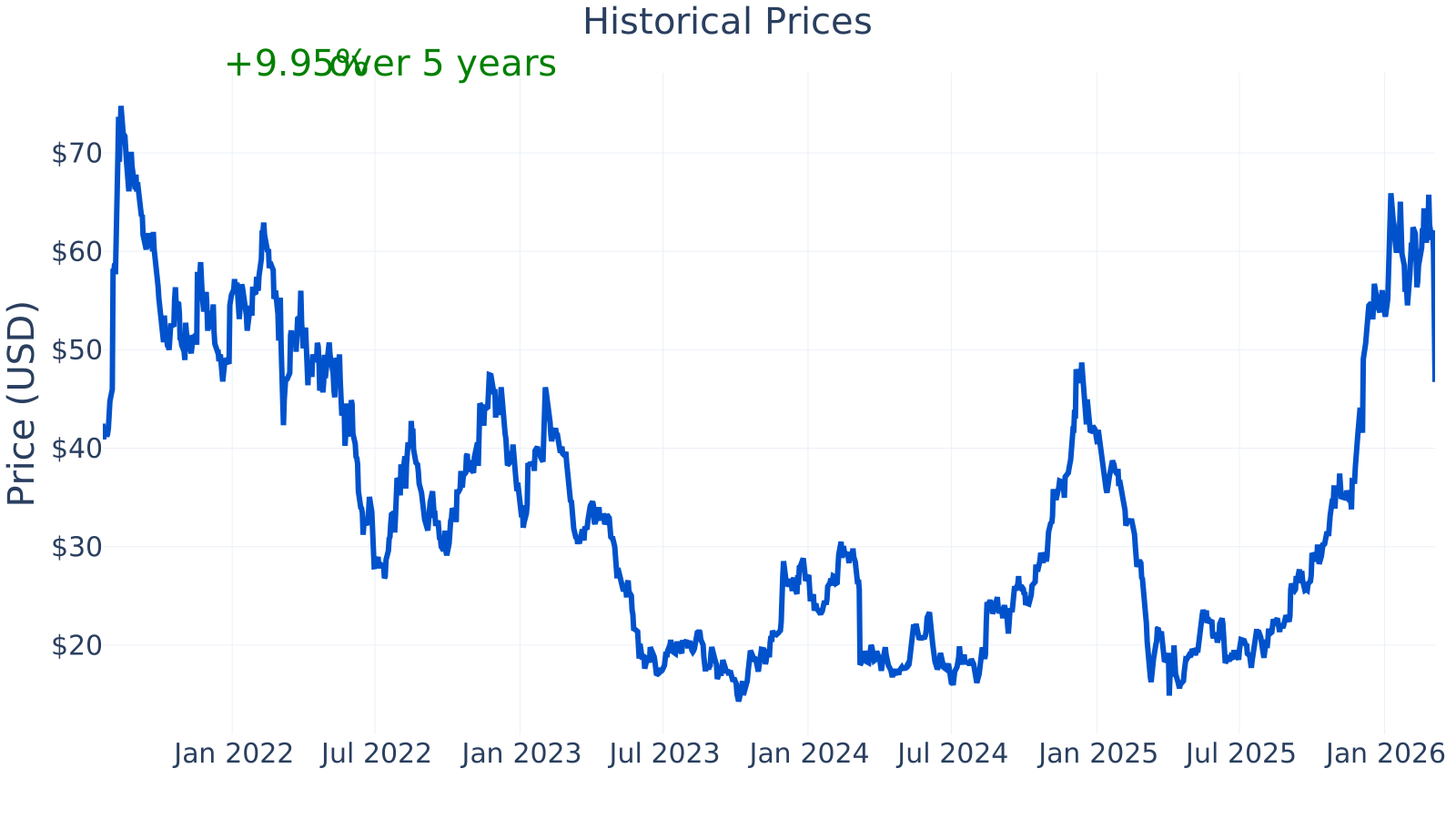
At a market capitalization of about $3.75 billion, VSCO is a mid-sized public retailer. The stock’s beta of ~2.27 indicates that its share price has historically moved more than the overall market (higher volatility).
On profitability, the company’s latest profit margin is about 2.45%, which is below the industry median shown here (about 8.32%). Recent year-over-year revenue growth is about 7.78%, slightly below the industry median listed (about 8.9%). The balance sheet stands out: debt-to-equity is about 725% versus an industry median near 93%, suggesting meaningfully higher financial leverage than many peers. Over the trailing twelve months, free cash flow is about $309 million, which indicates the core business has recently generated cash after operating needs and capital spending.
Growth (Medium)
VSCO operates in apparel retail, a mature and highly competitive industry that tends to grow roughly in line with consumer spending rather than expanding rapidly over long periods. Demand is also cyclical: it can rise when consumers feel confident and pull back when inflation, interest rates, or employment weaken. In other words, the industry environment is typically more about winning market share and improving execution than benefiting from strong, structural industry-wide growth.
For future growth, what tends to matter most for this type of company is whether it can consistently: (1) refresh product lines to match changing tastes, (2) keep brand relevance high, (3) improve the digital business, and (4) control promotions and costs. A practical catalyst in retail is sustained improvement in operating discipline—better inventory management and fewer markdowns can lift profits even if sales growth is modest.
Revenue growth was negative through much of 2022 and 2023, then turned mixed and improved more recently, ending with a mid-to-high single-digit year-over-year increase (about 7.78%). This pattern is consistent with a retailer that experienced a downturn period and then stabilized, rather than one showing uninterrupted expansion.
Free cash flow has fluctuated meaningfully over the last few years, moving from about $682 million (fiscal 2022) down to $133 million (fiscal 2024), then back up to roughly $247 million (fiscal 2025) and about $309 million on a trailing basis. For long-term business resilience, this line matters because it reflects how much cash the company can generate after funding day-to-day operations and store/technology investment—though the variability highlights that results can shift materially from year to year.
Risks (High)
A key risk is that VSCO is a brand-driven retailer in categories where consumer preferences change quickly and where promotions can heavily influence demand. If products miss trends, if competitors gain mindshare, or if the company needs deeper discounting to clear inventory, margins can compress. The profit margin history reflects this sensitivity, with a clear decline from earlier levels and only partial improvement more recently.
Another major risk is financial leverage. Higher debt relative to equity can amplify outcomes: it can improve returns in strong periods but increases pressure during weaker cycles due to interest costs and reduced flexibility.
The company’s debt-to-equity ratio has frequently been many times higher than the industry median over the period shown and is currently around 725% versus an industry median near 93%. Even allowing for accounting and capital structure differences among retailers, this gap indicates that the company is more exposed to refinancing conditions and earnings volatility than many peers.
Profit margin declined from roughly 9–10% in fiscal 2022 toward low single digits more recently (about 2.45% at the latest point shown), while the industry median displayed remains around 8%. This implies the company has recently been operating with less pricing power and/or higher costs than many comparable apparel retailers, which can limit the room for error if sales soften.
Competitive positioning is another central consideration. VSCO is a well-known name in intimate apparel, but the competitive field is broad and includes both specialty brands and large apparel companies that can use scale, marketing budgets, and distribution reach to compete aggressively. In addition, digital-first brands and marketplaces can intensify price competition and raise customer acquisition costs online. VSCO’s main advantages tend to be brand awareness, an established store footprint, and a large customer base, while its challenges include maintaining brand relevance and sustaining profitability in a crowded market.
Valuation
VSCO’s latest price-to-earnings (P/E) ratio is about 21.94, above the industry median shown (about 14.87). Over time, the company’s P/E has varied widely—rising meaningfully in more recent periods—while the industry median has generally been lower. A higher P/E can reflect expectations of improved earnings in the future, but it can also indicate that the current earnings level is relatively low compared with the share price (which can happen when margins are compressed).
Given the combination of (1) relatively low current profit margin compared with the industry median and (2) higher leverage than typical peers, valuation comparisons can be particularly sensitive to whether profitability continues to recover. In simple terms, the valuation looks different depending on whether the company sustains higher earnings power in future periods or returns to lower-margin outcomes seen recently.
Conclusion
Victoria’s Secret & Co is a consumer-cyclical retailer built around two major brands, with results that can swing based on merchandising success, promotional intensity, and cost control. Recent revenue trends show improvement compared with prior declines, and the business has continued to generate positive free cash flow, but profitability remains well below the industry median level shown.
The main long-term points that stand out are the company’s brand recognition and scale on one hand, and its elevated leverage and historically volatile margins on the other. With the P/E ratio currently above the industry median presented, the market appears to be assigning a valuation that can be harder to support if margin recovery does not continue. The overall profile depends heavily on execution in a mature, competitive retail environment and on maintaining financial flexibility through changing consumer cycles.
Sources:
- SEC EDGAR — Victoria’s Secret & Co filings (Form 10-K, Form 10-Q)
- Victoria’s Secret & Co Investor Relations — Quarterly and annual materials (press releases and presentations)
- Wikipedia — “Victoria’s Secret” and “Victoria’s Secret & Co” (basic company background)
This article is for informational purposes only and does not constitute financial advice. Some content is AI-generated. See Disclaimer