Stock Analysis · Vicor Corporation (VICR)
Overview
Vicor Corporation designs and manufactures advanced power-conversion components. In simple terms, its products help turn electricity into the right “shape” (voltage/current) and deliver it efficiently inside electronic systems. This matters in applications where space, heat, and energy losses are major constraints—such as high-performance computing, data centers, industrial equipment, telecommunications infrastructure, and defense/aerospace systems.
Vicor reports its business as a single operating segment and its filings primarily break sales down by geography rather than by product line, so a precise, public percentage split by “product category” is typically not provided in a simple, consistent way for revenue sources. At a high level, revenue is generated from selling power components and power systems used by customers building:
- Computing and data-center power solutions (including high-density power delivery for advanced processors)
- Industrial and automation-related power solutions
- Telecommunications and network infrastructure power solutions
- Defense and aerospace power solutions
From a business-model standpoint, the company’s economics are shaped by manufacturing scale, product mix (standard vs. more specialized designs), and sustained spending on research and development to keep power density and efficiency improving over time.
Looking across recent years, total revenue has been relatively steady in the roughly $359M–$408M range (2021–2025), while operating expenses (including R&D) have remained substantial. Net income shows meaningful variability over time, underscoring that product mix, volumes, and operating leverage can materially affect profits from year to year.
Key Figures
| Metric | Value | Industry ⓘ |
|---|---|---|
| Date | May 04, 2026 | |
| Context | ||
| Sector | Technology | |
| Industry | Electronic Components | |
| Market Cap ⓘ | $12.18B | |
| Beta ⓘ | 1.98 | |
| Fundamental | ||
| P/E Ratio ⓘ | 90.10 | 46.65 |
| Profit Margin ⓘ | 32.03% | 6.29% |
| Revenue Growth ⓘ | 20.20% | 17.50% |
| Debt to Equity ⓘ | 0.95% | 37.71% |
| PEG ⓘ | N/A | |
| Free Cash Flow ⓘ | $87.32M | |
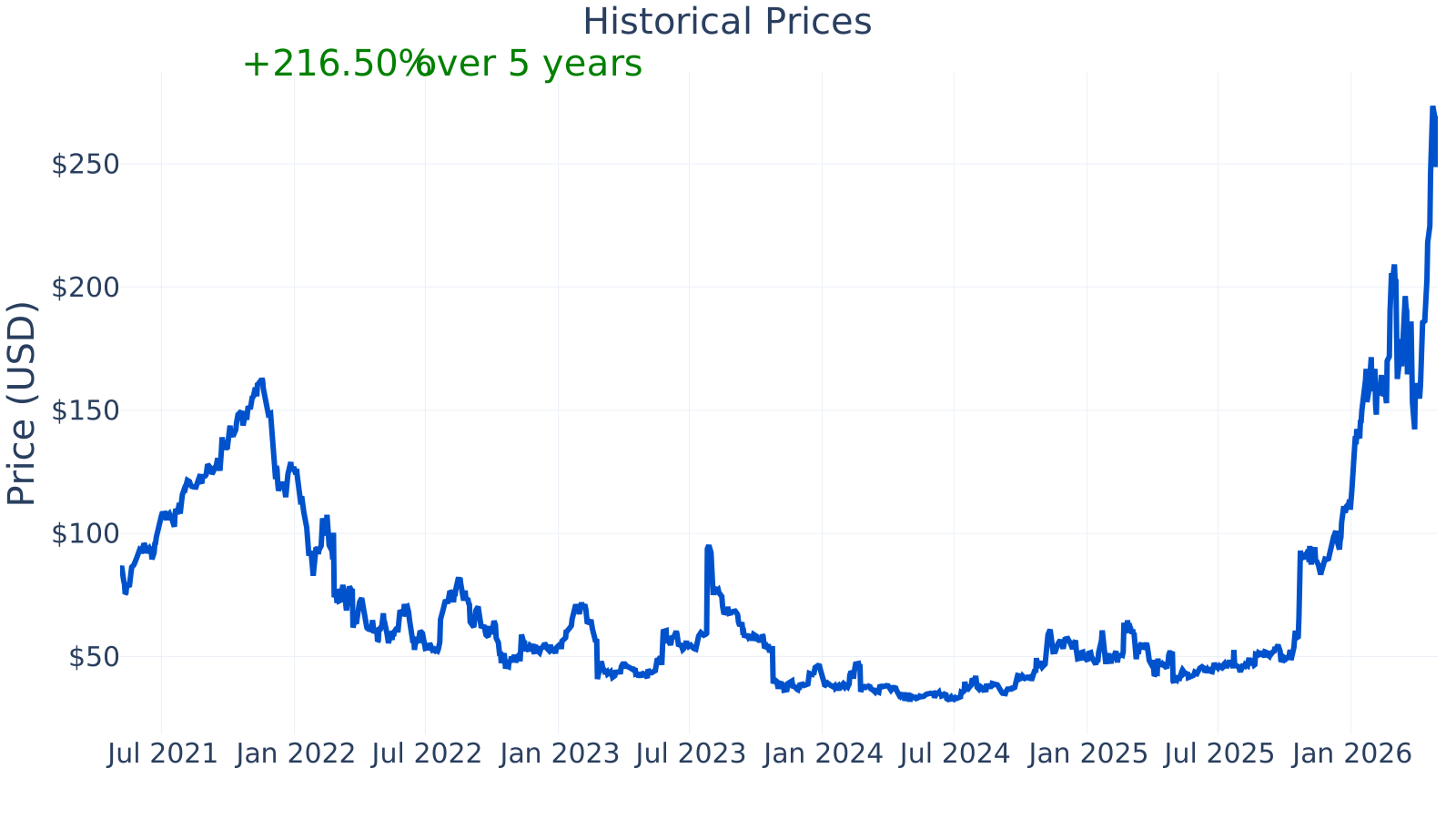
Vicor’s market capitalization is about $12.2B, and its beta of ~1.98 indicates the stock has historically moved more than the broader market (higher price volatility). The company’s P/E ratio is ~90.1 versus an industry median near 46.6, meaning the stock is valued at a higher multiple of earnings than many peers.
On profitability, the latest profit margin is ~32.0%, well above the industry median near 6.3%, which suggests strong recent profitability relative to peers (though this metric can fluctuate significantly over time for Vicor). The latest year-over-year revenue growth is ~20.2%, somewhat above the industry median of about 17.5%. Financial leverage is low: debt-to-equity is ~0.95% versus an industry median around 37.7%. Trailing twelve-month free cash flow is ~$87.3M.
Growth (medium)
Vicor operates in areas tied to long-term electrification and computing trends. As data centers, advanced processors, and AI-related infrastructure evolve, power delivery becomes more challenging: more power is needed in tight spaces, with strict efficiency and heat constraints. This backdrop can support demand for higher-density power conversion solutions—an area where Vicor positions its products.
Strategically, Vicor’s emphasis on continued innovation (including meaningful R&D spending in its financial statements over time) aligns with an industry where performance improvements can differentiate suppliers. In power electronics, small gains in efficiency or packaging can matter because they can reduce cooling needs and free up space inside systems.
Revenue growth has been uneven in recent years, including a period of year-over-year declines through parts of 2024, followed by a return to positive growth and a stronger run through 2025 into early 2026. This pattern is consistent with a business that may be influenced by customer program timing and product-cycle adoption rather than smooth, linear expansion.
Free cash flow has improved from negative levels in 2022–2023 to positive and rising levels by 2024–2026. This shift can matter for long-term business resilience because internally generated cash can fund R&D, capacity needs, and working capital without relying heavily on external financing.
Potential catalysts (in a factual, business-driver sense) generally revolve around broader adoption of high-density power delivery architectures in computing platforms, expansion of design wins into volume production, and scaling manufacturing efficiently as demand grows.
Risks (high)
Vicor’s fundamentals show meaningful swings over time, which can be important for understanding risk. Revenue has not consistently compounded each year in the 2021–2025 window, and profitability has also been variable. This can happen when demand depends on a smaller number of large programs, when customer inventory cycles shift, or when product mix changes.
Balance-sheet leverage appears low: debt-to-equity has remained around the low single digits (about 1% most recently), far below the industry median (around 38%). Low debt can reduce financial risk, but it does not eliminate business risk (such as demand volatility or competitive pressure).
Profit margins have been especially volatile. After a period of relatively modest margins in 2024, margins rose sharply through 2025 into early 2026, reaching levels far above the industry median. This can reflect improved mix, pricing, and/or operating leverage—but the history also shows that margins may compress when volumes or mix weaken.
Competitive dynamics are a core consideration. Vicor participates in power electronics markets where customers can have alternatives ranging from large, diversified semiconductor and power-management suppliers to specialized power module makers. Competition can show up through pricing pressure, faster product iteration, or customers choosing in-house designs.
Main competitors typically include large analog/power semiconductor and power-module providers, as well as specialized power-supply companies serving similar end markets. Examples often discussed in the power-management ecosystem include Texas Instruments, Analog Devices, Infineon Technologies, onsemi, STMicroelectronics, and power-focused suppliers such as TDK-Lambda (TDK) and Advanced Energy. Compared with these larger firms, Vicor is more specialized and smaller in scale, which can be an advantage in focus but a disadvantage in pricing power, manufacturing scale, and breadth of customer relationships.
Whether the company has a durable competitive advantage depends on execution: translating performance claims into repeatable, high-volume adoption; maintaining quality and reliability; protecting intellectual property; and delivering cost-competitive solutions as competitors improve. Customer concentration and reliance on a limited number of high-impact programs can also amplify volatility if any major customer changes direction.
Valuation
Valuation commonly starts with how much the market is paying relative to current earnings. Vicor’s latest P/E ratio (~90) is well above the industry median (~47). Historically, the company’s P/E has also moved sharply over time, which typically happens when the share price changes quickly, earnings change quickly, or both.
A higher-than-peer earnings multiple can be consistent with expectations of stronger future growth, sustained high margins, or expanding profitability. At the same time, when a valuation multiple is elevated, results often need to stay strong to keep the multiple from compressing. Given the company’s history of uneven revenue growth and shifting margins, a key context point is that valuation may be sensitive to changes in growth rates and profitability.
Conclusion
Vicor is a specialized power-conversion company serving demanding applications where efficiency, size, and heat management are critical. The business is tied to long-term themes like data-center expansion and higher power needs in advanced computing, and recent metrics show strong profitability, improving free cash flow, and very low financial leverage.
At the same time, the company’s operating history shows meaningful variability in growth and margins, and it competes in markets that include very large, well-resourced players. The current valuation multiple is above industry norms, which places added importance on sustaining strong execution and continued adoption of its solutions over time.
Sources:
- SEC EDGAR — Vicor Corporation Form 10-K (Annual Report)
- SEC EDGAR — Vicor Corporation Form 10-Q (Quarterly Report)
- Vicor Corporation Investor Relations — Press Releases and SEC Filings
- Wikipedia — “Vicor Corporation” (basic company background)
This article is for informational purposes only and does not constitute financial advice. Some content is AI-generated. See Disclaimer


