Stock Analysis · Vicor Corporation (VICR)
Overview
Vicor Corporation is a U.S.-based designer and manufacturer of high-performance power components and power systems. In simple terms, it builds hardware that converts and delivers electricity efficiently inside complex electronic equipment. These power-conversion products are used in environments where space is tight, performance matters, and energy losses (heat) are costly—such as data centers, advanced computing systems, industrial equipment, and other electronics that need stable, efficient power delivery.
From a business-model perspective, Vicor generates revenue primarily by selling power-conversion products to equipment makers (often through direct sales and distributors). In its SEC filings, the company describes revenue largely in terms of product sales rather than a mix of subscriptions or services, meaning results can move up and down with customer order patterns and broader electronics demand cycles.
Public filings commonly describe revenue by product families and end markets, but exact percentage splits can vary by period and are not always presented as a simple fixed breakdown. As a result, the most reliable high-level view is that revenue is dominated by product shipments (power modules, power components, and related solutions), with demand influenced by a small number of large programs in certain end markets.
Looking across recent years, total revenue moved from about $359M (2021) to $399M (2022) and $405M (2023), then fell back to about $359M (2024). Over the same period, operating expenses increased (notably R&D and SG&A), which helps explain why operating income and net income compressed sharply in 2024 even though gross profit remained substantial.
Key Figures
| Metric | Value | Industry ⓘ |
|---|---|---|
| Date | Feb 07, 2026 | |
| Context | ||
| Sector | Technology | |
| Industry | Electronic Components | |
| Market Cap ⓘ | $7.18B | |
| Beta ⓘ | 1.90 | |
| Fundamental | ||
| P/E Ratio ⓘ | 87.84 | 41.23 |
| Profit Margin ⓘ | 18.63% | 6.11% |
| Revenue Growth ⓘ | 18.50% | 12.20% |
| Debt to Equity ⓘ | 1.17% | 39.00% |
| PEG ⓘ | N/A | |
| Free Cash Flow ⓘ | $117.45M | |
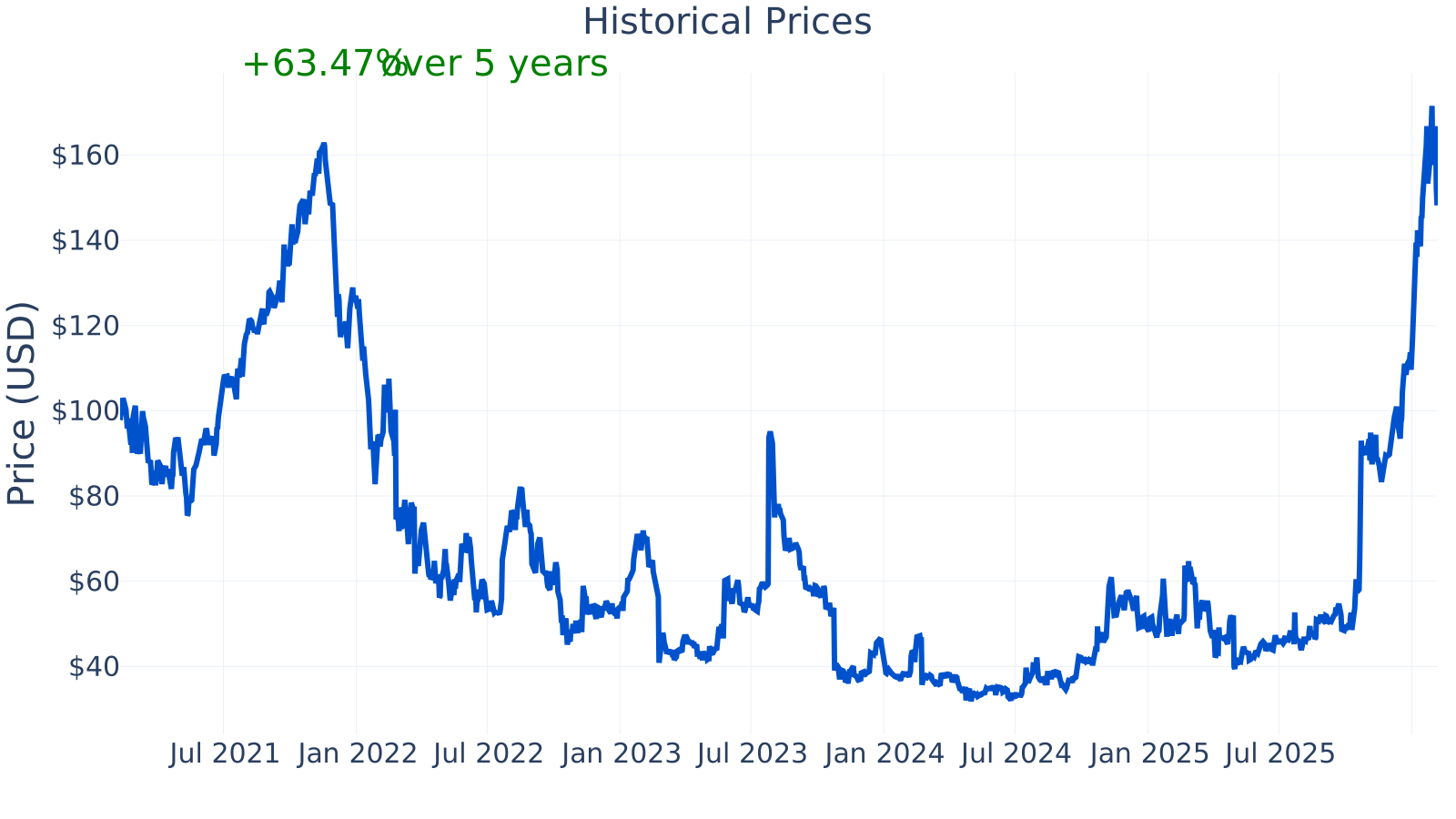
Vicor’s market capitalization is about $7.18B, and the stock has shown high sensitivity to market moves (beta ~1.90). The company’s trailing P/E ratio is ~87.8 versus an industry median around ~41.2, indicating a higher earnings multiple than many peers. Profitability (profit margin ~18.6%) is higher than the industry median (~6.1%), while leverage is very low (debt-to-equity ~1.2% vs an industry median near ~39%). Revenue growth year-over-year is ~18.5% versus an industry median ~12.2%, and trailing twelve-month free cash flow is about $117.4M.
Growth (Medium)
Vicor operates in power electronics, a category supported by long-term trends such as higher data-center power needs, increased power density in advanced computing, and continued electrification across many types of equipment. These trends generally require more efficient and compact ways to convert and move power within systems, which aligns with Vicor’s focus on high-performance power modules and power systems.
A key question for long-term business momentum is whether growth is broad-based and consistent or driven by a smaller number of major programs that can fluctuate. The company’s recent history shows meaningful variability: strong periods can be followed by slower ones, which is common in components businesses where customer ramps, inventory cycles, and design-win timing can cause sharp swings.
The year-over-year revenue growth line shows this variability clearly. After negative growth through much of 2024, growth turned positive again by late 2024 and strengthened in 2025 (including a notably strong quarter in mid-2025). This pattern is consistent with an upcycle following a weaker demand period, but it also highlights that growth can be uneven.
Free cash flow also improved over time. After negative trailing free cash flow in 2022 and 2023, it turned positive in 2024 and increased further into 2025. For a manufacturing-focused technology company, sustained positive free cash flow can matter because it can support continued R&D investment and operational flexibility without relying heavily on borrowing.
Risks (High)
This article is for informational purposes only and does not constitute financial advice. Some content is AI-generated. See Disclaimer