Stock Analysis · Verizon Communications Inc (VZ)
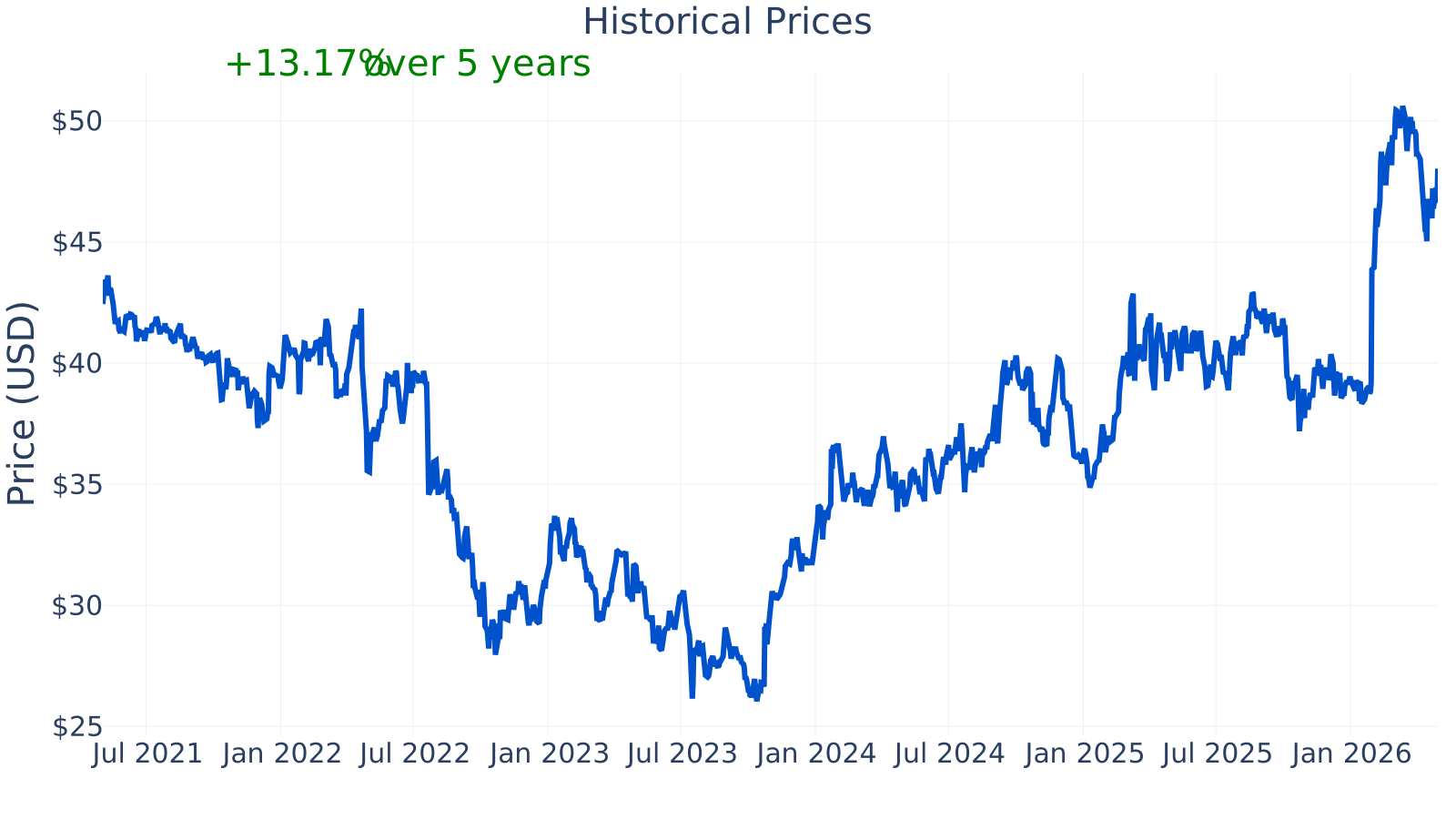
Overview
Verizon Communications Inc. is a U.S.-based telecommunications company. Its core business is providing wireless connectivity (mobile phone service and data plans) and fixed-line connectivity (broadband internet and related services). Verizon also serves businesses and government customers with network, connectivity, and communications solutions.
In simple terms, Verizon earns most of its money by charging monthly service fees for connectivity, plus additional revenue from selling devices (like smartphones) and offering value-added services to consumer and business customers.
Across its public reporting, Verizon’s activities are commonly discussed through two main operating segments:
- Verizon Consumer: wireless services for individuals and households, plus home internet services.
- Verizon Business: wireless and wireline services for companies and public-sector organizations.
Verizon’s revenue is concentrated in connectivity and related service fees. In its annual reporting, the company provides detailed breakdowns of revenue categories (for example, wireless service revenue, wireless equipment revenue, and wireline revenue). Percentages by category can vary by year and are best read directly from the most recent annual report’s revenue note and segment discussion.
Over the 2021–2025 period shown, total revenue stayed in a relatively tight range (about $134B–$138B). Operating income and net income moved more meaningfully from year to year, and interest expense rose notably versus earlier years, which matters in a capital-intensive industry that regularly uses debt to fund network buildouts.
Key Figures
| Metric | Value | Industry ⓘ |
|---|---|---|
| Date | May 01, 2026 | |
| Context | ||
| Sector | Communication Services | |
| Industry | Telecom Services | |
| Market Cap ⓘ | $200.57B | |
| Beta ⓘ | 0.27 | |
| Fundamental | ||
| P/E Ratio ⓘ | 11.71 | 14.35 |
| Profit Margin ⓘ | 12.46% | 7.29% |
| Revenue Growth ⓘ | 2.90% | 4.10% |
| Debt to Equity ⓘ | 189.60% | 105.78% |
| PEG ⓘ | 0.88 | |
| Free Cash Flow ⓘ | $20.05B | |
Verizon’s market capitalization is about $200.6B. The stock’s beta of 0.27 indicates it has historically moved much less than the broader market (though low beta does not remove business risk). The P/E ratio is 11.71, below the industry median shown (14.35). Net profit margin is 12.46%, above the industry median shown (7.29%). Year-over-year revenue growth is 2.90%, below the industry median shown (4.10%). Debt-to-equity is about 189.6%, above the industry median shown (105.8%). Trailing twelve-month free cash flow is about $20.05B.
Growth (Low to Medium)
Telecommunications is a mature, essential-services industry. Demand for connectivity is structural—people and businesses rely on it daily—but growth tends to be steadier than in fast-expanding technology categories. In many developed markets, the number of potential mobile subscribers grows slowly, so revenue expansion often depends on pricing, customer retention, plan mix (more premium plans), and new use cases (for example, fixed wireless access for home internet, private networks for enterprises, and internet-of-things connectivity).
Verizon’s strategy is typically framed around network quality, upgrading to newer wireless generations (including 5G), expanding broadband options, and serving higher-value customer segments. These initiatives can support long-run competitiveness, but they also require sustained capital investment.
The year-over-year revenue growth pattern shown is modest and sometimes negative in parts of 2023, followed by a return to small positive growth through 2025 into early 2026 (about 2.85% most recently). This fits the profile of a mature telecom business: stability matters, and growth tends to be incremental rather than explosive.
Free cash flow increased from about $10.40B (2022) to roughly $20.05B most recently. For telecom companies, free cash flow is particularly important because networks require ongoing investment, and cash generation helps fund capital spending, spectrum-related obligations, and debt service.
Risks (Medium to High)
Telecom carries several structural risks that long-term readers should understand. First, it is capital-intensive: maintaining and upgrading a nationwide network requires large, recurring investment. Second, the industry is highly competitive, and promotional activity (discounts, device incentives, switching offers) can pressure profitability. Third, the business is regulated and depends on access to spectrum and compliance with federal and state requirements. Finally, results can be sensitive to interest rates because operators often use substantial debt to finance long-lived network assets and spectrum licenses.
Competitive advantages in telecom often come from network scale, coverage and reliability perception, brand recognition, and distribution (retail and digital sales channels). Verizon is widely recognized as one of the major nationwide U.S. wireless carriers, competing at the top end of the market on network performance and service quality. However, advantages are not permanent: competitors can invest aggressively, and customer switching is possible, especially when promotions are strong.
The main U.S. wireless competitors are AT&T and T-Mobile. In addition, cable operators (such as Comcast and Charter) participate in mobile through MVNO arrangements, and they compete strongly in home broadband. This creates a competitive environment where wireless and broadband offerings increasingly overlap.
Verizon’s debt-to-equity is shown at about 189.6%, above the industry median shown (about 104.4%). The chart also shows Verizon trending down from higher levels earlier in the period, but still remaining elevated versus peers. Higher leverage can increase sensitivity to refinancing conditions and interest costs, even when revenues are relatively stable.
Net profit margin is currently about 12.46%, which is higher than the industry median shown (about 7.76%). The margin history also shows variability, including a lower-margin stretch in parts of 2024 before improving into 2025 and early 2026. In telecom, margins can move due to promotion intensity, pricing, cost inflation, network expenses, and the pace of depreciation tied to major investment cycles.
Valuation
Valuation is often discussed using simple multiples such as the price-to-earnings ratio (P/E). A lower P/E can reflect slower expected growth, higher perceived risks (such as leverage), or uncertainty about future earnings stability. A higher P/E can reflect expectations for stronger growth or more durable profitability.
Verizon’s latest P/E is about 11.71, compared with the industry median shown of about 14.35. Historically in the chart, Verizon’s P/E is frequently below the industry median, with periods where it converges or briefly exceeds it. Interpreting this in context, Verizon’s profile combines relatively steady demand with modest revenue growth and comparatively high leverage, which can weigh on valuation multiples even when profitability is solid.
Another commonly referenced metric is the PEG ratio (P/E relative to growth). Verizon’s PEG ratio is shown at 0.88. PEG ratios depend heavily on how growth is estimated and can be less reliable for mature businesses where growth is modest and influenced by pricing, competition, and investment cycles.
Conclusion
Verizon is a large, established telecom operator whose results are shaped by stable underlying demand for connectivity, intense competition, and ongoing network investment needs. The company’s recent figures show modest revenue growth, solid net profit margins relative to the industry median shown, and stronger free cash flow than a few years ago, alongside higher leverage than the industry median shown.
From a long-term, business-focused perspective, the key elements to track over time are: whether revenue can grow consistently without relying on aggressive promotions, whether free cash flow remains durable after network investment needs, and whether leverage and interest costs trend in a direction that preserves financial flexibility.
Sources:
- SEC EDGAR — Verizon Communications Inc. filings (Form 10-K, Form 10-Q)
- Verizon Investor Relations — Annual Report materials and SEC filing links
- Wikipedia — “Verizon Communications” (basic company background)
This article is for informational purposes only and does not constitute financial advice. Some content is AI-generated. See Disclaimer


