Stock Analysis · Verizon Communications Inc (VZ)
Overview
Verizon Communications Inc is a major U.S. telecommunications company. Its core business is providing wireless service (mobile phone plans and data) and broadband connectivity (including fiber and fixed wireless). Telecom networks require large, long-lived infrastructure investments, so the business tends to focus on reliability, scale, and customer retention rather than rapid product cycles.
In its financial reporting, Verizon’s operations are primarily organized around two segments: Verizon Consumer (wireless service, devices, and home internet for individuals and families) and Verizon Business (connectivity and related services for companies and public sector customers). Revenue is largely recurring, coming from monthly service plans, with additional contributions from device sales and other service fees.
Main revenue sources (typical telecom mix; exact split varies by year and is detailed in company filings):
- Wireless service revenue (monthly mobile plans and data)
- Wireless equipment revenue (device sales and related)
- Wireline / broadband services (including fiber broadband and related services)
- Business services (enterprise connectivity, network services, and solutions)
At a high level, recent annual revenue has been relatively stable, fluctuating around the mid-$130B range across 2021–2025, reflecting a mature industry where gains often come from pricing, customer mix, and efficiency rather than large unit growth.
Across 2021–2025, total revenue stayed in a fairly narrow band (about $133.6B to $138.2B). Over the same period, interest expense rose notably (from about $3.5B in 2021 to about $6.7B in 2025), which highlights how financing costs can matter for a capital-intensive telecom operator.
Key Figures
| Metric | Value | Industry ⓘ |
|---|---|---|
| Date | Feb 07, 2026 | |
| Context | ||
| Sector | Communication Services | |
| Industry | Telecom Services | |
| Market Cap ⓘ | $195.29B | |
| Beta ⓘ | 0.32 | |
| Fundamental | ||
| P/E Ratio ⓘ | 11.41 | 15.18 |
| Profit Margin ⓘ | 12.43% | 6.18% |
| Revenue Growth ⓘ | 2.00% | 2.10% |
| Debt to Equity ⓘ | 192.03% | 113.97% |
| PEG ⓘ | 1.14 | |
| Free Cash Flow ⓘ | $19.79B | |
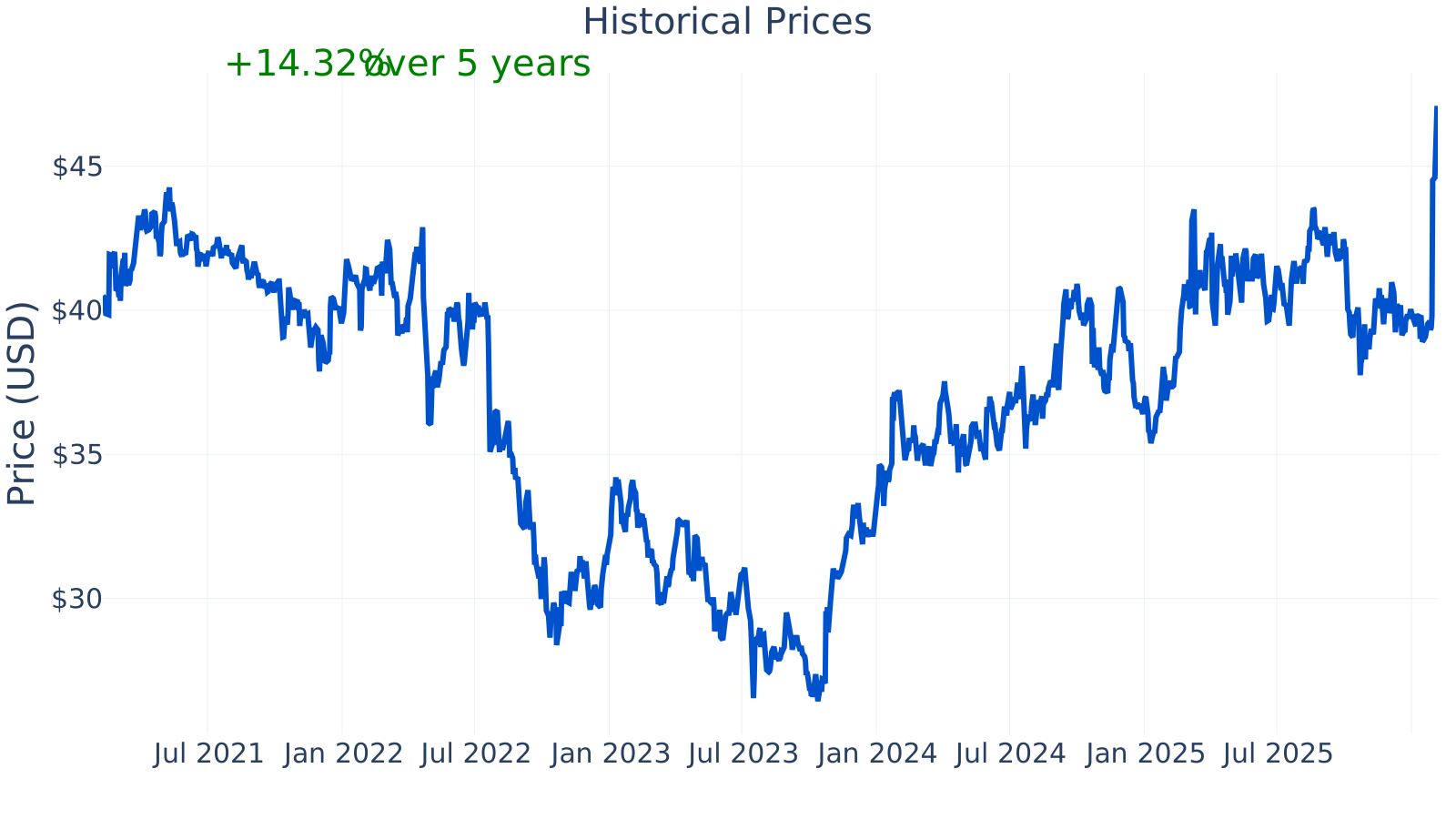
Verizon’s market capitalization is about $195B and the stock’s beta of ~0.32 suggests the share price has historically been less volatile than the broader market. The P/E ratio (~11.4) is below the industry median (~15.2), while the profit margin (~12.4%) is above the industry median (~6.2%). Year-over-year revenue growth is modest at about 2.0%, roughly in line with the industry median. Leverage is meaningful: debt-to-equity is ~192% versus an industry median near 114%. Trailing twelve-month free cash flow is about $19.8B, a key metric for funding network investment, servicing debt, and shareholder returns.
Growth (Low to Medium)
Telecom in the United States is generally a mature industry: most people already have mobile service, and competition is often about switching customers, improving network performance, and bundling services (for example, pairing wireless plans with home internet). That backdrop tends to produce steady but limited revenue growth compared with faster-growing technology segments.
Verizon’s growth strategy is typically centered on improving network capabilities (including 5G), increasing the value of each customer relationship over time, and expanding broadband reach through fiber and fixed wireless offerings. In a mature market, these initiatives may support incremental gains through customer retention, premium plan adoption, and capturing share in home internet—rather than through explosive expansion.
The year-over-year revenue growth trend shows periods of low or even slightly negative growth around 2023, followed by a return to modest positive growth through 2024–2025, ending near ~2% most recently. This pattern is consistent with a large operator operating in a saturated market where pricing and customer mix changes can meaningfully influence results.
Free cash flow over the trailing twelve months improved materially from the negative level shown in 2021 to roughly $10.4B (2022), $13.6B (2023), $18.6B (2024), and about $20.2B (2025). For a network business, rising free cash flow can be an important signal of improving financial flexibility, though it still needs to be weighed against ongoing capital spending requirements and financing costs.
Risks (Medium to High)
This article is for informational purposes only and does not constitute financial advice. Some content is AI-generated. See Disclaimer