Stock Analysis · VeriSign Inc (VRSN)
Overview
VeriSign, Inc. (VRSN) provides critical infrastructure for the internet’s “address book.” Its main role is operating the registry systems for certain top-level domains (TLDs), most notably .com and .net. In practical terms, VeriSign helps ensure that when someone types a web address ending in these domains, the underlying system can reliably and securely route users to the correct destination.
VeriSign’s business is mainly built around long-lived registry agreements, where it supports the technical operations of the domain registries and charges fees tied to domain name registrations and renewals. This model tends to produce recurring revenue because many domain names renew annually and because established websites often keep their domains for long periods.
VeriSign reports revenue primarily by registry services rather than a long list of products. Based on its filings, the largest sources of revenue are typically:
- .com registry services (largest contributor)
- .net registry services
- Other registry-related and ancillary services (smaller portion)
Because the company’s economics are closely tied to the number of registered domain names and renewal behavior, the key operating drivers are domain base growth, renewal rates, and the pricing terms allowed under its agreements.
Over the years shown, total revenue rises steadily (from about $1.33B in 2021 to about $1.66B in 2025), while costs and operating expenses increase more slowly in absolute terms. That combination helps explain why VeriSign can generate substantial operating income relative to revenue.
Key Figures
| Metric | Value | Industry ⓘ |
|---|---|---|
| Date | Feb 07, 2026 | |
| Context | ||
| Sector | Technology | |
| Industry | Software - Infrastructure | |
| Market Cap ⓘ | $20.78B | |
| Beta ⓘ | 0.75 | |
| Fundamental | ||
| P/E Ratio ⓘ | 25.44 | 25.66 |
| Profit Margin ⓘ | 49.84% | 6.68% |
| Revenue Growth ⓘ | 7.60% | 15.20% |
| Debt to Equity ⓘ | -121.35% | 19.82% |
| PEG ⓘ | 2.74 | |
| Free Cash Flow ⓘ | $1.07B | |
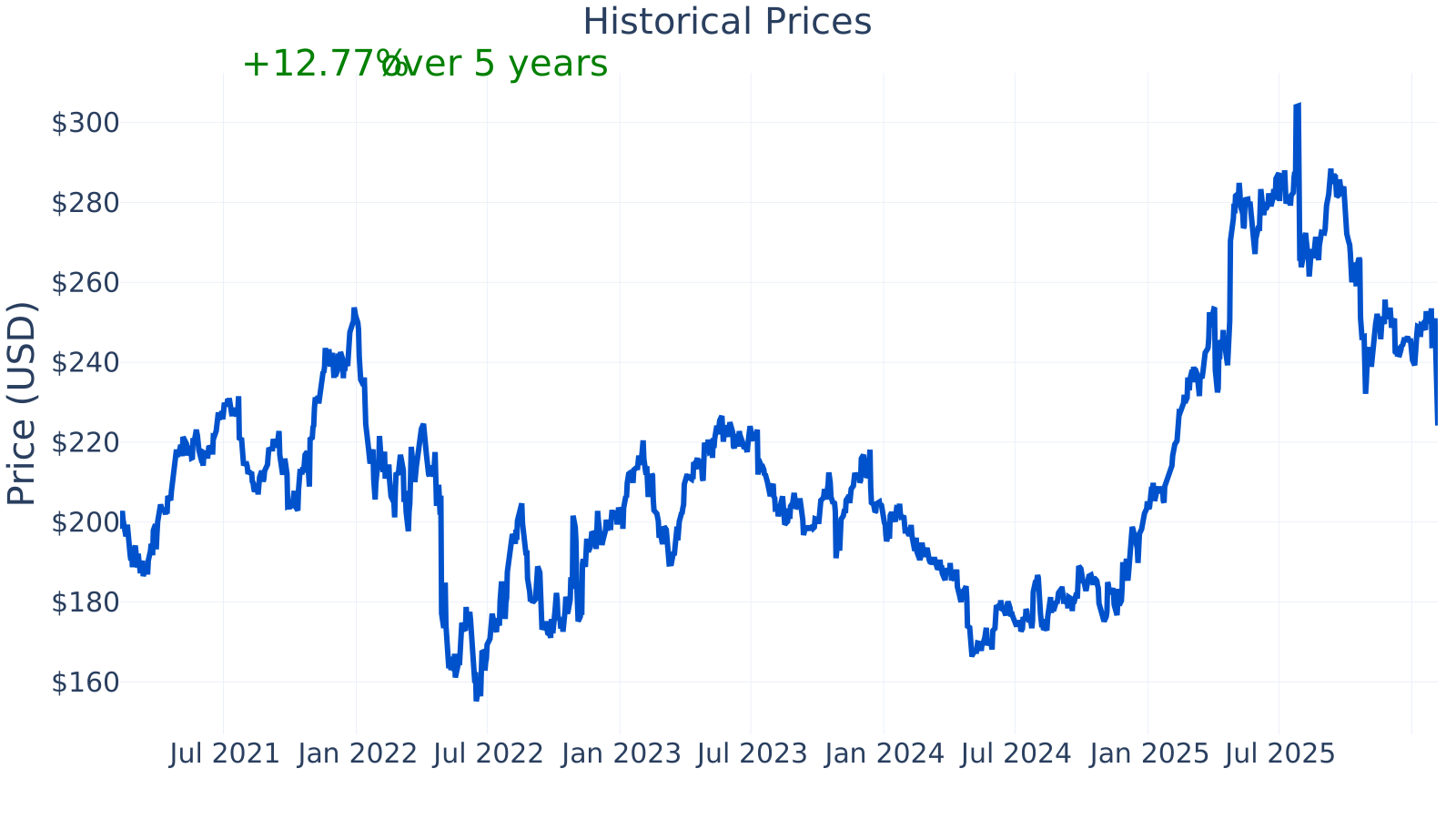
VeriSign’s market capitalization is about $20.8B, and its beta of 0.75 indicates the share price has historically moved less than the broader market on average. The current P/E ratio is ~25.4, close to the industry median (~25.7). Profitability stands out: profit margin is about 49.8% versus an industry median near 6.7%. Recent year-over-year revenue growth is about 7.6%, which is below the industry median (~15.2%). Free cash flow over the trailing twelve months is about $1.07B.
Growth (Low)
VeriSign operates in an area that benefits from long-term trends like digital commerce, online identity, and the continuing need for stable internet infrastructure. However, the domain registry business for mature TLDs like .com and .net is generally not a hyper-growth market. Growth tends to be incremental and linked to overall levels of business formation, website creation, online marketing activity, and renewal behavior.
The revenue growth pattern shown is steady rather than explosive, generally in the mid-single digits and reaching the mid-to-high single digits more recently (about 7.6% in the latest period shown). This is consistent with a mature, recurring-revenue model where expansion is often gradual.
Free cash flow has been substantial over time, moving from roughly $709M (2021) to about $907M (2025, as shown), with the latest trailing twelve months at about $1.07B. For a business like VeriSign, sustained free cash flow matters because it reflects the ability to fund operations, service debt, and return capital under its chosen policies without needing to raise money frequently.
Potential catalysts are typically less about launching new products and more about: (1) changes in allowed pricing under registry agreements, (2) shifts in the number of registered domains (new registrations minus deletions), and (3) renewal rates. In addition, the company’s trusted role in internet infrastructure can support long-term relevance, but the growth rate is still anchored to domain-market fundamentals.
Risks (Medium)
A central risk is concentration: VeriSign’s results depend heavily on .com (and to a lesser extent .net). If domain growth slows, if renewals weaken, or if competitive pressures change how businesses choose domains, revenue growth can decelerate.
Another key risk relates to the contractual and regulatory framework around domain registries. The ability to raise prices and the continuation of registry agreements matter a lot for long-term economics. Changes in contract terms, oversight, or policy decisions could affect future revenue and margins.
Competition is somewhat different from typical software markets. VeriSign is the established registry operator for .com and .net, but domain name choices compete at the “ending” level (for example, country-code domains like .de or .uk, and many newer generic TLDs). That means competitive pressure can show up as substitution—organizations choosing alternatives rather than .com or .net—even though VeriSign remains the operator for its contracted TLDs.
VeriSign’s competitive advantages are mainly tied to scale, reliability, and mission-critical operations. Operating a top-level domain registry requires high availability, security, and operational track record. That said, leadership is largely specific to the TLDs it runs; it is not a general-purpose software leader across the broader infrastructure software industry.
The debt-to-equity ratio is shown as negative in the periods displayed (for example, about -121% most recently). This commonly happens when a company has negative shareholders’ equity, which can result from capital return programs such as share repurchases over long periods. A negative value makes simple comparisons to an industry median (around 20%) less straightforward and increases the importance of monitoring cash generation, debt levels, and interest coverage in the filings.
Profit margin has remained very high—often around the 50%+ range across the timeline shown—while the industry median is far lower. High margins can be a strength (efficient operations and pricing power within contract terms), but they can also increase scrutiny from stakeholders and make the business more sensitive to any unfavorable contract or volume changes.
Valuation
On earnings-based valuation, VeriSign’s current P/E (about 25.4) is close to the industry median (about 25.7). Historically in the periods shown, the company’s P/E moved across a fairly wide range (roughly low 20s to low 40s at different points), sometimes below and sometimes above the industry median. This suggests the market has periodically re-rated the stock depending on expectations for domain growth, pricing, and broader market conditions.
A practical way to interpret the valuation in context is to connect it to VeriSign’s profile: moderate revenue growth (mid-single digits recently), very high profitability, and strong free cash flow. The valuation level therefore tends to reflect a balance between durable cash generation and the reality that the core market is mature. The company’s PEG ratio (about 2.74) also aligns with the idea that growth is not especially high relative to the earnings multiple.
Conclusion
VeriSign is a specialized internet infrastructure company whose financial profile is shaped by operating key domain registries, especially .com and .net. The model is characterized by recurring revenue, steady (often mid-single-digit) growth, and unusually high profit margins compared to the broader software infrastructure peer set.
The main factors that can shape long-term outcomes are domain registration trends and renewal behavior, the pricing and duration terms embedded in registry agreements, and policy or oversight changes affecting those agreements. Financially, the combination of high margins and strong free cash flow is a defining feature, while the negative debt-to-equity reading highlights the importance of understanding balance-sheet structure through the company’s filings rather than relying on a single ratio.
Sources:
- SEC EDGAR — VeriSign, Inc. Form 10-K (Annual Report)
- SEC EDGAR — VeriSign, Inc. Form 10-Q (Quarterly Reports)
- VeriSign Investor Relations — Annual Reports / SEC Filings section
- Wikipedia — “VeriSign” (company overview and history)
This article is for informational purposes only and does not constitute financial advice. Some content is AI-generated. See Disclaimer


