Stock Analysis · Veeco Instruments Inc (VECO)
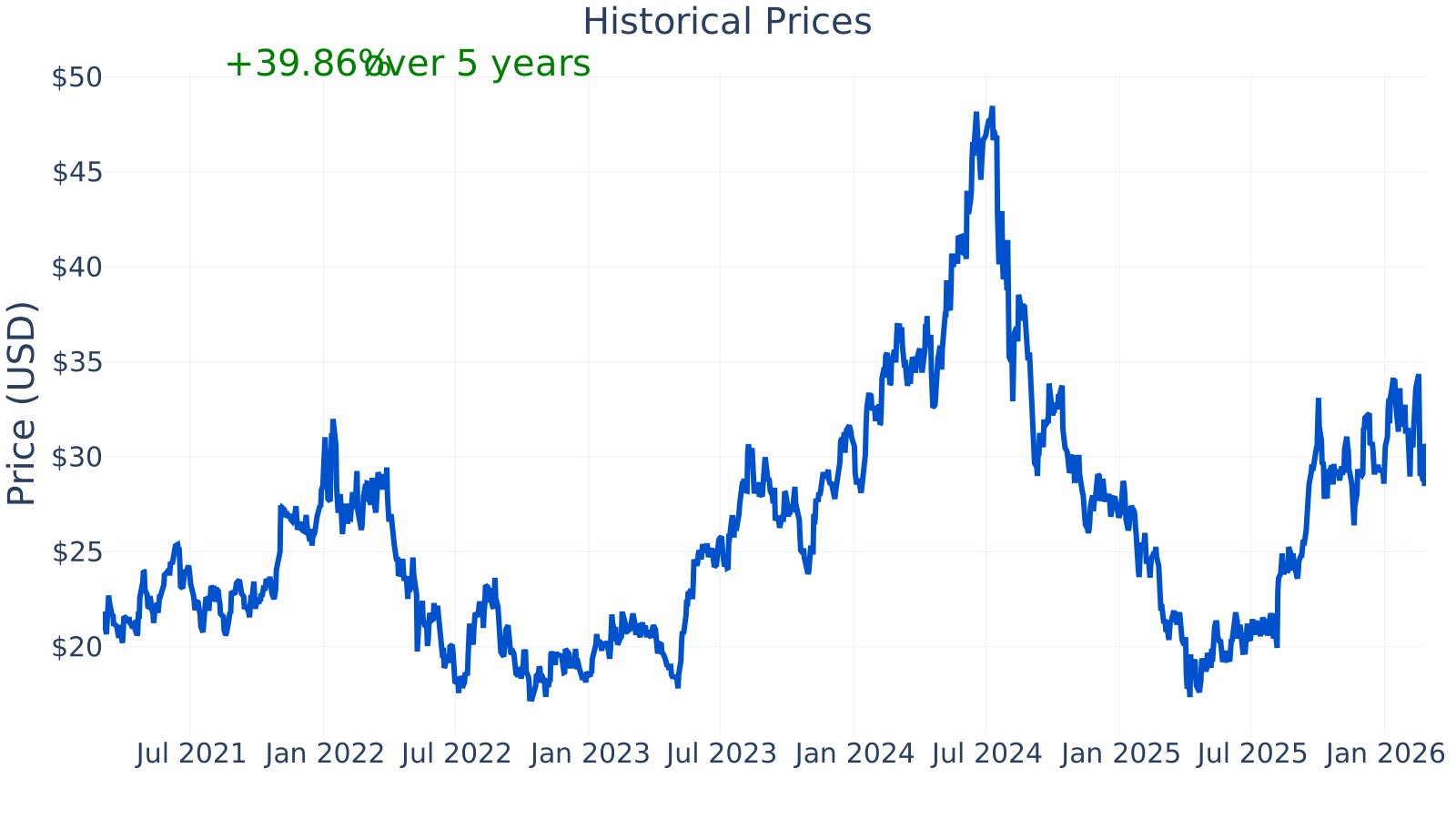
Overview
Veeco Instruments Inc. (VECO) designs and sells specialized manufacturing equipment used to make advanced electronic devices. In plain terms, its tools help customers deposit or shape very thin layers of material with high precision—steps that are required to produce certain semiconductors and other high-tech components.
The company’s equipment is used in end markets that tend to follow long investment cycles, where customers place large orders when they build or upgrade production capacity. Veeco also typically generates additional revenue after an initial tool sale through spare parts, service, and support over the life of the equipment.
In its SEC filings, Veeco describes its revenue primarily as coming from sales of its manufacturing systems and related services/spares. A simple way to think about the revenue mix is:
- Equipment / systems (largest driver): sales of the company’s tools used in production environments
- Services and spares (smaller but recurring): installation, support, and parts over time
Percentages can vary by year and are typically detailed in the company’s annual report and segment/revenue disclosures.
Over the last several years, total revenue moved from about $583M (2021) to about $717M (2024), then eased to about $664M (2025). Operating spending remains significant, with research and development typically a major cost line (roughly $90M–$125M per year across 2021–2025), reflecting the need to keep improving tool performance and reliability in demanding customer environments.
Key Figures
| Metric | Value | Industry ⓘ |
|---|---|---|
| Date | Mar 02, 2026 | |
| Context | ||
| Sector | Technology | |
| Industry | Semiconductor Equipment & Materials | |
| Market Cap ⓘ | $1.84B | |
| Beta ⓘ | 1.17 | |
| Fundamental | ||
| P/E Ratio ⓘ | 36.82 | 48.57 |
| Profit Margin ⓘ | 5.33% | 7.37% |
| Revenue Growth ⓘ | -9.40% | 8.10% |
| Debt to Equity ⓘ | 29.12% | 25.99% |
| PEG ⓘ | 0.53 | |
| Free Cash Flow ⓘ | $45.70M | |
Veeco’s market capitalization is about $1.84B, and the stock’s beta (~1.17) suggests it has tended to move somewhat more than the broader market. The latest P/E ratio (~36.8) is below the industry median shown (~48.6), while profit margin (~5.3%) is below the industry median (~7.4%). The most recent year-over-year revenue growth is negative (~-9.4%), compared with a positive industry median (~8.1%), which highlights the cyclical nature of customer spending in semiconductor equipment. Leverage appears moderate with debt-to-equity ~29% (industry median ~26%). Trailing twelve-month free cash flow is about $45.7M, indicating the business has recently generated cash after operating needs and capital spending.
Growth (Medium)
Veeco operates in the semiconductor equipment ecosystem, which is tied to long-term trends like increasing chip complexity, expanding data center capacity, and the ongoing need for more efficient power electronics. Even so, demand for equipment can be uneven because customers often buy in “waves” when they expand factories and pause when capacity is sufficient.
Strategically, Veeco’s long-term growth logic is centered on continuing to develop specialized tools that solve difficult manufacturing steps, where performance and reliability matter and qualification cycles can be lengthy. This type of positioning can support customer stickiness once a tool is proven in production, but it also requires sustained investment in engineering and customer support.
The revenue growth pattern shows that growth has not been steady: strong positive rates were visible in 2021–2022, while more recent quarters turned negative, culminating around -9% year-over-year by late 2025. This is consistent with an industry where customer capital expenditures can fluctuate meaningfully from year to year.
Free cash flow has also varied: it was about $48M (2021), dipped to about $32M (2022), rose to about $77M (2023), fell to about $30M (2024), and improved to about $56M (2025). For long-term business quality, this variability matters because it suggests results depend not only on technology execution but also on timing of customer orders, margins on specific projects, and working-capital swings.
Risks (High)
The biggest risk is cyclicality: Veeco’s customers can delay or accelerate equipment purchases depending on broader semiconductor demand, funding conditions, and factory utilization. This can lead to volatile revenue and profit from year to year, even if the company’s technology remains competitive.
A second key risk is execution and competition. Semiconductor equipment markets often have powerful incumbents and well-funded specialists. Veeco competes based on tool performance, cost of ownership, and the ability to support high-volume manufacturing. Competitive advantages can exist when a tool becomes qualified in a customer’s process flow, but leadership is often narrow (tool-by-tool and application-by-application) rather than across the entire semiconductor equipment landscape.
In broad terms, competitors can include other semiconductor equipment providers, including large diversified tool companies and specialized deposition/processing tool makers. Relative positioning depends heavily on the specific application, the customer’s manufacturing approach, and how well each vendor’s tool meets yield, throughput, and reliability requirements. Veeco’s SEC filings typically discuss competition and market dynamics in the “Risk Factors” and business sections.
Leverage has trended down meaningfully over time, from levels above 80% debt-to-equity in 2021 to about 29% most recently. While the latest level is only somewhat higher than the industry median shown (~26%), the direction is notable because lower leverage generally provides more flexibility during downcycles.
Profitability has been uneven. Net profit margin moved from slightly negative in early 2021 to strong positives in parts of 2022–2023, then dipped negative again around late 2023 and early 2024, before settling to mid-single-digit levels by late 2025 (about 5%). The industry median shown is higher in many periods, and Veeco’s margin pattern suggests sensitivity to volume, product mix, and cost structure.
Valuation
Valuation is often discussed using the price-to-earnings (P/E) ratio, which compares the stock price to earnings. Veeco’s latest P/E is about 36.8, below the industry median shown of about 48.6. That relative discount can be consistent with the company’s lower recent profit margin versus the peer median and the recent period of negative year-over-year revenue growth.
Historically, Veeco’s P/E ratio has swung widely (including periods where it was much lower and periods where it was higher), which is common when earnings change meaningfully from year to year. In a cyclical business, a single-point-in-time P/E can shift quickly if profitability improves or weakens, so it is typically interpreted alongside operating performance, margin stability, and cash generation.
Conclusion
Veeco is a specialized semiconductor equipment company whose results can reflect both long-term technology demand and short-term customer spending cycles. The business shows meaningful ongoing investment in research and development, moderate leverage that has improved over time, and free cash flow that has remained positive but variable.
The main trade-off visible in the fundamentals is that recent growth and profitability metrics have been weaker than the industry median shown, while valuation multiples are also lower than the peer median displayed. The overall long-term picture depends heavily on whether Veeco can sustain competitive tool performance in its target applications and translate that into steadier revenue and margin outcomes across industry cycles.
Sources:
- SEC EDGAR — Veeco Instruments Inc. filings (Form 10-K, Form 10-Q): “Business”, “Management’s Discussion and Analysis”, and “Risk Factors” sections
- Veeco Instruments Inc. — Investor Relations materials and press releases (company-hosted)
- Wikipedia — “Veeco Instruments” (basic company background)
This article is for informational purposes only and does not constitute financial advice. Some content is AI-generated. See Disclaimer


