Stock Analysis · Valvoline Inc (VVV)
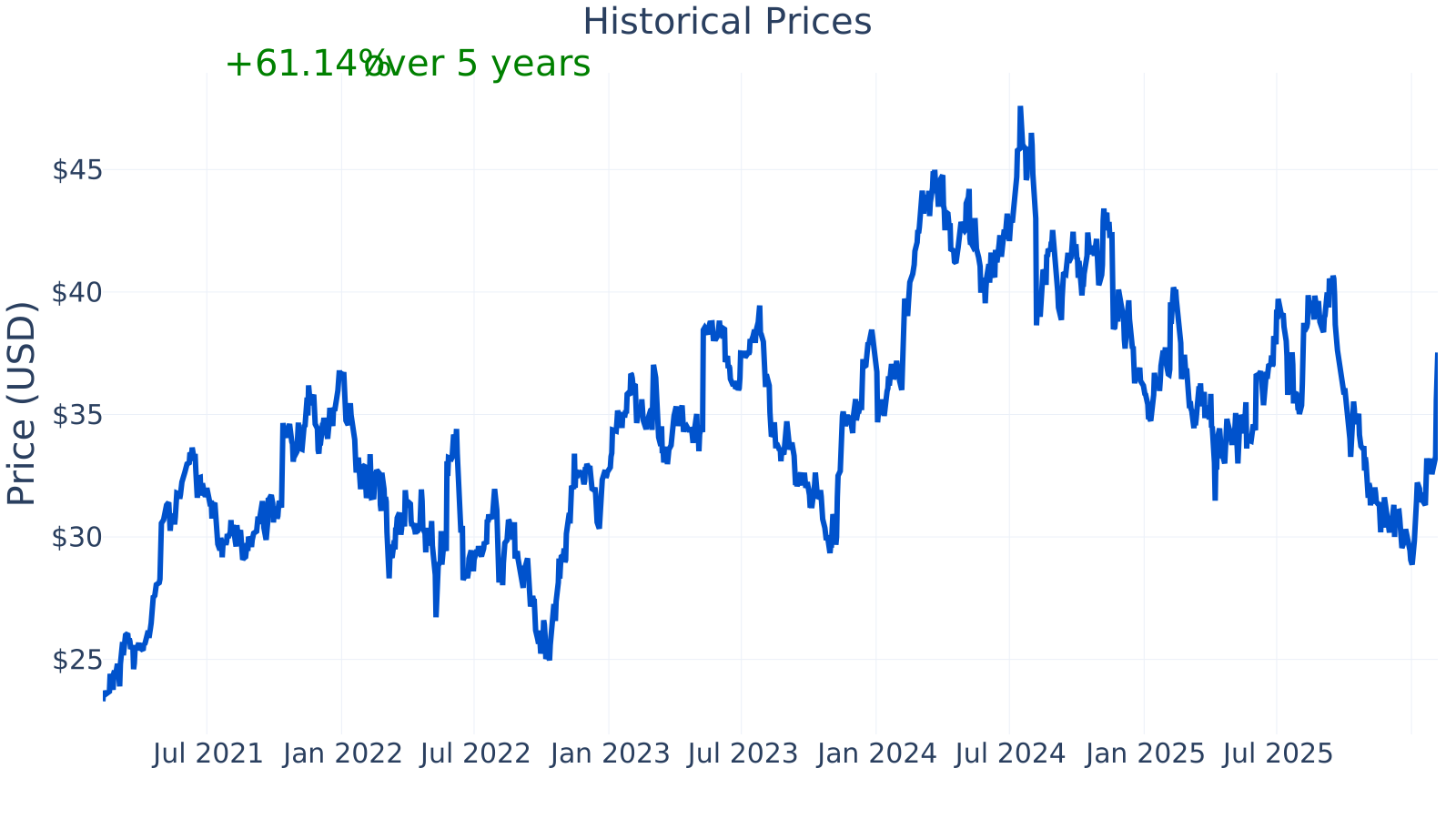
Overview
Valvoline Inc. (VVV) operates a retail automotive services business focused on preventative maintenance. The company is best known for quick, stay-in-your-car oil changes, but its service menu also includes other routine items such as fluid exchanges (transmission, coolant, etc.), batteries, filters, wiper blades, and related maintenance checks. Its model centers on convenience, speed, and standardized service processes, with locations run by the company and by franchisees.
Following the separation of its former product business, Valvoline is primarily a service company today. That means revenue is tied less to oil brand sales on store shelves and more to the number of cars serviced, the mix of services performed, and pricing.
Main revenue sources are typically described in the company’s filings along these lines (exact splits can vary by year and reporting format):
- Service sales at company-operated locations (oil changes and other maintenance services)
- Franchising-related revenue (royalties/fees and other franchise income)
- Other revenue (items ancillary to the core service offering)
Over the years shown, total revenue rises materially (from about $1.04B in fiscal 2021 to about $1.71B in fiscal 2025). At the same time, interest expense remains a noticeable line item (roughly $70–$110M in the periods shown), which highlights the importance of financing costs to the overall profit picture.
Key Figures
| Metric | Value | Industry ⓘ |
|---|---|---|
| Date | Feb 08, 2026 | |
| Context | ||
| Sector | Consumer Cyclical | |
| Industry | Auto & Truck Dealerships | |
| Market Cap ⓘ | $4.78B | |
| Beta ⓘ | 1.20 | |
| Fundamental | ||
| P/E Ratio ⓘ | 54.39 | 16.79 |
| Profit Margin ⓘ | 4.91% | 2.73% |
| Revenue Growth ⓘ | 28.10% | 5.70% |
| Debt to Equity ⓘ | 785.70% | 143.50% |
| PEG ⓘ | 1.10 | |
| Free Cash Flow ⓘ | $57.80M | |
At the latest point shown, Valvoline’s market capitalization is about $4.8B and the stock’s beta is ~1.20, which indicates it has tended to move somewhat more than the broader market. The company’s P/E ratio is ~54.4 versus an industry median near ~16.8, while its profit margin is ~4.9% versus an industry median near ~2.7%. Recent year-over-year revenue growth is ~28.1% compared with an industry median near ~5.7%. A major outlier is leverage: debt-to-equity is ~786% versus an industry median near ~143%. Trailing twelve-month free cash flow is about $58M.
Growth (medium)
Valvoline operates in automotive maintenance, a category supported by a large, long-lived vehicle fleet that requires regular service regardless of new-car sales cycles. Over long periods, demand is often driven by miles driven, the age of vehicles on the road, and consumers choosing maintenance over replacement—factors that can make routine service relatively resilient compared with more discretionary automotive spending.
The company’s strategy focuses on expanding its service network and increasing sales per visit. In practice, that typically means adding new locations (company-operated and/or franchised), improving store-level throughput (more cars served per day), and broadening the service mix beyond basic oil changes into additional preventative services that can raise the average ticket.
Revenue growth is uneven quarter-to-quarter in the historical series, but the most recent value shown is ~11.5% year over year (fiscal 2025), with earlier periods reaching higher rates (including the latest-metrics snapshot showing ~28.1%). For a retail service model, sustaining higher growth typically depends on continued unit expansion and consistent same-store sales progress.
Free cash flow has been volatile over time, including a notably negative period (around -$251M in fiscal 2024 in the series shown) followed by a return to positive territory (around $22.7M in fiscal 2025, and $58M in the latest snapshot). For long-term business durability, readers often track whether cash generation becomes steadier as the store base grows and as capital spending levels normalize.
Risks (high)
A key risk for Valvoline is financial leverage. Higher debt levels can amplify results in good periods but can also reduce flexibility when interest rates rise, when operating performance softens, or when the company needs to fund expansion. This matters because routine service is recurring, but it is not immune to pressure from wage inflation, rent, and promotional competition.
The debt-to-equity ratio is consistently well above the industry median in the periods shown and ends at roughly 786% (vs. an industry median near 154%). Even though debt-to-equity can be affected by accounting equity levels, the magnitude still signals that debt and related servicing costs are central to the company’s financial profile.
Another risk is profitability variability and the role of one-time items. Net profit can swing due to unusual gains/losses, taxes, or other non-operating effects, so it can be useful to look at multiple profit measures over time rather than relying on a single period’s net income.
Profit margin is above the industry median for most periods shown, but it also moves significantly over time and declines to about 4.9% in the most recent point displayed (still above the industry median near 2.35%). For a retail service chain, sustained margins depend on labor productivity, pricing power, and the ability to keep bays busy while controlling costs.
Competitive dynamics are also important. Valvoline competes with other quick-lube chains, independent garages, and dealership service departments. In many local markets, switching costs for customers can be low, so advantages often come from brand recognition, convenient locations, consistent service times, and customer trust. Scale can help through marketing efficiency and standardized training, but competition remains fragmented and local in nature.
Finally, the long-term vehicle transition toward electric vehicles could gradually reduce demand for certain maintenance items (for example, oil changes) over many years. That does not eliminate the need for service overall (tires, brakes, wipers, cabin filters, coolant in some designs, and general inspections remain relevant), but it may require adaptation in the service mix and value proposition over time.
Valuation
The company’s valuation, as represented by the P/E ratio, has varied widely in the historical series and is currently shown at about 54.4 (latest snapshot). In the timeline, Valvoline’s P/E moved from the low-to-mid teens in 2021–2022, to low single digits in parts of 2023–early 2024, and then into much higher levels from mid-2024 onward (mostly in the high teens to 30s range in the chart, ending near ~19.5 in late 2025). The industry median in the chart generally ranges from mid-single digits to the high teens.
In plain terms, a higher P/E typically means the market price implies higher expected future earnings (or temporarily lower current earnings). When the P/E is far above the industry median—as it is in the latest snapshot—readers often focus on whether revenue growth, margin stability, and cash generation are likely to remain strong enough to support that higher valuation, especially given the company’s leverage and interest expense.
Conclusion
Valvoline is a consumer-facing automotive services business built around recurring preventative maintenance, with a convenience-driven model and an expansion strategy that can support growth when execution is consistent. The company’s recent profile shows faster revenue growth and better profit margin than the industry median at the latest point shown, suggesting operational momentum relative to peers.
At the same time, the financial picture includes meaningful leverage (debt-to-equity far above the industry median), interest costs that remain significant, and free cash flow that has been volatile in the periods shown. Valuation indicators also show a higher P/E than the industry median in the latest snapshot, which increases the importance of sustained performance and steady cash generation over time. The overall long-term assessment therefore hinges on how effectively the company balances expansion and service mix improvements with debt management and consistent profitability across economic cycles.
Sources:
- SEC EDGAR — Valvoline Inc. Form 10-K (Annual Report)
- SEC EDGAR — Valvoline Inc. Form 10-Q (Quarterly Report)
- Valvoline Inc. Investor Relations — SEC Filings & Annual Reports (company-hosted)
- Wikipedia — “Valvoline” (company background and history)
This article is for informational purposes only and does not constitute financial advice. Some content is AI-generated. See Disclaimer


