Stock Analysis · Unity Software Inc (U)
Overview
Unity Software Inc. develops software used to create and operate real-time 2D and 3D interactive content. Its best-known product is the Unity engine, a toolset that developers use to build video games and other interactive experiences that can run across many platforms (mobile, PC, consoles, and more). Beyond creating content, Unity also provides services that help developers run, update, and monetize their products after launch.
In its SEC filings, Unity describes two main revenue streams:
- Create Solutions: tools and subscriptions that help teams build interactive content (including the Unity engine and related development products).
- Grow Solutions: products and services tied to operating and monetizing applications (for example, advertising, user acquisition, and other live-operations tools).
Unity’s mix between these two areas has shifted over time, and the company has also been changing parts of its monetization approach and product portfolio. One high-level takeaway from recent years is that Unity has generated meaningful gross profit, but operating expenses (notably research and development) have remained large relative to revenue, contributing to ongoing net losses.
From 2021 to 2024, total revenue increased from about $1.11B (2021) to about $1.81B (2024), while operating losses remained large (operating income stayed negative each year). Research and development has been the biggest operating cost line, which helps explain why net income remained negative even when gross profit was substantial.
Key Figures
| Metric | Value | Industry ⓘ |
|---|---|---|
| Date | Feb 07, 2026 | |
| Context | ||
| Sector | Technology | |
| Industry | Software - Application | |
| Market Cap ⓘ | $10.74B | |
| Beta ⓘ | 2.08 | |
| Fundamental | ||
| P/E Ratio ⓘ | N/A | 27.79 |
| Profit Margin ⓘ | -24.15% | 6.02% |
| Revenue Growth ⓘ | 5.40% | 15.80% |
| Debt to Equity ⓘ | 69.75% | 25.15% |
| PEG ⓘ | N/A | |
| Free Cash Flow ⓘ | $391.00M | |
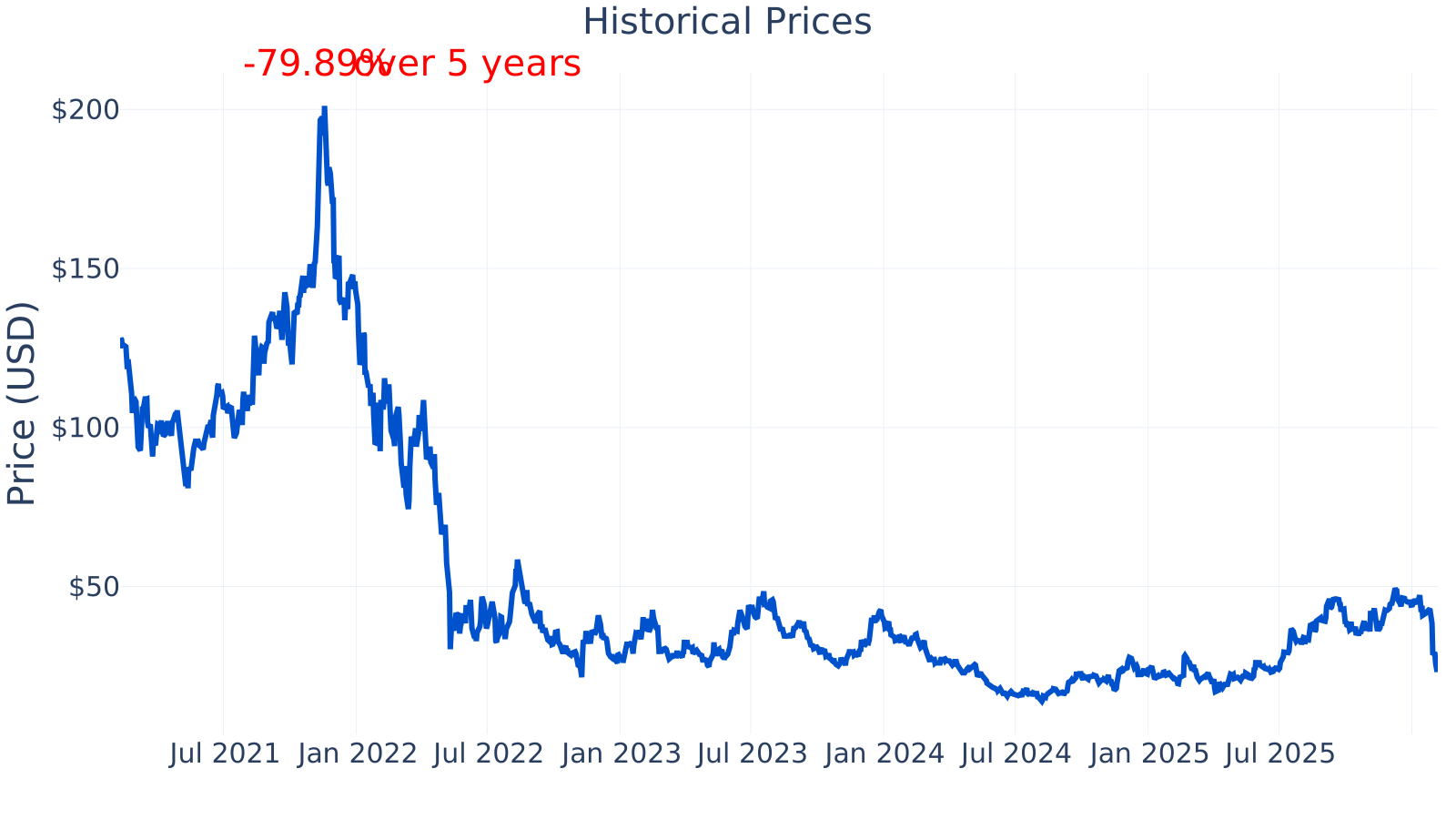
Unity’s market capitalization is about $10.7B. The stock’s beta of ~2.09 suggests it has historically moved more than the broader market, which is consistent with the large price swings visible in the historical price chart. On profitability, Unity’s latest profit margin is about -24%, while the industry median is about +6%, indicating Unity is still materially less profitable than many software peers. Growth has also been more modest recently: latest year-over-year revenue growth is ~5.4% versus an industry median near 15.8%. Leverage is higher than the peer median, with debt-to-equity around 70% compared with an industry median near 25%. A notable positive is free cash flow (TTM) around $391M, meaning the business has recently generated cash after operating needs and capital spending, despite accounting losses.
Growth (Medium)
Unity operates in markets tied to interactive 3D content, gaming, and real-time visualization. These areas can benefit from long-term trends such as more sophisticated mobile/PC/console games, ongoing content updates (“live services”), and broader use of real-time 3D in fields like simulation and visualization. In other words, the end markets Unity serves can expand over time, but Unity’s results will depend on execution, product competitiveness, and how its pricing and platform strategy evolves.
The year-over-year revenue growth pattern has been uneven. After very high growth rates earlier in the timeline, growth turned negative through much of 2024 and then returned to a modest positive level (about +5% most recently). For long-term business momentum, this shift matters because it suggests Unity has been working through a period of slower demand and/or business transition, and it has not yet returned to the higher growth rates seen in earlier years.
Cash generation has improved meaningfully over time, moving from negative free cash flow in 2021 to positive in 2022, dipping again in 2023, and then turning positive in 2024 and improving further into 2025 (about $295M as of 2025-03-31, and $391M in the latest metrics snapshot). This can be an important operational signal because it indicates the company has recently been able to fund operations with internally generated cash, even while reported net income remains negative.
Potential catalysts that can influence Unity’s longer-run trajectory tend to be execution-driven rather than one-time events: sustained adoption of its creation tools, stabilization and improvement in monetization-related offerings, and continued progress on cost discipline (especially given the historically high level of operating expenses).
Risks (High)
Unity’s largest risk is that it has not been consistently profitable. The company has produced significant operating losses across multiple years, and the profit margin remains negative (about -24% recently). For shareholders, this raises the importance of monitoring whether revenue growth re-accelerates and whether operating costs scale more slowly than revenue over time.
The profit margin trend shows improvement from very negative levels earlier in the period (worse than -60% at times) toward approximately -24% recently, but it remains below the industry median (around +6%). This gap highlights that Unity is still in a different profitability profile than many established application software companies.
Another meaningful risk is financial leverage and funding flexibility. While Unity’s debt-to-equity has come down from peak levels, it remains elevated versus typical peers in its industry grouping.
Unity’s debt-to-equity is about 70% recently, versus an industry median near 25%. Higher leverage can reduce flexibility if the business hits another slowdown, because more cash may be needed for interest and other fixed obligations rather than product investment.
Competitive pressure is also significant. Unity’s creation tools compete with other engines and in-house solutions. A commonly cited alternative in the industry is Epic Games’ Unreal Engine (private company), which is strong in high-end visuals and large productions, while many major publishers also build proprietary engines for their own games. In monetization and advertising-related tools, Unity faces a broad and fast-changing competitive set, and performance can be influenced by platform policies and changes in the digital advertising ecosystem.
Finally, Unity’s stock has shown substantial volatility historically (also reflected in its higher beta). For long-term shareholders, this volatility can amplify the impact of execution missteps or macro slowdowns in technology spending and gaming-related activity.
Valuation
A common valuation yardstick is the price-to-earnings (P/E) ratio, but Unity’s P/E is not meaningful in this period because the company has reported losses (which typically results in negative or non-applicable P/E values). By contrast, the industry median P/E shown is in a more typical positive range (around ~28 in the latest table), reflecting that many peers are profitable.
Because earnings-based valuation is not very informative here, valuation discussions for Unity often rely more on operational progress indicators (such as revenue growth trajectory and free cash flow generation) and on how quickly profitability could improve relative to operating expenses. The current context is mixed: free cash flow has recently been positive, but revenue growth has been modest and profit margins remain negative. Those elements together generally imply that the market’s view of value can be sensitive to changes in growth expectations and cost structure.
Conclusion
Unity is a well-known platform for building real-time interactive content, with a broad developer ecosystem and products spanning both creation tools and monetization/operations services. Over the last several years, the company has produced substantial gross profit but has continued to report sizable operating and net losses, largely due to high operating expenses. Recent periods show improved free cash flow and some improvement in profit margin, while revenue growth has been inconsistent and only recently returned to a modest positive rate.
From a long-term ownership perspective, the main facts to track are whether Unity can sustain healthier revenue growth while continuing to narrow losses, and whether leverage and competitive pressures remain manageable. The company’s volatility and still-negative profitability profile make outcomes more dependent on execution than for many mature software businesses.
Sources:
- SEC EDGAR — Unity Software Inc. Forms 10-K and 10-Q (Business description, risk factors, financial statements)
- Unity Software Inc. Investor Relations — Annual Report materials and shareholder communications (as published by the company)
- Wikipedia — “Unity Technologies” (basic company background and history)
This article is for informational purposes only and does not constitute financial advice. Some content is AI-generated. See Disclaimer


