Stock Analysis · Array Digital Infrastructure Inc (AD)
Overview
Array Digital Infrastructure Inc (AD) is listed in the Communication Services sector and categorized in the Telecom Services industry. In practical terms, telecom services businesses typically generate revenue by providing connectivity and related network services (for example, voice, data, broadband, and enterprise connectivity offerings). The company’s long-term profile depends heavily on how durable its customer relationships are, how much it must continuously invest in its network and systems, and how exposed it is to pricing pressure in a competitive market.
Based on the information available here, a detailed revenue breakdown (by product line, customer type, or geography) with exact percentages is not provided. In filings, telecom companies often describe revenue in categories such as consumer services, business services, wholesale/network services, and other items, but the exact split for AD should be taken from its most recent annual report (Form 10‑K) and quarterly filings (Form 10‑Q).
The recent multi-year income flow shows a business where revenue was in the multi‑billion range from 2021–2024, followed by a much smaller revenue base in 2025. Over the same period, operating costs and profit moved significantly, including a year with negative net income (2024) and a large positive net income number in 2025 despite negative operating income—suggesting that non-operating items (items outside core operations) may have materially influenced the bottom line in 2025.
Key Figures
| Metric | Value | Industry ⓘ |
|---|---|---|
| Date | May 04, 2026 | |
| Context | ||
| Sector | Communication Services | |
| Industry | Telecom Services | |
| Market Cap ⓘ | $4.25B | |
| Beta ⓘ | 0.19 | |
| Fundamental | ||
| P/E Ratio ⓘ | 25.36 | 14.31 |
| Profit Margin ⓘ | 29.92% | 7.29% |
| Revenue Growth ⓘ | 131.30% | 4.10% |
| Debt to Equity ⓘ | 66.57% | 105.78% |
| PEG ⓘ | 2.10 | |
| Free Cash Flow ⓘ | $169.64M | |
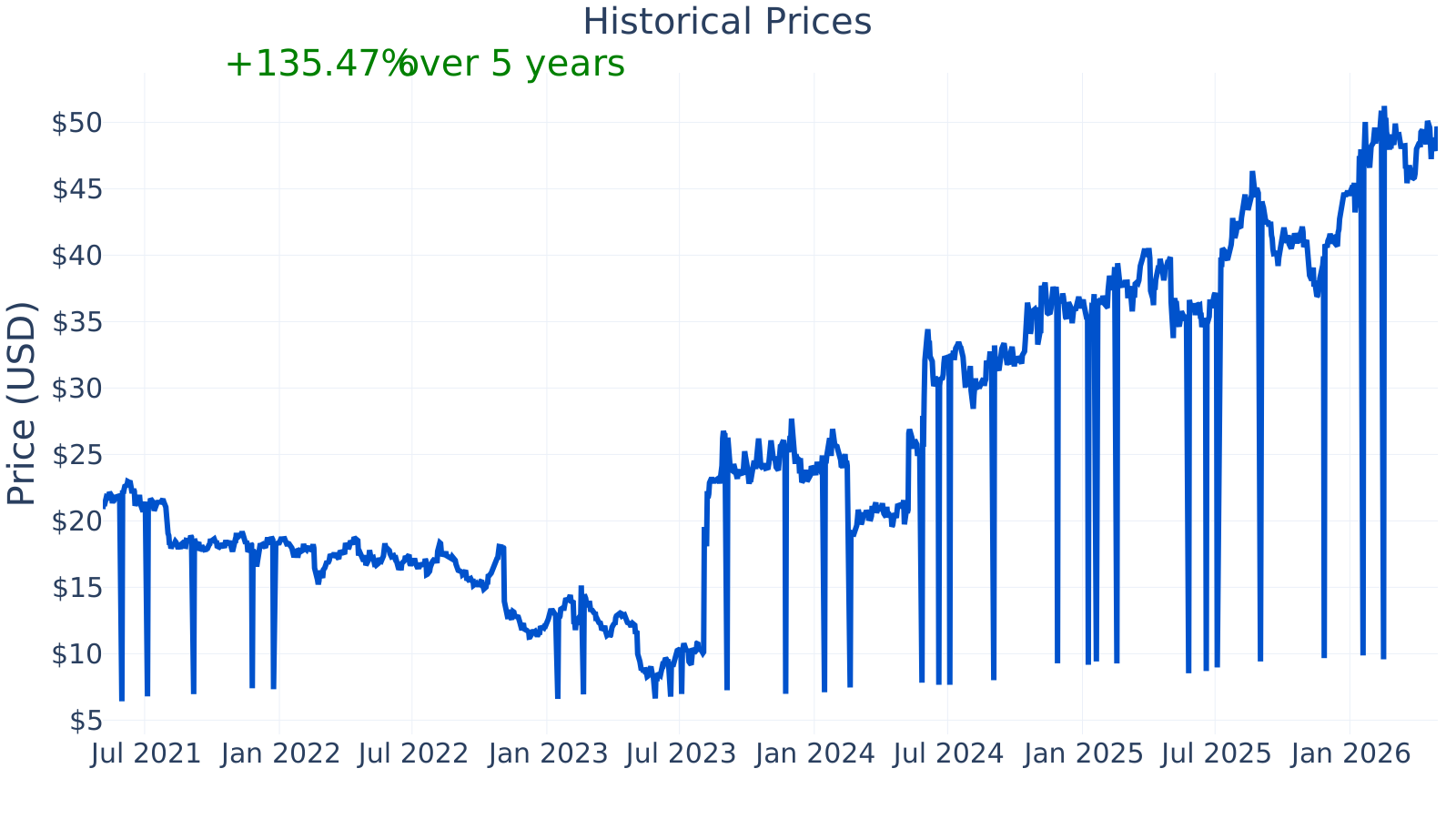
AD’s market capitalization is about $4.25B. The stock’s beta of ~0.19 indicates it has historically moved much less than the overall market (though low beta does not remove business risk). Profitability and growth metrics stand out versus the industry median: the latest profit margin is ~29.9% versus an industry median near 7.3%, while the latest year-over-year revenue growth is shown at ~131% versus an industry median near 4.1%. Balance-sheet leverage appears lower than the peer median with debt-to-equity ~66.6% versus an industry median near 105.8%. The latest P/E ratio is ~25.4 compared with an industry median near 14.3, and the PEG ratio is ~2.10. Free cash flow (trailing twelve months) is shown at about $169.6M.
Growth (medium)
Telecom services is generally a mature industry: demand is steady because connectivity is essential, but growth can be constrained by competition, regulation, and the ongoing cost of maintaining and upgrading networks. That said, certain pockets can grow faster—such as business connectivity, fiber buildouts, and bandwidth needs driven by cloud usage and data-heavy applications—depending on a company’s specific footprint and strategy.
The year-over-year revenue growth line shows a long period of mostly flat-to-negative growth through 2021–2024, followed by an extremely large negative reading in 2025 (around -94% to -95% in the last quarters shown). This pattern points to a major change in the business scale or reporting base during 2025 rather than normal telecom “organic” growth. When revenue changes are that large, a long-term reader typically needs to confirm in filings what drove the shift (for example, divestitures, discontinued operations, a restructuring, or a change in consolidation/reporting).
Free cash flow (cash left after operating needs and capital spending) has been volatile over the periods shown: positive around $248M (2022), negative around -$86M (2023), then strongly positive around $483M (2024) and $353M (2025). For telecom-style businesses, sustained free cash flow matters because networks and customer acquisition can be capital-intensive. The variability here increases the importance of understanding what is recurring versus one-time.
Potential catalysts in telecom businesses often include network expansion milestones, improved pricing discipline, refinancing that reduces interest costs, large enterprise contract wins, or strategic transactions. For AD specifically, the sharp changes visible in revenue and profit suggest that corporate actions or accounting classification changes could be the real drivers—something that can only be clarified by reading the company’s most recent Form 10‑K/10‑Q and any related Form 8‑K filings.
Risks (high)
A primary risk signal is the large discontinuity between 2021–2024 financial scale and 2025 figures shown in the income flow, alongside extreme revenue growth readings in 2025. Sudden shifts can reflect strategic repositioning, but they can also make it harder to compare performance over time and to judge “normalized” earnings power.
Debt-to-equity trends are generally below the industry median across the timeline shown, ending around 66.6% at the latest point (versus an industry median near 113.9%). Lower leverage can reduce financial strain, but telecom companies can still face meaningful fixed obligations (network leases, spectrum-related commitments where applicable, long-term contracts, and ongoing capital spending). Also, the step-down visible around late 2025 (with a later move back up) suggests the capital structure may have changed during that period.
Profit margin has been unstable: mostly low single digits (and negative in parts of 2023–2025), then turning sharply higher in late 2025 (about 9.0% in 2025‑09‑30 and 15.2% in 2025‑12‑31), above the industry median shown for those dates. Because margins in telecom can be affected by depreciation, financing costs, and one-time items, the late-2025 improvement is meaningful but should be verified for sustainability using management discussion in filings.
Competitive positioning in telecom services typically depends on network reach/quality, customer service, bundling, and pricing. Competitive advantages can come from local scale, owned infrastructure, or long-term enterprise relationships, but many telecom offerings are difficult to differentiate. Without a confirmed revenue breakdown and market footprint from filings, it is not possible here to classify AD as a category leader. In general, competitors for telecom services companies include other regional or national telecom operators and connectivity providers; competitive pressure often shows up as slower growth, higher churn, or reduced margins.
Valuation
The P/E chart shows AD’s valuation multiple moving widely over time, with some periods not displayed (set to zero on the chart when not meaningful). At the latest point shown, AD’s P/E is about 13.8, slightly above the industry median near 12.0. However, the latest metrics table lists a current P/E around 25.4 versus an industry median around 14.3, indicating the valuation picture can change materially depending on timing and the earnings used in the calculation.
In general, a higher-than-industry P/E can be consistent with expectations of higher future earnings quality, better growth, or lower risk. In AD’s case, the valuation needs to be interpreted alongside (1) the high volatility in revenue and margin trends shown, (2) the presence of positive trailing free cash flow but with meaningful swings year to year, and (3) the possibility that non-recurring items impacted profitability in 2025 (as suggested by positive net income alongside negative operating income in the income flow).
The PEG ratio shown (~2.10) is a reminder that valuation depends not just on today’s earnings, but on the growth rate assumed going forward. When the recent revenue history includes extreme changes, growth assumptions become more uncertain, which makes any single-number valuation shortcut less reliable until the underlying business trajectory is clearer in filings.
Conclusion
Array Digital Infrastructure Inc sits in telecom services, an industry that is typically steady but competitive and capital-intensive. The most notable feature in the information shown is the break in financial continuity around 2025: revenue and profitability signals change sharply, and the income flow suggests that items outside core operations may have influenced net income. At the same time, the company shows lower leverage than the industry median in the debt-to-equity trend and has produced positive trailing free cash flow, although with sizable volatility.
For a long-term, fundamentals-focused read, the key factual follow-up is to confirm in AD’s most recent SEC filings what changed in 2025 (business mix, divestitures/discontinued operations, accounting presentation, or other major corporate actions) and whether the more recent margin improvement is operationally durable. Without that context, the company can look strong on certain headline metrics while still carrying elevated uncertainty about the underlying earnings and revenue base.
Sources:
- U.S. SEC EDGAR — Company filings (Form 10‑K, 10‑Q, 8‑K) for Array Digital Infrastructure Inc
- Array Digital Infrastructure Inc — Investor Relations materials and SEC filing copies (company-hosted)
- Wikipedia — “Array Digital Infrastructure Inc” (basic company background, if available)
This article is for informational purposes only and does not constitute financial advice. Some content is AI-generated. See Disclaimer


