Stock Analysis · Ultra Clean Holdings Inc (UCTT)
Overview
Ultra Clean Holdings, Inc. (UCTT) provides critical subsystems, components, and ultra-high purity services used to build and run semiconductor manufacturing equipment. In simple terms, it helps the companies that make chipmaking tools by supplying complex assemblies (including fluid delivery and gas systems) and precision cleaning/processing services that are needed for advanced semiconductor production.
The company’s business is closely tied to semiconductor capital spending: when chipmakers and equipment makers expand capacity or upgrade to new technology nodes, demand for UCTT’s subsystems and services typically rises; when the industry slows, orders can decline.
Based on company reporting, revenue is primarily generated from two broad buckets (exact percentages can vary by year and customer demand):
- Products / Subsystems: engineered modules and assemblies used inside semiconductor manufacturing equipment.
- Services: precision cleaning, coating, and other contamination-control services supporting semiconductor manufacturing operations.
Over recent years, total revenue has moved with the semiconductor cycle (rising into 2022, falling in 2023, recovering in 2024, and softening again in 2025). Profitability has also been volatile: operating income turned negative in 2025, indicating that costs and pricing/mix pressures outweighed gross profit that year.
Key Figures
| Metric | Value | Industry ⓘ |
|---|---|---|
| Date | May 04, 2026 | |
| Context | ||
| Sector | Technology | |
| Industry | Semiconductor Equipment & Materials | |
| Market Cap ⓘ | $3.34B | |
| Beta ⓘ | 1.81 | |
| Fundamental | ||
| P/E Ratio ⓘ | N/A | 48.78 |
| Profit Margin ⓘ | -9.38% | 8.18% |
| Revenue Growth ⓘ | 2.90% | 11.50% |
| Debt to Equity ⓘ | 124.29% | 26.74% |
| PEG ⓘ | 0.90 | |
| Free Cash Flow ⓘ | -$44.00M | |
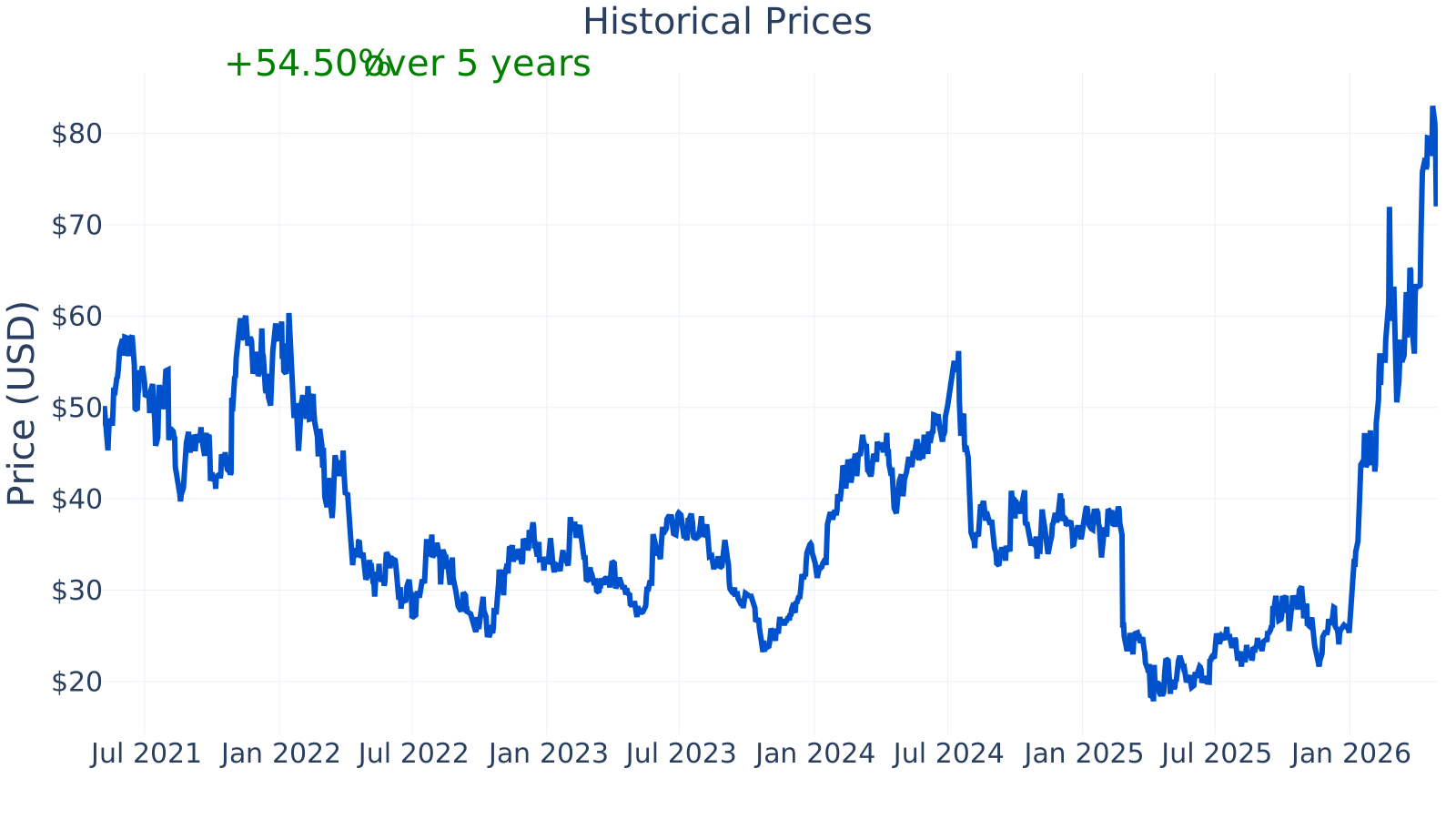
Ultra Clean has a market capitalization of about $3.34B and a relatively high beta of 1.81, which means the stock has tended to move more than the overall market. Profitability is currently weak: the latest profit margin is about -9.38% versus an industry median near +8.18%. Growth is also currently modest: latest year-over-year revenue growth is about +2.9%, below the industry median of roughly +11.5%. Leverage is elevated: debt-to-equity is about 124%, well above the industry median near 27%. Free cash flow over the trailing twelve months is -$44M, which can matter because it indicates the business did not generate excess cash after operating needs and capital spending over that period.
Growth (Medium)
UCTT operates in the semiconductor equipment and materials ecosystem, which is supported by long-term drivers such as increasing chip content in everyday products, AI and data center buildouts, and continued process complexity in leading-edge manufacturing. However, the path is rarely smooth: semiconductor equipment demand tends to be cyclical, reacting to changes in end-market demand and customer inventory/capacity decisions.
Revenue growth has shown pronounced swings over the cycle: strong positive growth in 2021 and early 2022, a deep downturn through 2023, a rebound across much of 2024, and then a more mixed pattern into late 2025 and early 2026 (with the latest reading returning to low single-digit growth). For long-term context, this pattern is typical of “picks-and-shovels” suppliers tied to semiconductor capital expenditures.
Cash generation has also been inconsistent. Free cash flow improved significantly in 2023, stayed positive (though lower) through 2024 and 2025, and then turned negative most recently (about -$44M TTM). For a manufacturing and services business, sustained negative free cash flow can limit flexibility (for example, to invest, reduce debt, or withstand downturns) unless it is temporary and followed by a clear recovery.
Potential catalysts that can influence UCTT’s results typically include: (1) a renewed upcycle in wafer fab equipment spending, (2) recovery in customer utilization rates that lifts services demand, and (3) internal execution such as improving cost structure, yields, and product/service mix. Because UCTT is a supplier within a larger value chain, changes in a small number of major customers’ order patterns can have an outsized effect.
Risks (High)
The main risk is cyclicality. When semiconductor equipment orders slow, subsystem demand can decline quickly, and manufacturing overhead can pressure margins. This is visible in recent profitability weakness, with net income turning negative in 2025 after profitability in 2024.
Financial leverage is another notable risk factor. Debt-to-equity has trended upward over time and most recently stands around 124%, compared with an industry median near 27%. Higher leverage can amplify outcomes: it may help in strong periods, but it can also increase interest burden and reduce flexibility during downturns.
Margins have deteriorated materially versus peers. The company’s profit margin moved from low-single-digit positives earlier in the period to persistent negatives more recently, while the industry median remained positive. If this gap persists, it can indicate challenges such as pricing pressure, unfavorable product mix, under-absorption of fixed costs in weaker demand environments, or higher operating costs.
Competition is meaningful because many subsystem and contract manufacturing/service providers compete on quality, reliability, cost, and the ability to scale. UCTT’s competitive positioning generally depends on deep integration with customers’ tool platforms, high-purity/contamination-control know-how, operational execution, and long-standing relationships. Even so, it is not the sole provider in these categories, and switching can occur over time—especially if competitors offer lower cost, better lead times, or improved performance.
Additional risks to monitor include customer concentration (common in semiconductor supply chains), supply chain constraints, quality issues that can lead to rework/warranty costs, and geopolitical/trade restrictions that can affect where semiconductor equipment and components can be sold and sourced.
Valuation
Price-to-earnings (P/E) ratios for UCTT have been highly volatile, including periods where the P/E is not meaningful due to very low or negative earnings (those periods are omitted in the chart). In other periods, the company’s P/E has swung from modest levels (teens to 20s earlier in the timeline) to much higher readings during earnings compression, while the industry median has also moved but generally remained in a more stable band.
Because the most recent profitability and free cash flow are weak (negative margin and negative trailing free cash flow), any valuation approach relying heavily on current earnings can be less informative. In practice, investors often look at normalized (mid-cycle) profitability, balance sheet strength, and evidence of margin recovery when comparing valuation to peers in cyclical industries. The current context—elevated leverage relative to the industry and weaker margins—raises the importance of assessing whether profitability can normalize during an upcycle and whether cash generation improves enough to support the balance sheet.
Conclusion
Ultra Clean Holdings operates in a strategically important part of the semiconductor manufacturing ecosystem, where long-term demand drivers exist but results can fluctuate sharply with the industry cycle. Recent history shows meaningful volatility in revenue growth and a notable deterioration in profitability, alongside leverage that is higher than the industry median and trailing free cash flow that has turned negative.
From a long-term perspective, the central questions are whether the company can (1) restore more consistent margins through improved utilization, pricing/mix, and cost control, (2) return to sustained positive free cash flow, and (3) manage leverage through the cycle. The answers to those points—visible in future filings through margin trends, cash generation, and balance sheet movement—are key for evaluating how durable the business model is across semiconductor upturns and downturns.
Sources:
- SEC EDGAR — Ultra Clean Holdings, Inc. Forms 10-K, 10-Q, and 8-K (various filings)
- Ultra Clean Holdings, Inc. — Investor Relations materials and press releases (company website)
- Wikipedia — “Ultra Clean Holdings” (general company background)
This article is for informational purposes only and does not constitute financial advice. Some content is AI-generated. See Disclaimer


