Stock Analysis · Ultra Clean Holdings Inc (UCTT)
Overview
Ultra Clean Holdings Inc (UCTT) provides critical parts, tools, and services used to build and run semiconductor manufacturing equipment. In simple terms, it helps the companies that make chipmaking machines keep those machines operating reliably and at high quality. Ultra Clean’s offerings include subsystems (integrated assemblies that go into larger equipment), high-precision components, and cleaning/conditioning services that remove contamination from parts used in the chipmaking process.
Its revenue is closely tied to semiconductor equipment spending and factory activity, because its customers are typically equipment makers and chip manufacturers that buy more when the industry is expanding and reduce spending when demand weakens.
Main revenue sources are commonly described in company filings by business lines rather than consumer-style products. Based on how the company describes its business in SEC filings, key sources include:
- Products (subsystems and components for semiconductor equipment) — typically the largest contributor
- Services (cleaning, coating/conditioning, and related support that keeps parts within required specifications)
Public filings may break revenue down by customer, geography, or end-market depending on the period; exact percentages can vary over time.
From 2021 to 2024, total revenue moved from about $2.10B (2021) to $2.38B (2022), fell to $1.73B (2023), and then returned to about $2.10B (2024). Over the same period, profitability swung materially: net income was about $119.5M (2021), $40.4M (2022), a loss of about $31.1M (2023), and then back to a profit of about $23.7M (2024). This pattern is consistent with a business that is sensitive to semiconductor industry cycles, where volumes and pricing can change faster than the cost structure.
Key Figures
| Metric | Value | Industry ⓘ |
|---|---|---|
| Date | Feb 08, 2026 | |
| Context | ||
| Sector | Technology | |
| Industry | Semiconductor Equipment & Materials | |
| Market Cap ⓘ | $2.19B | |
| Beta ⓘ | 2.00 | |
| Fundamental | ||
| P/E Ratio ⓘ | N/A | 47.44 |
| Profit Margin ⓘ | -7.66% | 9.40% |
| Revenue Growth ⓘ | -5.60% | 9.90% |
| Debt to Equity ⓘ | 91.58% | 20.73% |
| PEG ⓘ | 1.01 | |
| Free Cash Flow ⓘ | $17.10M | |
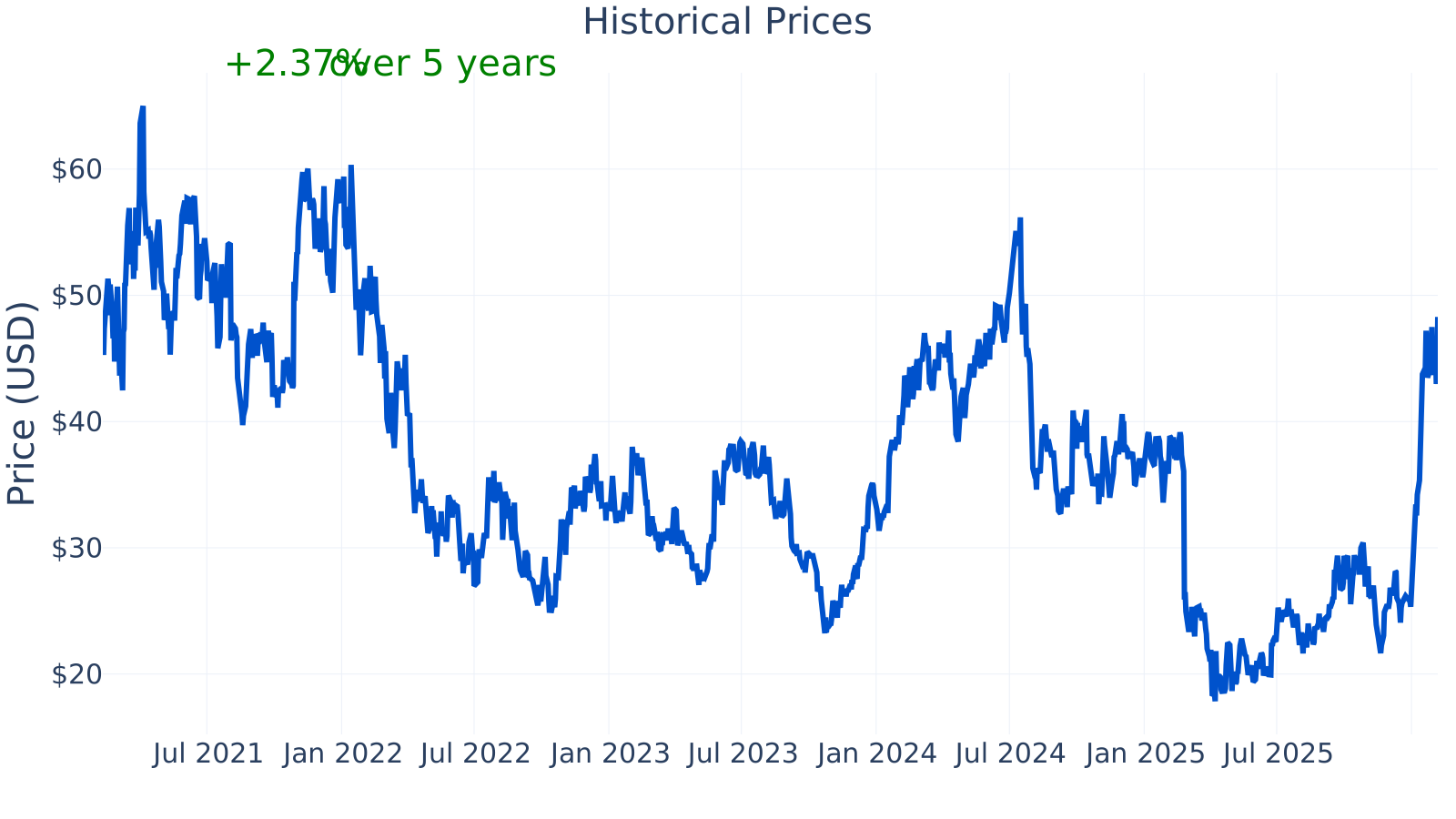
Ultra Clean’s market capitalization is about $2.19B, placing it in the small-to-mid cap range. The stock’s beta of ~2.0 indicates it has historically moved about twice as much as the broader market on average, which can matter for long-term holders who prefer smoother returns.
The latest profitability and growth snapshot is weaker than the industry median: profit margin is about -7.7% versus an industry median near 9.4%, and year-over-year revenue growth is about -5.6% versus an industry median near 9.9%. Leverage is also higher: debt-to-equity is ~91.6% compared with an industry median near 20.7%. Free cash flow over the trailing twelve months is about $17.1M, which is positive but relatively modest for a company with multi-billion-dollar annual revenue.
Growth (Medium)
Ultra Clean operates in the semiconductor equipment and materials ecosystem, which is supported over the long run by broad drivers such as increasing chip content in electronics, ongoing technology transitions in manufacturing, and continued investment in fabrication capacity. However, this part of the chip supply chain is also known for pronounced ups and downs, because customers tend to adjust capital spending quickly when end-demand changes.
Strategically, Ultra Clean’s mix of product shipments (tied to new equipment builds and upgrades) and services (tied more to installed base and utilization) can provide a more balanced model than a pure “new equipment” supplier. In theory, service activity can help during softer periods, although it may not fully offset downturns if factory utilization falls or customers reduce maintenance intensity.
The revenue growth trend illustrates this cyclicality: growth was very strong in 2021 (roughly 30% to 66% year-over-year across quarters), turned negative through much of 2022–2023 (reaching about -31% at the trough), then rebounded in 2024 (roughly 10% to 27%), and most recently softened again to around -5.6%. For long-term analysis, this pattern emphasizes that “one-year” growth rates can be misleading without viewing the broader cycle.
Free cash flow has also varied significantly over time: about $111.0M (TTM as of 2021-03-31), around -$2.6M (2022-03-31), about $115.3M (2023-03-31), about $50.9M (2024-03-31), and about $25.5M (2025-03-31). This volatility matters because free cash flow is what ultimately supports debt repayment, reinvestment, and financial flexibility through the cycle.
Potential catalysts generally relate to an upswing in semiconductor capital spending, improving factory utilization (which can lift service demand), and execution that improves margins when volumes rise. That said, catalysts are industry- and customer-driven and can be difficult to time.
Risks (High)
This article is for informational purposes only and does not constitute financial advice. Some content is AI-generated. See Disclaimer


