Stock Analysis · Ulta Beauty Inc (ULTA)
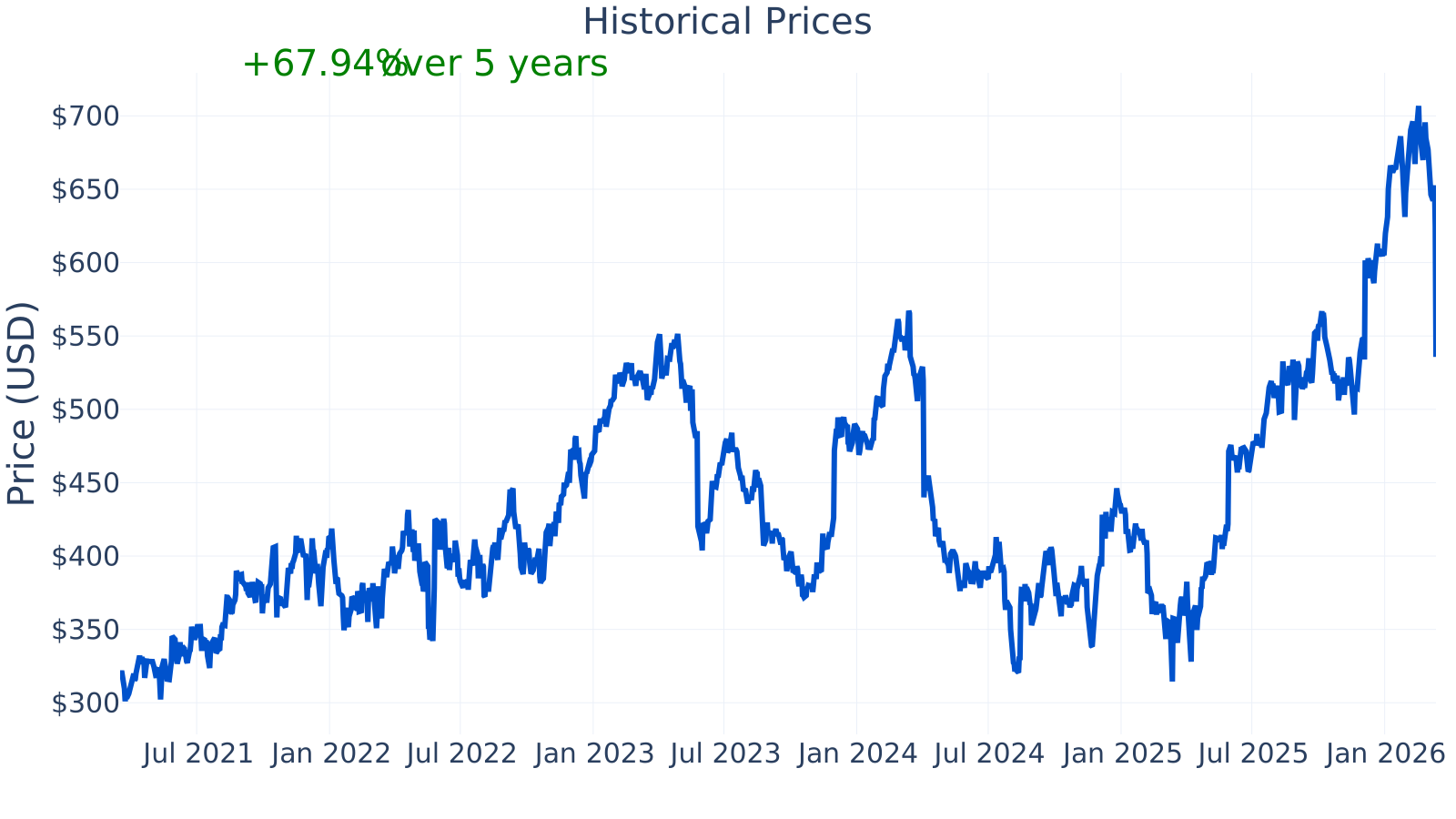
Overview
Ulta Beauty, Inc. is a U.S. specialty retailer focused on beauty products and related services. It sells cosmetics, fragrance, skin care, hair care, and bath/body products through a large chain of stores and through its e-commerce channel. Many stores also include in-store salon services, which adds a service component to a primarily product-driven retail model. The company also runs a large loyalty program, which management highlights as a key part of how it engages customers and drives repeat purchasing.
In its SEC filings, Ulta generally describes its revenue as coming mainly from product sales, with a smaller portion from salon services. The company’s product assortment is typically grouped into broad categories such as cosmetics, fragrance, skin care, and hair care (with services presented separately).
Main sources of revenue (largest to smallest, as described in filings):
- Product sales (the large majority of revenue)
- Salon services (a smaller share of revenue)
Across recent fiscal years, total revenue increased meaningfully (about $8.6B in FY2022 to about $12.4B in FY2026). Over the same period, gross profit also rose (about $3.4B to about $4.8B). Operating expenses increased as well, which is typical for a retailer expanding stores, staffing, fulfillment, and marketing, but the business continued to generate substantial net income in each year shown.
Key Figures
| Metric | Value | Industry ⓘ |
|---|---|---|
| Date | Mar 16, 2026 | |
| Context | ||
| Sector | Consumer Cyclical | |
| Industry | Specialty Retail | |
| Market Cap ⓘ | $24.02B | |
| Beta ⓘ | 0.85 | |
| Fundamental | ||
| P/E Ratio ⓘ | 20.57 | 20.21 |
| Profit Margin ⓘ | 9.31% | 4.93% |
| Revenue Growth ⓘ | 11.80% | 4.60% |
| Debt to Equity ⓘ | 77.83% | 103.28% |
| PEG ⓘ | 2.27 | |
| Free Cash Flow ⓘ | $985.55M | |
Ulta Beauty’s market capitalization is about $24.0B. The stock’s beta of ~0.85 suggests it has historically moved somewhat less than the overall market on average (though this can change over time). On profitability, the latest profit margin is ~9.3% versus an industry median near 4.9%, indicating stronger net profitability than the typical peer in its specialty retail group. Growth has been higher than the peer median as well, with ~11.8% year-over-year revenue growth versus an industry median around 4.6%. Leverage appears lower than the peer median: debt-to-equity ~77.8% versus an industry median near 103.3%. Ulta also shows sizable cash generation, with ~$986M in trailing twelve-month free cash flow.
Growth (Medium)
Ulta operates in the beauty and personal care retail segment, which is often supported by recurring consumer demand (many purchases repeat regularly) and ongoing product innovation and brand launches. However, it is still a discretionary retail category in important ways: customer demand can shift with consumer confidence, inflation, and competitive promotions.
Strategically, Ulta’s model is built around offering a wide selection across price points (including prestige brands and mass brands) and combining product retail with in-store services. This “one-stop” approach can support repeat visits and larger baskets, while a scaled loyalty program can help personalize marketing and improve retention. Over the long term, store expansion, e-commerce growth, and ongoing brand partnerships are typical levers for growth in this business model.
The company’s year-over-year revenue growth has fluctuated meaningfully over time. It was very elevated in 2021 (partly reflecting recovery dynamics after the pandemic period), then moderated, briefly dipped negative in early 2025, and later re-accelerated to about 11.8% most recently. This pattern suggests growth is not linear and can be sensitive to comparisons, demand trends, and execution.
Free cash flow has remained substantial over the period shown, ranging from roughly $887M to $1.17B and most recently around $986M. For a retailer, sustained free cash flow is often a key indicator of operational strength because it reflects the ability to fund inventory, stores, technology investments, and other needs while still generating cash beyond those requirements.
Risks (Medium)
Ulta’s results depend on consumer spending patterns, and beauty retail can become highly promotional when competitors push discounts or when shoppers trade down to lower-priced items. Changes in product mix (for example, more lower-margin categories) or higher shrink (inventory loss) can pressure profitability. Retail execution risks also matter: inventory planning, supply chain reliability, and in-store labor availability can influence sales and customer experience.
Competition is a central risk. Ulta competes with other specialty beauty retailers, department stores, mass retailers, and online-focused sellers. Key competitors often cited by investors in the category include Sephora (including Sephora’s in-store partnership presence), as well as beauty offerings from large retailers and e-commerce platforms. Competitive intensity can show up through pricing, exclusive brand relationships, speed of new product launches, and convenience (store locations and shipping).
Ulta’s competitive positioning is often associated with (1) breadth across prestige and mass products in one chain, (2) an integrated store + digital model, and (3) a scaled loyalty program. These features can function as advantages, but they are not permanent protections: brand access, customer preferences, and the shopping experience can shift, and competitors can replicate parts of the model over time.
The debt-to-equity ratio has generally trended downward from levels around ~100% earlier in the period toward about 77.8% most recently, which is also below the peer median near 95.2%. In simple terms, this points to a balance sheet that, relative to many peers, relies somewhat less on debt versus shareholder equity—though retail lease obligations and other fixed commitments can still make cost structure important in weaker demand environments.
Net profit margin has declined from peaks around ~12% in 2022–2023 to about 9.3% most recently, but it remains above the peer median (around 4.9%). This combination—margin compression but still above-peer profitability—can be important to monitor, because sustained competitive pressure or rising costs could further reduce profitability over time.
Valuation
One common way to describe valuation is the price-to-earnings (P/E) ratio. Ulta’s latest P/E is about 20.6, close to the specialty retail peer median near 20.2. Historically, Ulta’s P/E in the period shown moved from much higher levels (including a very elevated point in 2021) down into the mid-teens at times in 2024–2025, and then back above 20 more recently.
Interpreting this in context: a P/E near the industry median suggests the market is valuing Ulta roughly in line with its peer group on this simple measure. Whether that is “high” or “low” depends on factors discussed earlier—especially the sustainability of growth and the direction of margins. The company’s PEG ratio (~2.27) is a reminder that, if earnings growth slows, the same P/E can represent a more demanding valuation; if growth improves, the valuation can look more easily supported. Valuation is also influenced by business quality indicators such as cash generation (close to $1.0B trailing free cash flow) and balance sheet leverage (debt-to-equity below the peer median).
Conclusion
Ulta Beauty is a large, scaled beauty retailer with a business model combining stores, e-commerce, and salon services, supported by a major loyalty program. Financially, it has produced meaningful revenue expansion over the last several years and continued to generate substantial free cash flow.
The main long-term discussion points for the company are the durability of demand in beauty retail, the ability to protect margins in a competitive environment, and the effectiveness of execution (merchandising, inventory, customer experience, and digital capabilities). Recent metrics show profitability remains above the peer median even after some margin compression, while leverage appears lower than the peer median.
On valuation, Ulta’s P/E is currently close to the industry median, which indicates the market is not assigning an unusually large premium or discount versus peers based on this measure alone. The overall picture depends heavily on whether Ulta can sustain revenue growth and stabilize profitability in the face of competition and shifting consumer behavior.
Sources:
- U.S. Securities and Exchange Commission (SEC) EDGAR — Ulta Beauty, Inc. Form 10-K (Annual Report)
- Ulta Beauty, Inc. Investor Relations — SEC Filings (10-K, 10-Q, 8-K)
- Ulta Beauty, Inc. Investor Relations — Earnings materials and press releases (company-hosted)
- Wikipedia — “Ulta Beauty” (basic company background)
This article is for informational purposes only and does not constitute financial advice. Some content is AI-generated. See Disclaimer


