Stock Analysis · Uipath Inc (PATH)
Overview
UiPath Inc. is a software company focused on automation. In simple terms, it builds tools that help organizations reduce repetitive digital work—such as moving data between systems, generating reports, processing forms, or coordinating steps across multiple applications. The company’s platform is commonly associated with “robotic process automation” (RPA), and it has expanded toward broader enterprise automation that can include workflow coordination and AI-assisted capabilities.
UiPath primarily makes money by selling software subscriptions and related services to organizations (rather than selling to consumers). Based on how the company describes its business in its SEC filings, revenue is generally grouped into these major buckets:
- Subscription revenue (typically the largest): recurring fees for access to UiPath software and cloud services.
- Professional services and other revenue: implementation, training, and support-related services.
The company’s recent income statement trend shows rising revenue over time, and a shift from operating losses to operating profit in the most recent fiscal year shown, suggesting improved cost discipline as the business scales.
From fiscal year 2022 to fiscal year 2026 (as shown), total revenue increased from about $0.89B to about $1.61B. Over the same period, gross profit rose as well (about $0.72B to about $1.34B), while operating income moved from negative to positive in fiscal year 2026, indicating that operating expenses grew more slowly than gross profit most recently.
Key Figures
| Metric | Value | Industry ⓘ |
|---|---|---|
| Date | Mar 16, 2026 | |
| Context | ||
| Sector | Technology | |
| Industry | Software - Infrastructure | |
| Market Cap ⓘ | $6.19B | |
| Beta ⓘ | 1.09 | |
| Fundamental | ||
| P/E Ratio ⓘ | 27.57 | 27.17 |
| Profit Margin ⓘ | 17.53% | 7.12% |
| Revenue Growth ⓘ | 13.60% | 15.80% |
| Debt to Equity ⓘ | 3.41% | 24.92% |
| PEG ⓘ | 0.41 | |
| Free Cash Flow ⓘ | $352.16M | |
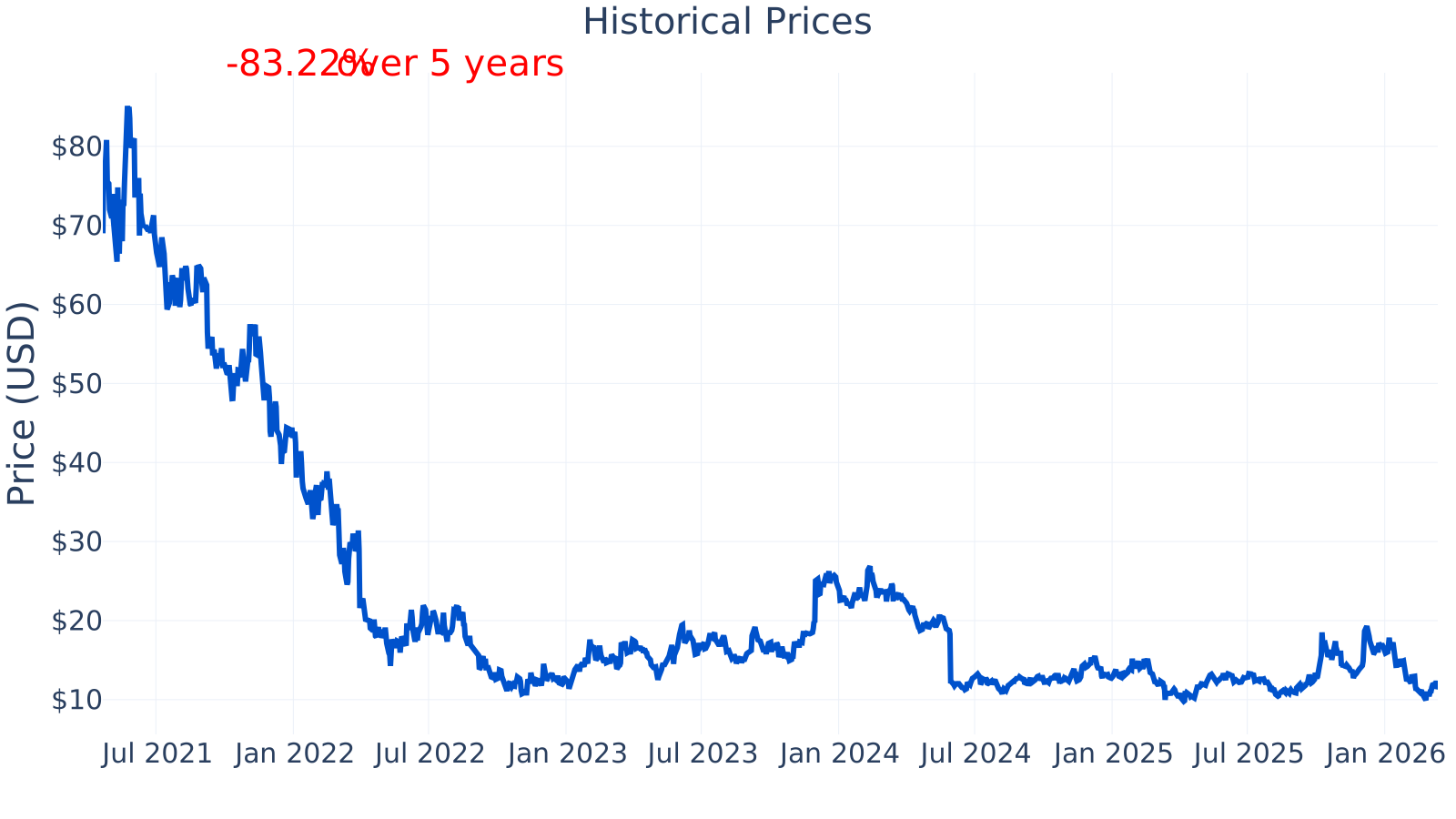
UiPath’s market capitalization is about $6.2B. The stock’s beta of ~1.09 indicates price movements that have been somewhat close to the broader market on average (though the historical price line also shows meaningful swings over time).
On profitability, the latest profit margin is ~17.5%, which is higher than the industry median (~7.1%) shown in the table. On growth, the latest year-over-year revenue growth is ~13.6%, slightly below the industry median (~15.8%) in the table.
Balance-sheet leverage appears low: debt-to-equity is ~3.4% versus an industry median ~24.9%. Free cash flow (trailing twelve months) is about $352M, which indicates the business has recently been generating cash after operating costs and capital expenditures.
Growth (Medium)
Automation software is generally tied to long-term drivers that many organizations care about: improving productivity, reducing operational errors, standardizing processes, and integrating work across many different IT systems. In that context, UiPath operates in a part of enterprise software that tends to benefit when companies prioritize efficiency and modernize internal processes.
Strategically, UiPath’s growth thesis typically depends on expanding usage within existing customers (more departments and processes automated) and continuing to add new customers. Because a significant portion of revenue is subscription-based, longer-term growth is often linked to renewals and expansion within the installed base, along with product relevance as customer needs evolve.
The year-over-year revenue growth rate has fluctuated over time. It was much higher earlier in the period shown (for example, above 30% in parts of 2022 and early 2024), and later settled into the low-to-mid teens, reaching about 13.6% most recently. For long-term business building, this pattern can matter because it suggests UiPath is operating in a more mature phase than the earliest high-growth period, and future upside may rely more on product expansion, competitive execution, and larger enterprise rollouts than on rapid category adoption alone.
Free cash flow improved materially across the period shown: from negative levels in 2021–2023 to positive and rising levels in 2024–2026 (about $292M to $352M). For a software company, sustained positive free cash flow can provide flexibility to invest in research and development, sales capacity, and potential acquisitions without needing significant external financing.
Risks (Medium to High)
A major risk for UiPath is competitive pressure in enterprise software. Automation is a valuable capability, and multiple large software vendors and specialized providers offer overlapping features (workflow tools, integrations, low-code automation, and AI-assisted process tools). Competitive environments can lead to pricing pressure, higher sales and marketing costs, and slower customer expansion if alternatives become “good enough” inside a broader software suite.
Another key risk is execution. UiPath must continue converting product value into durable renewals and expansions while keeping operating costs under control. The company has shown improving profitability over time (including a more recent positive profit margin), but the history of losses in prior periods highlights that profitability can change with investment levels, demand cycles, and product transitions.
Financial leverage appears relatively low. Debt-to-equity is about 3.4% most recently, and it has remained far below the industry median across the time period shown. Low leverage can reduce financial risk, though it does not remove business risks such as demand changes or competitive disruption.
Profitability has improved significantly across the period shown, moving from deeply negative margins in 2021–2023 to a positive margin recently (about 17.5%). The industry median shown is also positive, and UiPath’s latest margin is above that median. Even so, investors typically track whether such margins are sustainable, especially in software markets where competitive intensity can influence long-term pricing and customer acquisition costs.
Competitive positioning is also a risk factor to monitor because “automation” is not a single-product market; it is a set of capabilities that can be embedded into many platforms. Commonly discussed competitors in automation and adjacent categories include large platform vendors (for example, Microsoft) and other automation-focused providers (for example, Automation Anywhere and Blue Prism/SS&C). How UiPath compares can vary by customer needs (ease of deployment, governance, breadth of integrations, security, and total cost). UiPath is widely recognized as a major player in RPA, but long-term outcomes depend on whether it maintains product differentiation as AI features and integrated platforms evolve.
Valuation
UiPath’s latest P/E ratio is ~27.6, close to the industry median (~27.2) shown in the table. That places the company near a “typical” valuation level for its listed peer group on this metric at this point in time. The historical P/E line shows that meaningful P/E comparisons may only appear once earnings become consistently positive; earlier periods can produce non-meaningful or unavailable P/E readings when net income is negative.
Whether the current valuation looks demanding or conservative usually depends on how durable the company’s profitability is (profit margins), how predictable subscription renewals and expansions are, and whether revenue growth can remain solid over time. In UiPath’s case, the combination of positive free cash flow, improved profit margin, and moderate revenue growth are the main fundamentals that typically frame how market participants interpret a P/E near the industry middle.
Conclusion
UiPath is an enterprise automation software company with a business model centered on subscriptions. Over the period shown, revenue increased meaningfully, free cash flow turned positive and rose, and profitability improved substantially, reaching a positive profit margin most recently. Balance-sheet leverage appears low compared with the industry median, which can reduce financing-related risk.
The main open questions for long-term outcomes are less about financial leverage and more about business execution: sustaining growth in a competitive software landscape, maintaining differentiation as automation becomes more integrated into broader platforms, and keeping margins resilient while continuing to invest in product development and go-to-market efforts. The current P/E ratio is close to the industry median, which suggests valuation—on that specific metric—looks broadly in line with peers, with the company’s future results likely driven by its ability to sustain profitable growth and defend its position in enterprise automation.
Sources:
- SEC EDGAR — UiPath, Inc. filings (Form 10-K and Form 10-Q)
- UiPath Investor Relations — Annual Report (Form 10-K) and Quarterly Reports (Form 10-Q)
- Wikipedia — “UiPath” (basic company background)
This article is for informational purposes only and does not constitute financial advice. Some content is AI-generated. See Disclaimer


