Stock Analysis · Uipath Inc (PATH)
Overview
UiPath Inc. (PATH) is a software company focused on automating repetitive work in offices and business processes. In simple terms, it sells tools that help organizations reduce manual steps in tasks like moving information between systems, preparing reports, processing forms, and handling routine customer or finance workflows. UiPath’s platform is commonly described as “automation software,” and it is designed to be used by both technical teams (IT) and business users.
UiPath mainly earns revenue by selling access to its software platform and related services. Based on the company’s SEC filings, its revenue is primarily generated from:
- Subscription (licenses / cloud and term access) — the largest portion of revenue
- Professional services and other — implementation, support, and related services (smaller portion)
Across recent fiscal years, the business profile shown below highlights a company with growing total revenue and improving profitability trends, while still spending heavily on operating costs such as research and development and go-to-market efforts.
Looking at the multi-year income flow, total revenue increased from about $892M (FY2022) to about $1.43B (FY2025), while net losses narrowed substantially over time (from roughly -$526M in FY2022 to roughly -$74M in FY2025). This points to improving cost discipline and/or better operating leverage as revenue grows, even though operating income was still negative in FY2025.
Key Figures
| Metric | Value | Industry ⓘ |
|---|---|---|
| Date | Feb 07, 2026 | |
| Context | ||
| Sector | Technology | |
| Industry | Software - Infrastructure | |
| Market Cap ⓘ | $6.89B | |
| Beta ⓘ | 1.07 | |
| Fundamental | ||
| P/E Ratio ⓘ | 30.69 | 25.66 |
| Profit Margin ⓘ | 14.79% | 6.68% |
| Revenue Growth ⓘ | 15.90% | 15.20% |
| Debt to Equity ⓘ | 3.74% | 19.82% |
| PEG ⓘ | 0.50 | |
| Free Cash Flow ⓘ | $311.55M | |
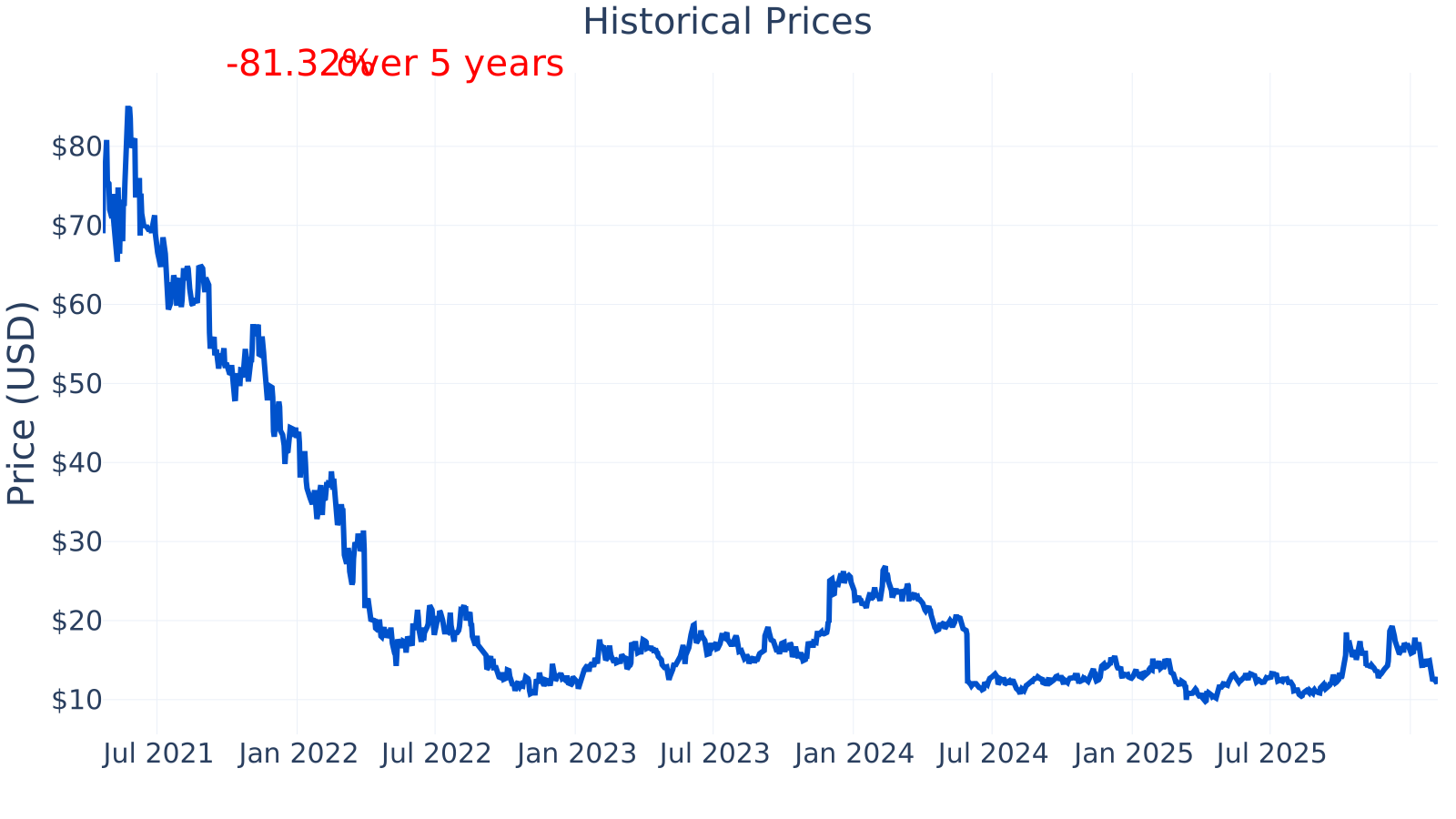
UiPath’s market capitalization is about $6.9B, and the stock’s beta (~1.07) suggests price moves broadly in line with the overall market. The company shows a P/E ratio of ~30.7 versus an industry median near 25.7, and a profit margin of ~14.8% versus an industry median near 6.7%. Year-over-year revenue growth is about 15.9% (close to the industry median near 15.2%). Balance-sheet leverage appears low with debt-to-equity near 3.7% versus an industry median near 19.8%. Free cash flow over the trailing twelve months is about $312M, indicating meaningful cash generation recently.
Growth (medium)
UiPath operates in the broader enterprise software market, specifically in automation. This area is tied to long-running business priorities: improving productivity, reducing costs, strengthening compliance, and speeding up how work moves across different systems. These drivers tend to persist across economic cycles, although spending can still slow when customers tighten budgets.
A key part of UiPath’s growth strategy is expanding beyond basic task automation into a broader platform approach—supporting more end-to-end workflows and more use cases across a company. In practice, this strategy relies on (1) keeping existing customers, (2) expanding within those customers to more departments and processes, and (3) continuing to improve the product so it remains relevant as enterprise software stacks change.
The year-over-year revenue growth trend shows that growth has moderated from very high levels earlier in the period (for example, near 39% in early 2022) to more recent levels around the mid-teens (~16%). This pattern is common for software companies as they become larger, but it also means future results depend more on consistent execution than on rapid market expansion alone.
Cash generation has improved meaningfully. Free cash flow moved from negative levels in 2021–2023 to approximately $292M by early 2024 and about $306M by early 2025, with the latest metric around $312M. For long-term business durability, sustained positive free cash flow can matter because it can help fund product development and operations without relying as much on external financing.
Risks (high)
This article is for informational purposes only and does not constitute financial advice. Some content is AI-generated. See Disclaimer