Stock Analysis · Tyler Technologies Inc (TYL)
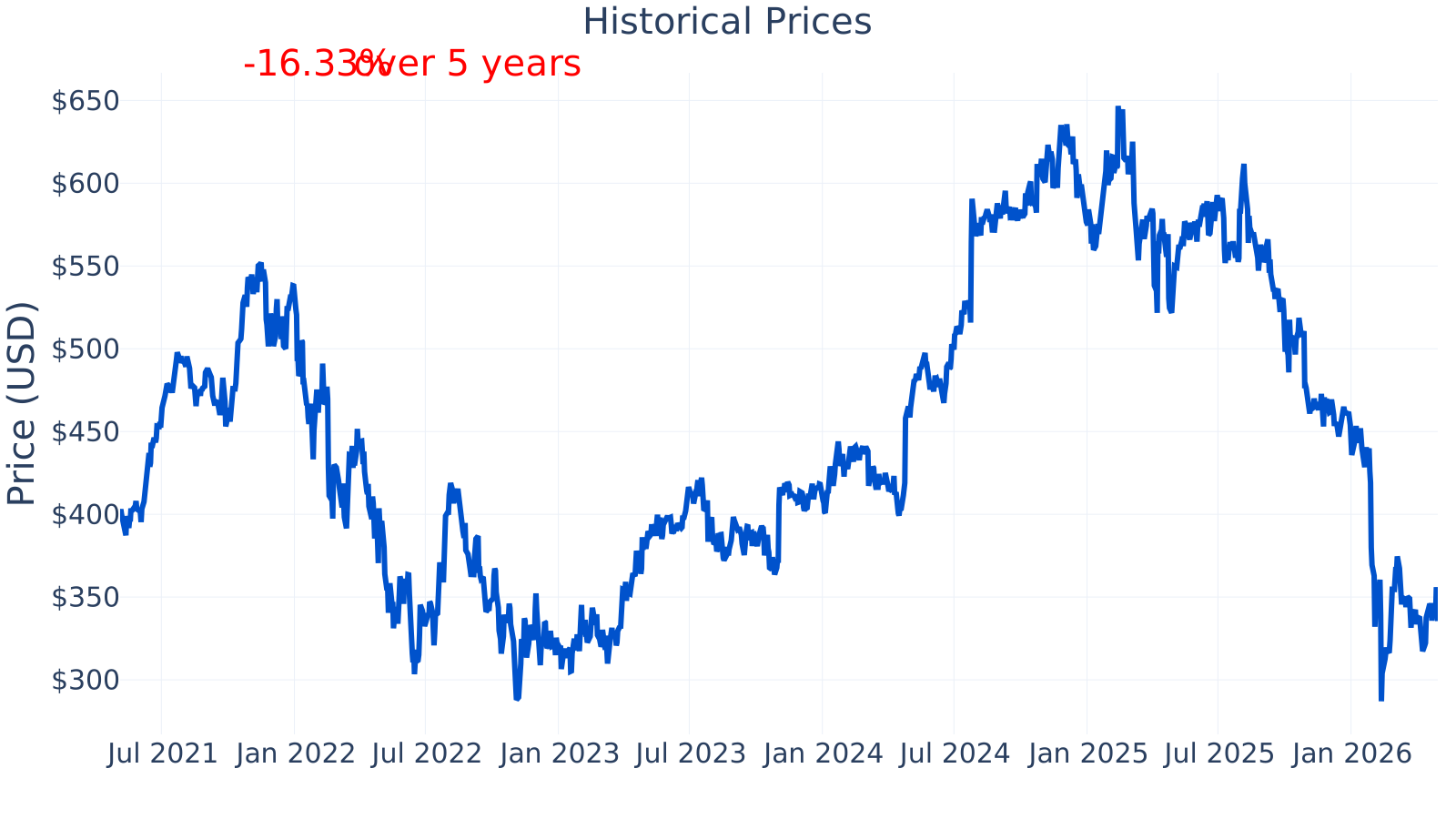
Overview
Tyler Technologies, Inc. (TYL) is a software company focused on the public sector, especially U.S. local governments (cities, counties), courts, schools, and other government entities. Its products help agencies run day-to-day operations such as managing financials and budgets, processing property taxes, administering courts and public safety workflows, and handling permitting and licensing. A key part of the business is offering these systems as long-term software subscriptions and cloud services, often paired with implementation work and ongoing support.
Because Tyler primarily sells to government organizations, demand is often linked to multi-year technology replacement cycles and modernization efforts rather than consumer trends. The business model typically involves long deployments and long relationships once the software is embedded into an agency’s processes.
Main sources of revenue are commonly described in company filings as:
- Subscription (SaaS) and transaction-based revenues (recurring software access and usage-based processing)
- Maintenance (support and updates for customers not yet fully on subscription arrangements)
- Professional services (implementation, configuration, training, and related services)
Percentages by category can vary by year and are best taken directly from the most recent annual report segment disclosures.
Across recent years, total revenue rises steadily (about $1.59B in 2021 to about $2.33B in 2025), while net income also increases (about $161M in 2021 to about $316M in 2025). Operating expenses rise as well, with research and development notably higher in 2025 versus prior years, suggesting increased product investment alongside growth.
Key Figures
| Metric | Value | Industry ⓘ |
|---|---|---|
| Date | May 04, 2026 | |
| Context | ||
| Sector | Technology | |
| Industry | Software - Application | |
| Market Cap ⓘ | $14.15B | |
| Beta ⓘ | 0.86 | |
| Fundamental | ||
| P/E Ratio ⓘ | 46.28 | 26.40 |
| Profit Margin ⓘ | 13.26% | 7.95% |
| Revenue Growth ⓘ | 8.60% | 15.60% |
| Debt to Equity ⓘ | 1.35% | 27.14% |
| PEG ⓘ | 1.68 | |
| Free Cash Flow ⓘ | $687.73M | |
Tyler’s market capitalization is about $14.1B and the stock’s beta is about 0.86, which indicates it has historically moved somewhat less than the broader market on average (though that can change). The company’s profit margin is about 13.3%, higher than the industry median shown (about 8.0%), while year-over-year revenue growth is about 8.6%, lower than the industry median shown (about 15.6%). Debt stands out as conservative: debt-to-equity is about 1.3% versus an industry median around 27.1%. Trailing twelve-month free cash flow is about $688M.
Growth (Medium)
Tyler operates in government-focused software, an area supported by long-term digitization needs: agencies modernizing legacy systems, moving workloads to cloud-hosted platforms, improving online citizen services, and strengthening security and compliance. These drivers tend to be persistent because many government organizations run mission-critical workflows on older systems for long periods, creating ongoing replacement and upgrade cycles.
The company’s strategy—expanding recurring software and cloud delivery while continuing to serve complex government workflows—aligns with how enterprise software has been evolving broadly. For a public-sector vendor, the stickiness of systems (high switching costs, deep integration into operations, and staff training) can support multi-year relationships once a platform is adopted.
Revenue growth shows a step-down from very high rates in 2021 to lower single-digit growth in 2022–2023, followed by a steadier pattern mostly in the high single digits to low double digits through 2024–2026 (for example, about 8–13% in several quarters). This looks more like a mature compounding profile than an early-stage expansion profile.
Free cash flow trends upward over time: roughly $295M (2022), $354M (2023), $321M (2024), then higher levels around $576M (2025) and $688M (2026). Rising free cash flow can matter for long-term durability because it can support reinvestment, acquisitions, debt reduction, or other corporate needs without relying as much on external financing.
Potential catalysts are typically tied to continued cloud migration of existing customers, winning new government contracts, expansion of transaction-based services, and successful rollout of new functionality that increases the value of platforms already in place.
Risks (Medium)
Tyler’s customer base brings specific operational risks. Government procurement can be slow and competitive, contracts can be delayed by budgeting cycles, and implementation timelines can extend. Customer concentration by sector (public agencies) can also mean that broad public budget pressure may slow decision-making in some periods. Another risk is execution: large enterprise implementations can face cost overruns, schedule delays, or customer dissatisfaction if project management is not strong.
Competition is meaningful in public-sector software. Tyler is a well-known specialist in this niche, but it faces rivals across different product lines, including large enterprise software vendors and other public-sector-focused providers. Competitive pressure can show up as pricing constraints, higher sales and marketing costs, or the need for sustained product investment. In practice, positioning often varies by product category (for example, ERP/financial systems, courts and justice solutions, tax and appraisal, and other agency workflows), so leadership is not uniform across every sub-market.
From a financial risk perspective, leverage appears limited.
Debt-to-equity trends downward over multiple years, falling from much higher levels earlier in the period to very low levels most recently (about 1.3% versus an industry median around 29.0% in the most recent point shown). Lower leverage can reduce vulnerability to rising interest rates and refinancing risk, though it does not eliminate business and execution risks.
Profitability is another area to watch, especially during periods of heavier investment (for example, increased R&D) or if implementation costs rise.
Profit margin trends upward from roughly 9–12% earlier in the period to around 13% more recently. The company’s margin is also consistently above the industry median shown across the timeline, suggesting comparatively strong profitability versus many peers in the same broad industry classification.
Valuation
Valuation is often discussed using the price-to-earnings (P/E) ratio, which compares the stock price to the company’s earnings. For companies with recurring revenue and steady growth, the market sometimes assigns higher P/E ratios, but that can also create sensitivity if growth slows or if profitability does not expand as expected.
The latest P/E ratio shown is about 46.3, above the industry median in the table (about 26.4). Historically in the chart, Tyler’s P/E was much higher earlier in the period and then compresses substantially over time, reaching around 50 most recently, while still staying above the industry median shown in the later dates. In descriptive terms, this indicates the stock has often traded at a premium to its industry group, which places more emphasis on continued execution and sustained growth and cash generation.
Conclusion
Tyler Technologies is a public-sector software provider with products embedded in mission-critical government workflows. The business profile is shaped by long customer relationships and ongoing modernization needs, which can support steady demand over time. Financially, the company shows improving profitability in recent years, rising free cash flow, and very low leverage in the most recent period displayed.
At the same time, growth appears more moderate than some software peers in the same broad industry category, and the stock’s valuation metrics indicate it has generally traded at a premium versus the industry median shown. Key uncertainties to track over time include government budget cycles and procurement timing, execution quality on implementations, and competitive dynamics across Tyler’s different product areas.
Sources:
- U.S. Securities and Exchange Commission (SEC) EDGAR — Tyler Technologies, Inc. Form 10-K (Annual Report)
- U.S. Securities and Exchange Commission (SEC) EDGAR — Tyler Technologies, Inc. Form 10-Q (Quarterly Reports)
- Tyler Technologies, Inc. Investor Relations — SEC Filings / Annual Report materials
- Wikipedia — “Tyler Technologies” (basic company background)
This article is for informational purposes only and does not constitute financial advice. Some content is AI-generated. See Disclaimer


