Stock Analysis · Tyler Technologies Inc (TYL)
Overview
Tyler Technologies, Inc. is a software company focused on the public sector. In simple terms, it builds and runs the technology that many local governments, courts, schools, and public safety agencies use to do everyday work—such as managing property taxes, processing court cases, paying vendors, handling permits, or running other administrative services.
Its business model is built around selling software and then supporting it over time. That often creates long-lasting customer relationships because government systems are complex to replace, must meet strict rules, and typically run for many years once implemented.
In its SEC filings, Tyler reports revenue by broad categories rather than by individual product lines. The main sources of revenue are typically:
- Software and subscriptions (including cloud/SaaS arrangements, where customers pay recurring fees)
- Maintenance and support (ongoing support contracts tied to the software)
- Professional services (implementation, configuration, training, and other services that help customers deploy the systems)
Percentages vary by year and are detailed in the company’s Form 10-K/10-Q revenue footnotes and segment discussion.
Across recent years, total revenue and operating income have generally expanded, and net income has risen meaningfully by the latest year shown. A notable cost trend is that research and development spending increases substantially in the most recent year shown, which can indicate heavier investment in the product portfolio (but it also means the company must convert that spending into future revenue and customer retention).
Key Figures
| Metric | Value | Industry ⓘ |
|---|---|---|
| Date | Feb 23, 2026 | |
| Context | ||
| Sector | Technology | |
| Industry | Software - Application | |
| Market Cap ⓘ | $13.71B | |
| Beta ⓘ | 0.90 | |
| Fundamental | ||
| P/E Ratio ⓘ | 44.03 | 25.48 |
| Profit Margin ⓘ | 13.53% | 7.23% |
| Revenue Growth ⓘ | 6.30% | 15.70% |
| Debt to Equity ⓘ | 18.26% | 25.08% |
| PEG ⓘ | 2.30 | |
| Free Cash Flow ⓘ | $637.53M | |
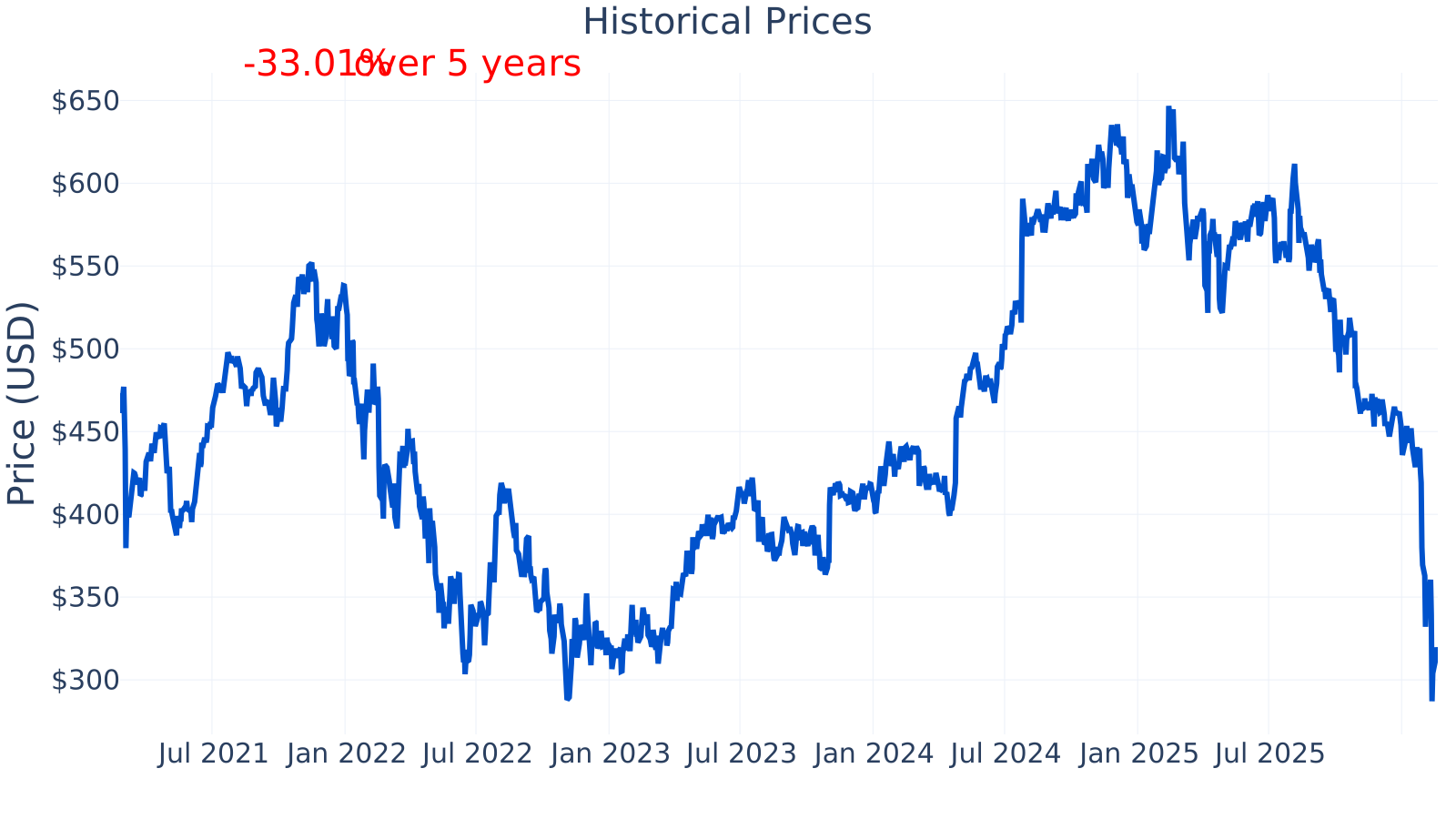
Tyler Technologies’ market capitalization is about $13.7B, and its beta (~0.90) suggests the stock has historically moved a bit less than the broader market. The company’s current P/E ratio (~44.0) is above the industry median (~25.5), while its profit margin (~13.5%) is also above the industry median (~7.2%). Recent year-over-year revenue growth (~6.3%) is below the industry median (~15.7%). Leverage looks moderate, with debt-to-equity (~18%) below the industry median (~25%). Trailing twelve-month free cash flow is about $638M, indicating meaningful cash generation after operating expenses and capital spending.
Growth (Medium)
Tyler operates in a part of the software market that is shaped by long upgrade cycles and steady demand: governments and public institutions must keep systems running, meet compliance needs, and modernize aging technology. This is not typically a “hyper-growth” environment, but it can be a durable one—especially when the vendor has deep expertise in public-sector workflows and regulations.
A key long-term growth driver is the continued shift from older on-premises installations to subscription and cloud-based software. For software companies, this can change revenue quality over time: subscription revenue tends to be more recurring, while implementation work may be more project-based. In many software businesses, this mix shift can also support higher predictability, but it can require sustained investment in hosting, security, and product development.
The year-over-year revenue growth rate appears much higher in earlier periods shown and then settles into a more moderate range more recently, ending at roughly 6% in the latest period. That pattern can happen when a company moves from a smaller base to a larger one, and when results normalize after unusually strong comparison periods.
Free cash flow trends upward overall, with a notable step-up in the most recent period shown (to roughly $576M in the latest point on the chart, and around $638M on a trailing twelve-month basis in the key figures). For long-term business resilience, the ability to generate cash can matter because it helps fund product investment, acquisitions, and balance-sheet flexibility.
Potential catalysts commonly discussed in company filings for businesses like Tyler include winning new multi-year public-sector contracts, expanding cloud adoption within the installed customer base, and continuing to improve operating efficiency as more customers run on standardized platforms.
Risks (Medium)
This article is for informational purposes only and does not constitute financial advice. Some content is AI-generated. See Disclaimer