Stock Analysis · Twilio Inc (TWLO)
Overview
Twilio Inc. is a communications platform company that provides cloud-based tools businesses use to communicate with their customers. In simple terms, it helps companies add messaging, voice calls, email, and other communication features directly into their apps and workflows (often through software building blocks commonly used by developers). Twilio’s services are typically used for customer support, account notifications, appointment reminders, two-factor authentication, marketing messages, and other customer engagement needs.
Twilio mainly earns revenue by charging customers for usage-based communication services (for example, per message, per minute, or per email), as well as from software products sold on a subscription and/or usage basis. In its filings, Twilio generally groups revenue into two broad categories:
- Communications (the core messaging/voice-related platform; includes messaging, voice, and other channels)
- Segment (customer data and engagement software offerings, associated with Twilio Segment)
Because Twilio’s disclosures can vary by reporting period and it may not always provide a single consistent percentage split in a summary form, the most reliable breakdown and definitions are found in the segment reporting notes of its most recent annual report (Form 10-K).
Across recent years, the business shows a pattern often seen in software/platform companies: revenue rising while profitability improves more gradually. Operating expenses—especially research and development—have been a major use of revenue, though operating results have moved closer to break-even over time.
Key Figures
| Metric | Value | Industry ⓘ |
|---|---|---|
| Date | May 04, 2026 | |
| Context | ||
| Sector | Technology | |
| Industry | Software - Infrastructure | |
| Market Cap ⓘ | $27.83B | |
| Beta ⓘ | 1.32 | |
| Fundamental | ||
| P/E Ratio ⓘ | 277.79 | 29.58 |
| Profit Margin ⓘ | 1.96% | 6.71% |
| Revenue Growth ⓘ | 20.00% | 18.30% |
| Debt to Equity ⓘ | 0.97% | 24.92% |
| PEG ⓘ | 0.37 | |
| Free Cash Flow ⓘ | $1.01B | |
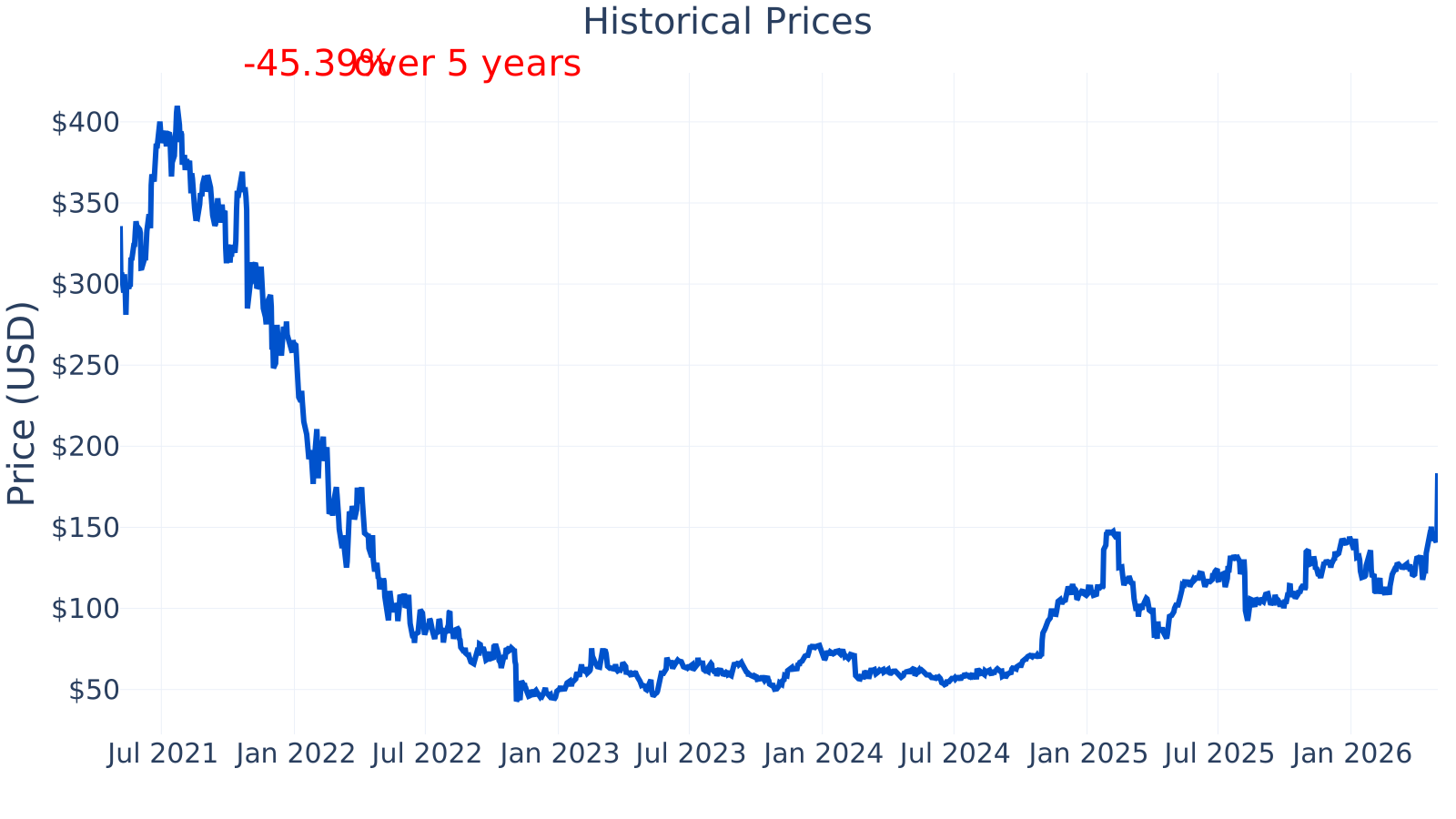
Twilio’s market capitalization is about $27.8B, and the stock’s beta of 1.32 indicates it has tended to move more than the overall market. The company’s profit margin is about 2.0%, below the industry median (about 6.7%), reflecting that profitability has improved but remains relatively modest versus many mature software peers.
Revenue growth is shown at about 20.0% year over year, slightly above the industry median (about 18.3%). Debt relative to equity is very low at roughly 1.0% versus an industry median near 24.9%, suggesting limited balance-sheet leverage. Free cash flow over the trailing twelve months is about $1.01B, which is a meaningful shift compared with earlier periods when free cash flow was negative.
Growth (Medium)
Twilio operates in a part of the software market that benefits from long-term digitization trends: more customer interactions moving online, more automated notifications, and more “embedded” communications inside applications (for example, a rideshare app texting a driver and rider). As businesses expand digital customer experiences, the need for reliable messaging, voice, email, and identity-related communications infrastructure can increase.
Twilio’s strategy has typically focused on expanding the number of communication channels it supports, improving deliverability and reliability, and building additional software layers that help companies manage customer engagement and data. The combination of communication tools and customer data capabilities is intended to help organizations both reach customers and personalize those interactions.
The revenue growth trend shows a sharp slowdown from very high growth rates earlier in the period to low single digits around 2023–2024, followed by a re-acceleration into the mid-teens and then around 20% most recently. That pattern suggests demand and/or customer usage improved after a slower phase, though growth has been uneven.
Free cash flow improved significantly over time, moving from negative territory in 2022–2023 to clearly positive in 2024 and reaching about $1.01B on a trailing-twelve-month basis by the latest point shown. For long-term business durability, sustained positive free cash flow can matter because it can support reinvestment, strengthen the balance sheet, or fund other corporate priorities without relying as heavily on external financing.
Risks (High)
A key business risk for Twilio is that a meaningful portion of its revenue is usage-based. When customers optimize costs, change messaging volumes, or reduce marketing and notification activity, Twilio’s revenue can be affected even if the customer count remains stable. This can make growth more sensitive to broader business conditions and customer behavior than purely subscription-based software models.
Competition is another major factor. Twilio participates in markets where some rivals compete on price, others compete by bundling communications into broader software suites, and large cloud providers can offer overlapping tools. Twilio’s competitive advantages often relate to developer adoption, breadth of communication options, global reach, and tooling that helps companies build and run communications at scale. However, these advantages must be maintained through ongoing investment and strong execution.
Main competitors commonly referenced in company disclosures and industry context include:
- CPaaS (communications platform) competitors such as Sinch and Bandwidth, and other messaging/voice providers
- Email and marketing communications providers (depending on product and channel)
- Large cloud and software platforms that provide communications-related services as part of broader offerings
Financially, Twilio shows very low leverage in the latest period: debt-to-equity is about 1%, well below the industry median shown on the chart for many periods. That can reduce certain financial risks (for example, sensitivity to interest costs), but it does not remove operating risks such as competitive pressure or demand fluctuations.
Profitability has improved substantially from deeply negative margins earlier in the timeline to slightly positive recently (about 2%). Even with this improvement, the company remains below the industry median margin (around 6–7% in the latest period). A key risk is whether Twilio can sustain and expand profitability while continuing to grow, especially in a competitive environment where pricing and customer acquisition costs can matter.
Valuation
Valuation is challenging to summarize with a single metric for a company transitioning from losses toward profitability. A commonly cited measure is the price-to-earnings (P/E) ratio, but it can be volatile when earnings are small, near zero, or recently turned positive.
The latest P/E shown in the table is about 277.8, much higher than the industry median near 29.6. This gap can happen when the market price reflects expectations of higher future earnings, while current earnings remain relatively low. In that situation, small changes in profit can cause large swings in the P/E ratio, so it is often interpreted alongside profitability trends, free cash flow generation, and the stability of growth rather than in isolation.
From a fundamentals perspective, the current valuation picture combines several positives (re-accelerating revenue growth versus the prior slowdown, and materially improved free cash flow) with uncertainties (profitability still below typical industry levels and competitive intensity). How those factors develop over time tends to be central to whether valuation levels remain supported by business performance.
Conclusion
Twilio is a communications infrastructure and customer engagement software company that helps businesses embed messaging, voice, email, and related capabilities into digital products. Its business has shown meaningful progress in cash generation and a clear improvement in profit margin from prior losses to modest profitability, while revenue growth has recently strengthened after a slower period.
At the same time, the company operates in highly competitive markets and has exposure to usage-based customer spending, which can make results more variable. The valuation metrics shown (including a high P/E versus the industry median) indicate that the stock price can be sensitive to whether profitability and growth continue to improve and become more consistent.
Sources:
- SEC EDGAR — Twilio Inc. Form 10-K (Annual Report)
- SEC EDGAR — Twilio Inc. Form 10-Q (Quarterly Reports)
- Twilio Investor Relations — Shareholder letters / earnings materials (company-hosted)
- Wikipedia — “Twilio” (basic company background)
This article is for informational purposes only and does not constitute financial advice. Some content is AI-generated. See Disclaimer