Stock Analysis · Twilio Inc (TWLO)
Overview
Twilio Inc (TWLO) builds cloud software that helps other companies communicate with their customers. In simple terms, Twilio provides building blocks (often called APIs, but they can be thought of as “plug-in” tools) that let businesses add messaging, voice calls, email, authentication, and customer-support features directly into their own apps and websites. This is commonly described as “communications software for developers,” because the tools are designed to be integrated into products by engineering teams rather than used as a standalone consumer app.
Twilio’s business model is largely usage-based: many customers pay more as they send more messages, make more calls, or run more customer interactions through Twilio’s platform. That structure can scale well when customers grow, but it can also make revenue sensitive to changes in customer activity (for example, fewer marketing messages or lower customer engagement).
In its SEC filings, Twilio reports revenue in two main categories:
- Communications (the larger segment): messaging, voice, authentication/identity, and related communication tools.
- Segment (customer data and engagement tools): software aimed at helping companies unify customer data and personalize interactions.
The company’s cost structure also matters for long-term economics. Based on the multi-year income statement flow, Twilio has been growing revenue while working to reduce operating losses by controlling operating expenses and improving efficiency.
From 2021 to 2025, total revenue increased from about $2.84B to about $5.07B. Over the same period, operating results improved materially: operating income moved from a large loss (about -$961M in 2021) to a positive result (about $175M in 2025), and net income turned slightly positive in 2025 (about $34M). This points to a shift from “growth at a loss” toward a model that is closer to sustainable profitability.
Key Figures
| Metric | Value | Industry ⓘ |
|---|---|---|
| Date | Feb 16, 2026 | |
| Context | ||
| Sector | Technology | |
| Industry | Software - Infrastructure | |
| Market Cap ⓘ | $17.34B | |
| Beta ⓘ | 1.31 | |
| Fundamental | ||
| P/E Ratio ⓘ | N/A | 25.13 |
| Profit Margin ⓘ | 0.67% | 6.91% |
| Revenue Growth ⓘ | 14.30% | 15.25% |
| Debt to Equity ⓘ | 14.52% | 19.82% |
| PEG ⓘ | 44.96 | |
| Free Cash Flow ⓘ | $1.10B | |
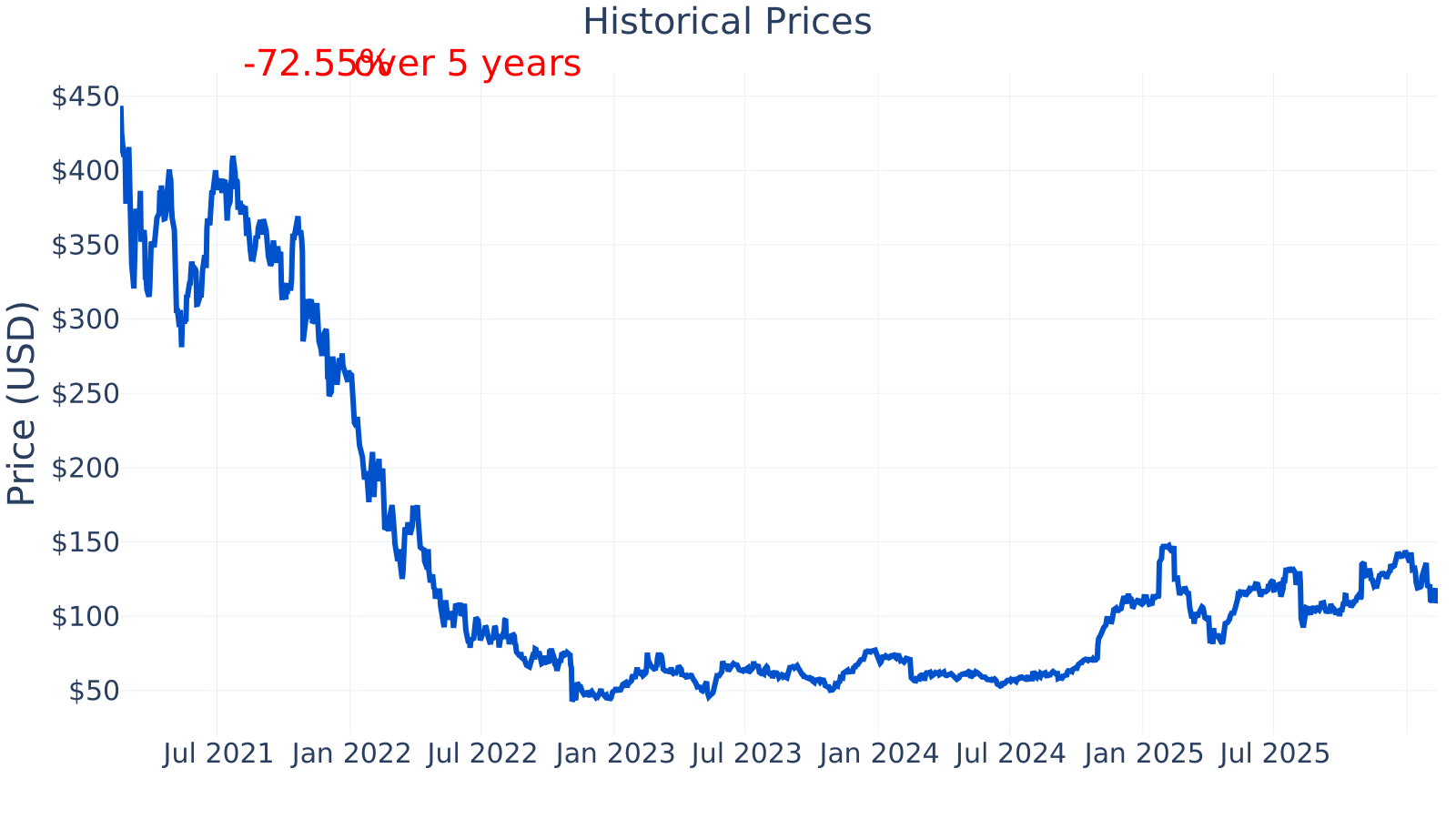
Twilio’s market capitalization is about $17.3B, and the stock’s beta of 1.31 indicates it has tended to move more than the broader market. Profit margin is about 0.67% versus an industry median near 6.91%, showing profitability has improved but still trails many peers. Year-over-year revenue growth is about 14.3%, close to the industry median of about 15.25%. Debt-to-equity is about 14.5%, modest and slightly below the industry median (about 19.8%). Free cash flow over the trailing twelve months is about $1.10B, which is a notable strength compared with the company’s earlier period of negative free cash flow. The P/E ratio is not consistently meaningful here (including periods where it is shown as 0), which can happen when earnings are negative or very small relative to the share price.
Growth (Medium)
Twilio operates in cloud communications and customer engagement software—areas supported by long-term trends such as digital customer support, app-based commerce, two-factor authentication, automated notifications, and the shift from legacy phone systems to internet-based communication. As more businesses try to deliver customer experiences across text, voice, email, and chat, platforms that simplify integration can remain relevant.
Strategically, Twilio’s “usage-based” approach can benefit from customer expansion over time: if a customer’s product gains more users, communication volumes can rise without Twilio needing to sell a brand-new product each time. At the same time, a key growth question is whether Twilio can continue moving toward more software-like revenue (typically higher margin and stickier) rather than being primarily tied to communication volumes that may have lower margins.
Revenue growth has clearly slowed from very high rates in 2021 (above 50% year-over-year in multiple quarters) to low single digits in parts of 2023–2024, then re-accelerated into the mid-teens by 2025 (about 14.3% most recently). This pattern suggests Twilio has moved from an earlier hypergrowth phase into a more mature growth profile, with a recent improvement that may reflect stabilization and better execution.
Free cash flow has improved significantly over time: it was negative in 2021–2023 (down to roughly -$414M at one point) and then turned positive by 2024 and remained positive into 2025 (about $658M as of 2025-03-31, and $1.10B in the latest metrics table). For long-term business durability, consistent free cash flow can matter because it can help fund product development, pay down obligations, or strengthen the balance sheet without relying on new financing.
Potential catalysts for future growth (in a neutral, factual sense) often include: broader adoption of customer engagement tools across multiple channels, expansion of higher-value software products within the customer base, and continued operating discipline that allows revenue gains to translate into earnings and cash generation.
Risks (High)
This article is for informational purposes only and does not constitute financial advice. Some content is AI-generated. See Disclaimer