Stock Analysis · Tractor Supply Company (TSCO)
Overview
Tractor Supply Company (TSCO) is a specialty retailer focused on the “rural lifestyle” customer in the United States. It sells products used for maintaining land, caring for pets and livestock, and supporting small-scale farming and outdoor projects. The business is primarily store-based, supported by a growing digital channel that integrates with stores for fulfillment and customer service.
From a business model perspective, TSCO’s results are driven mainly by retail sales volume (how many transactions and items it sells) and how efficiently it runs its store network and supply chain. Like most retailers, it carries meaningful costs for merchandise, store labor, distribution, and occupancy, and its profitability depends on maintaining healthy gross margins while controlling operating expenses as it grows.
The company reports revenue largely as net sales from retail merchandise (rather than breaking revenue into multiple operating segments). In practice, revenue is commonly discussed by major product groupings in company disclosures and presentations. The main categories typically include:
- Livestock, equine, and agriculture supplies (feed, animal health, fencing and farm supplies)
- Companion animal (pet food and pet care)
- Seasonal and recreational (outdoor living, seasonal goods)
- Work/recreation apparel and footwear
- Tools, hardware, and truck/automotive-related items
Because TSCO generally reports revenue primarily as total net sales (without a consistent public percentage split by category in standard financial statements), category percentages are not listed here.
Over the last several years, total revenue increased from about $12.7B (2021) to about $15.5B (2025), while net income remained around the $1.1B level in the most recent years shown. That mix—moderate revenue growth with relatively stable earnings—suggests a mature retailer that is still expanding, but where operating costs and pricing/merchandise dynamics can meaningfully influence bottom-line results year to year.
Across 2021–2025, revenue rose overall, and gross profit also increased in dollar terms. Over the same period, operating expenses (especially selling, general, and administrative expenses) also climbed, helping explain why net income stayed relatively flat around the $1.0–$1.1B range despite higher sales.
Key Figures
| Metric | Value | Industry ⓘ |
|---|---|---|
| Date | Apr 27, 2026 | |
| Context | ||
| Sector | Consumer Cyclical | |
| Industry | Specialty Retail | |
| Market Cap ⓘ | $19.33B | |
| Beta ⓘ | 0.75 | |
| Fundamental | ||
| P/E Ratio ⓘ | 18.09 | 21.79 |
| Profit Margin ⓘ | 6.91% | 4.93% |
| Revenue Growth ⓘ | 3.60% | 3.60% |
| Debt to Equity ⓘ | 254.95% | 92.65% |
| PEG ⓘ | 1.49 | |
| Free Cash Flow ⓘ | $584.78M | |
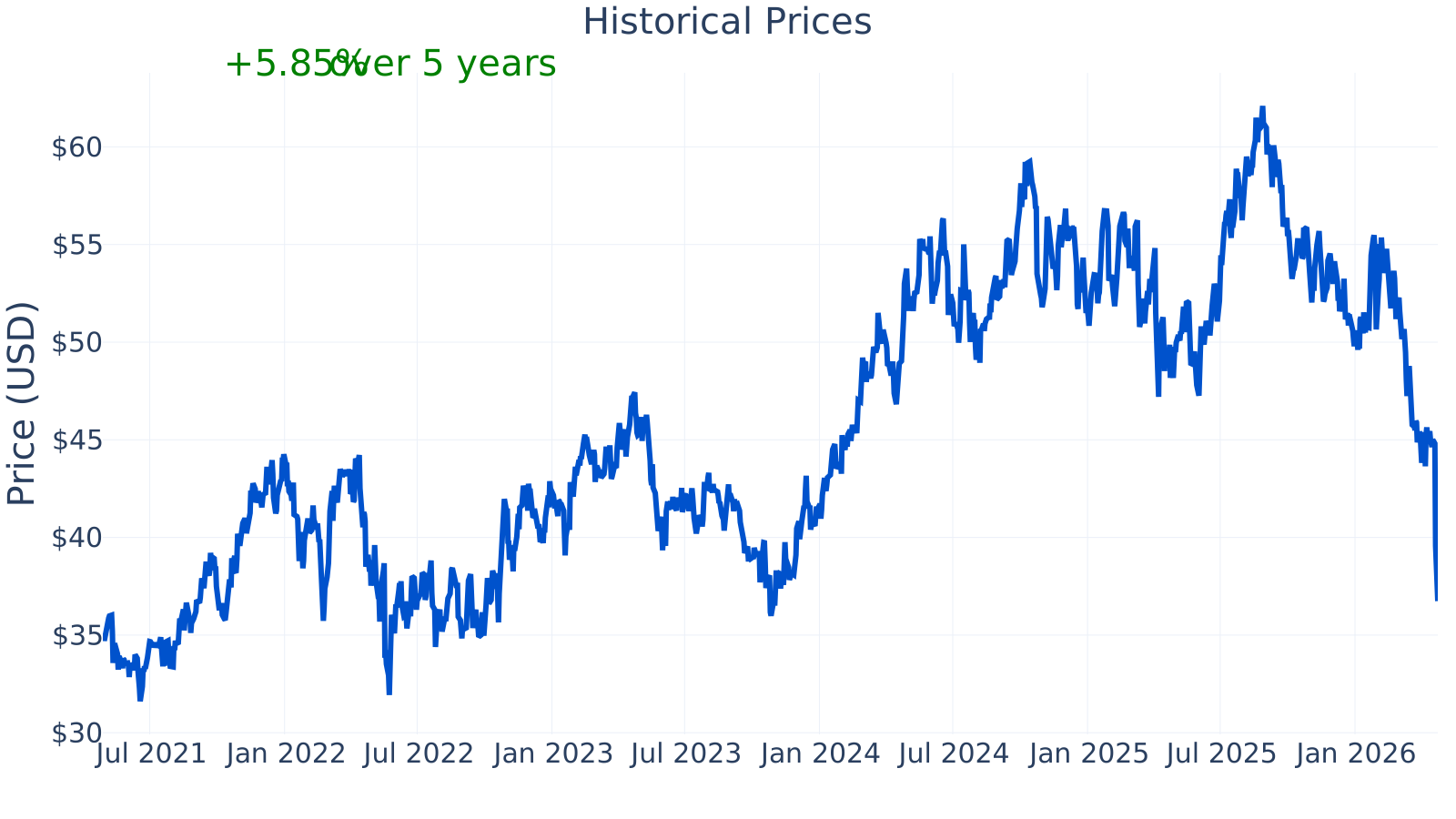
Tractor Supply Company’s market capitalization is about $19.3B, and its beta of about 0.75 indicates the stock has historically moved less than the broader market on average (though this can change over time). The company’s P/E ratio (~18.1) is below the specialty retail industry median shown here (~21.8). Profit margin is about 6.9%, higher than the industry median shown (~4.9%). Year-over-year revenue growth is about 3.6%, roughly in line with the industry median shown. One notable point is leverage: debt-to-equity is about 255%, which is higher than the industry median shown (~93%). Trailing twelve-month free cash flow is about $585M.
Growth (Medium)
TSCO operates in consumer retail, but with a specific focus on rural and “out here” lifestyle needs (pets, livestock, land and property maintenance). Demand in these categories can be steadier than highly discretionary retail because many purchases are recurring (such as feed and pet food) or tied to ongoing animal care and property upkeep. That said, it is still a retail business exposed to consumer spending cycles, weather-driven seasonality, and merchandise cost inflation/deflation.
A key long-term growth lever for TSCO is expanding and deepening its store network and improving productivity per store—supported by distribution capabilities and digital tools that connect online browsing with store pickup or delivery. In plain terms, the strategy relies on (1) adding convenient locations, (2) keeping core customers coming back frequently for necessities, and (3) earning more from each trip by improving assortment and availability.
Revenue growth has moderated from the higher levels seen in 2021–2022 to a low single-digit pace more recently. There was a notable dip into negative territory in late 2023 (year-over-year), followed by a return to modest positive growth through 2024–2026 periods shown. This pattern is consistent with a business that experienced stronger growth earlier and then normalized to slower, steadier expansion.
Free cash flow (a cash-based measure that reflects money left after operating needs and capital spending) rose into 2024 and then moved lower in 2025–2026, with the most recent value around $585M. For long-term business strength, the key question is whether free cash flow can remain consistently positive across cycles, since it helps fund reinvestment, debt service, and returns of capital under the company’s chosen policies.
Risks (Medium-High)
As a retailer, TSCO faces ongoing risks tied to consumer demand, merchandising decisions, and costs. If customers reduce discretionary spending, or if key categories soften due to economic conditions, weather, or shifts in pet/animal-related spending, sales growth can slow. Retailers also face margin pressure from promotions, shrink (inventory loss), wage inflation, transportation costs, and changes in product costs that may not be fully passed on to shoppers.
Competition is another structural risk. TSCO competes for rural lifestyle spending against a mix of big-box retailers, home improvement chains, online-only merchants, and regional farm-and-ranch stores. Instead of a single direct rival dominating every category, the competitive set is broad and can vary by product type and geography. How well TSCO holds share depends on convenience, in-stock reliability, customer service, and maintaining a relevant assortment for its target customer.
TSCO’s competitive advantages are typically associated with scale in its niche, brand recognition with rural lifestyle customers, and a store footprint designed for bulky and consumable products (feed, fencing supplies, animal care) that are often more convenient to buy locally than to ship individually. Its position can be described as a leading specialized chain in its category focus, although competition from larger generalists and e-commerce remains a constant factor.
Leverage is a notable area to monitor. Debt-to-equity increased over time and is about 255% in the most recent period shown, well above the industry median displayed (about 86%). Higher leverage can amplify outcomes: it may support growth and shareholder returns when business conditions are stable, but it can also reduce flexibility during weaker demand periods or when borrowing costs rise.
Profit margin has been relatively steady in the mid-to-high single digits, most recently about 6.9%. That is higher than the industry median shown (about 4.9%) and suggests TSCO has maintained comparatively solid profitability versus peers on this measure. At the same time, the chart shows some gradual compression from earlier highs, which is relevant because small margin changes can have an outsized effect on earnings in high-volume retail.
Valuation
Valuation is often summarized using the price-to-earnings (P/E) ratio, which compares the stock price to the company’s earnings per share. For a stable retailer, P/E levels tend to reflect expectations around future growth, durability of margins, and risk (including financial leverage).
Over the period shown, TSCO’s P/E moved across a range roughly from the high teens into the high 20s at times. The latest P/E shown in the key metrics is about 18.1, which is below the specialty retail industry median displayed (~21.8). A lower P/E than the median can reflect more conservative growth expectations, higher perceived risk, or simply a different business mix versus peers. In TSCO’s case, the combination of modest recent revenue growth, steady but slightly easing margins, and higher leverage than the median are factors that can influence how the market prices the earnings stream.
Whether the current price level is “expensive” or “cheap” cannot be determined from a single ratio alone. In TSCO’s context, a key practical way to frame valuation is: the market appears to be assigning a mid-range earnings multiple while the company shows (1) low single-digit sales growth recently, (2) margins that have been fairly resilient versus peers, and (3) above-median balance sheet leverage that may matter more if business conditions weaken.
Conclusion
Tractor Supply Company is a large, specialized retailer serving rural lifestyle needs, with revenue that has grown over the last several years and profitability that has remained solid relative to the industry median shown. Recent growth has been modest compared with earlier periods, suggesting a more mature phase where execution, store productivity, and cost control are central to results.
The long-term picture includes identifiable strengths—scale in a niche retail category and relatively steady demand drivers in consumables and animal care—balanced against typical retail uncertainties and a higher leverage profile than the industry median displayed. On valuation, the P/E multiple shown is below the industry median, which aligns with a business that is profitable but not currently showing high growth and carries meaningful debt relative to equity.
Sources:
- SEC EDGAR — Tractor Supply Company (TSCO) Form 10-K (Annual Report)
- SEC EDGAR — Tractor Supply Company (TSCO) Form 10-Q (Quarterly Report)
- Tractor Supply Company Investor Relations — Annual Report materials and financial results press releases
- Wikipedia — “Tractor Supply Company” (basic company background)
This article is for informational purposes only and does not constitute financial advice. Some content is AI-generated. See Disclaimer


