Stock Analysis · Tractor Supply Company (TSCO)
Overview
Tractor Supply Company (TSCO) is a U.S. specialty retailer focused on the “rural lifestyle” customer. Through its Tractor Supply stores and the Petsense by Tractor Supply chain, the company sells products used to care for pets and livestock, maintain homes and land, and support seasonal needs. The assortment includes animal feed and supplies, pet food and supplies, tools and hardware, workwear, lawn and garden items, and related seasonal merchandise. Sales come primarily from retail transactions in physical stores, supported by e-commerce options such as ship-to-home and pickup.
In its financial reporting, Tractor Supply describes its business as a single operating segment, so it does not typically publish a simple, fixed percentage breakdown of revenue by product category in the way some multi-division companies do. In general terms, management describes revenue as being driven by major merchandising groups that include:
- Livestock, equine, and agriculture (for example: feed and animal health supplies)
- Companion animal (pet food and pet supplies)
- Seasonal and recreational (seasonal goods, outdoor living items)
- Work and land (tools, hardware, truck/tractor-related items, workwear)
From a “where the money goes” perspective, the company’s recent income profile shows a large portion of sales spent on merchandise costs, with the remainder covering store and corporate operating costs, leaving operating profit and net income. Across 2021–2025, total revenue increased from about $12.7B to about $15.5B, while net income remained around $1.0B–$1.1B each year (reflecting a mature retailer with steadier profitability than high-growth businesses).
The pattern over the last several years is consistent with a scale retail model: revenues rose meaningfully, while net income stayed relatively steady around the $1.1B level. This suggests that growth has relied more on sales volume (stores, traffic, and mix) than on expanding profit per dollar of sales.
Key Figures
| Metric | Value | Industry ⓘ |
|---|---|---|
| Date | Feb 07, 2026 | |
| Context | ||
| Sector | Consumer Cyclical | |
| Industry | Specialty Retail | |
| Market Cap ⓘ | $29.38B | |
| Beta ⓘ | 0.73 | |
| Fundamental | ||
| P/E Ratio ⓘ | 27.00 | 23.78 |
| Profit Margin ⓘ | 7.06% | 6.27% |
| Revenue Growth ⓘ | 3.30% | 5.20% |
| Debt to Equity ⓘ | 373.25% | 103.28% |
| PEG ⓘ | 2.32 | |
| Free Cash Flow ⓘ | $740.49M | |
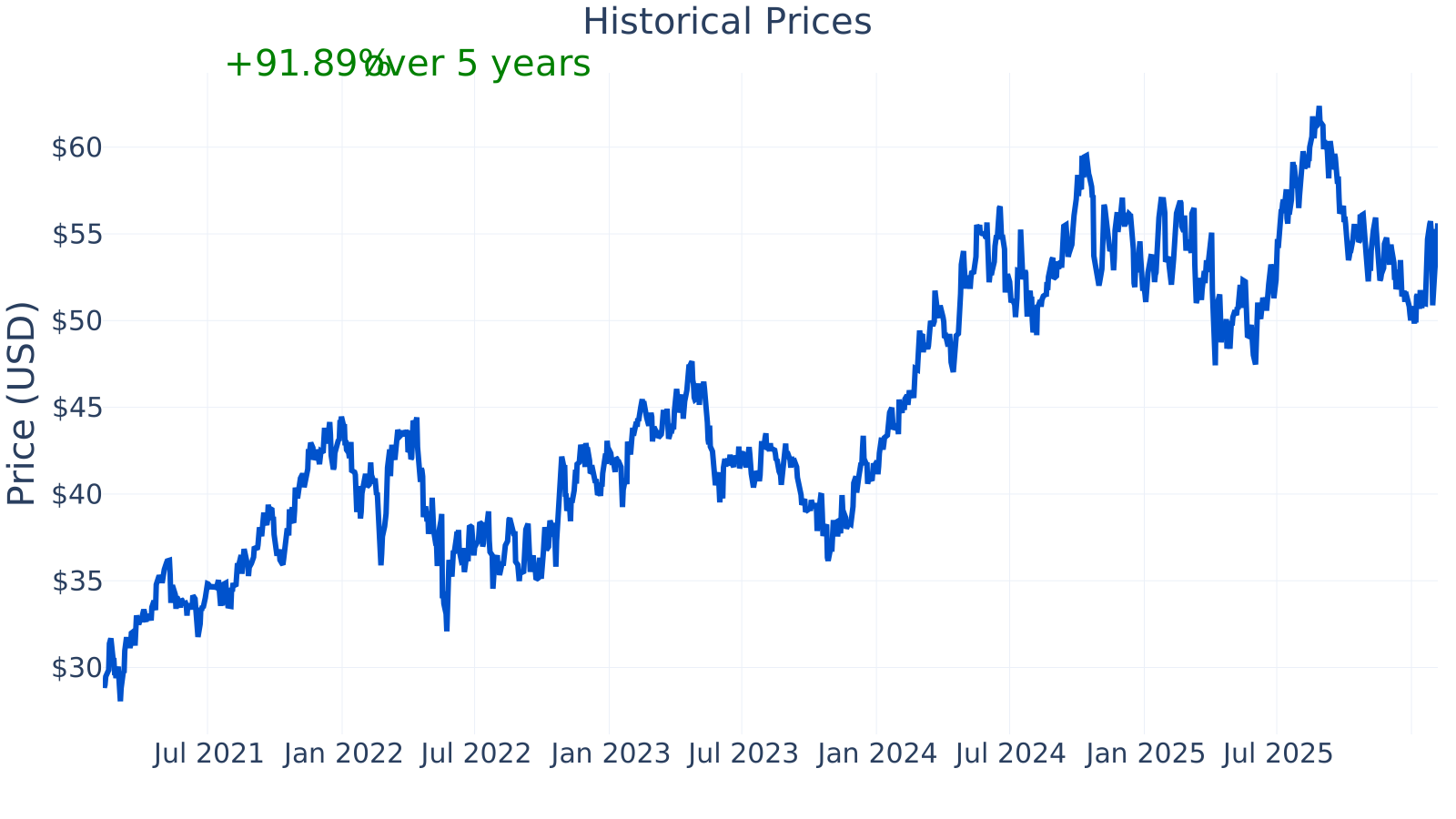
Tractor Supply’s market capitalization is about $29.4B. The stock’s beta of ~0.73 indicates it has historically moved less than the overall market on average (though individual periods can still be volatile).
On profitability, the company’s latest profit margin is ~7.1%, higher than the industry median shown here (~6.3%). Growth has recently been more moderate: latest year-over-year revenue growth is ~3.3%, below the industry median displayed (~5.2%).
Balance sheet leverage stands out: debt-to-equity is ~373% versus an industry median near 103%. This can amplify outcomes in both directions and is important context when comparing to peers.
Free cash flow over the trailing twelve months is about $740M, which is the cash left after operating needs and capital spending, and is a key resource for reinvestment, dividends, and share repurchases.
Growth (Medium)
Tractor Supply operates in specialty retail, which tends to be a mature industry overall. That said, the company’s niche—serving rural and “out-here” households with a strong focus on consumable and usable categories like feed and pet food—can be more resilient than purely discretionary retail. Many of its key categories are repeat-purchase items, which can help stabilize demand relative to retailers that rely heavily on big-ticket discretionary spending.
The company’s strategy for growth typically centers on expanding and improving store coverage, increasing customer frequency through consumable categories, building private brands, and offering convenient fulfillment options (such as pickup and delivery capabilities where available). For long-term business momentum, the most meaningful catalysts usually come from steady store expansion, continued share gains in rural markets, and operational improvements (for example: better inventory management and merchandising efficiency).
Recent revenue growth has been positive but modest. After very strong growth earlier in the 2021 period, the year-over-year growth rate cooled, including a negative quarter in late 2023, and then returned to low single digits through 2024–2025 (ending near 3.3% in the most recent period shown). This is consistent with a company that may be transitioning from a surge period to a more normalized growth pace.
Free cash flow has fluctuated in recent years (roughly $381M in 2022, improving to about $819M in 2024, and around $612M in 2025 based on the time points shown, with the latest trailing figure near $740M). For a retailer, stable and sizable cash generation is often a key support for long-term flexibility, but the variation also highlights that working capital needs and capital spending can meaningfully change year to year.
Risks (Medium)
This article is for informational purposes only and does not constitute financial advice. Some content is AI-generated. See Disclaimer