Stock Analysis · Toll Brothers Inc (TOL)
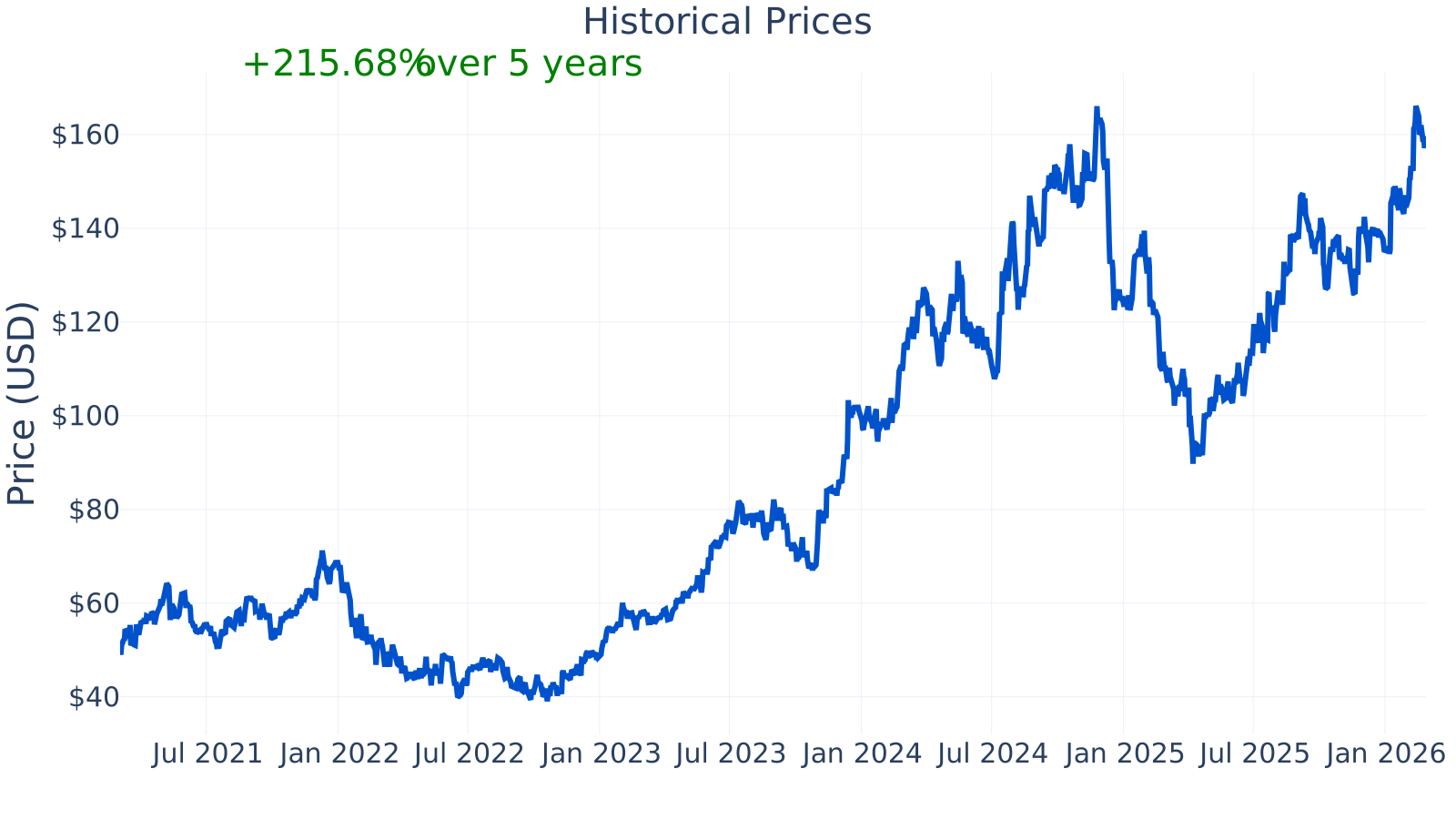
Overview
Toll Brothers Inc is a U.S. homebuilder focused on designing, building, and selling residential homes, with an emphasis on move-up, luxury, and active-adult communities. Beyond building homes, the company also develops and manages related real estate activities that support its communities, such as land development and certain ancillary services tied to new-home sales.
In simple terms, Toll Brothers earns most of its money when it sells a completed home to a buyer. Because it operates in residential construction, results tend to move with housing demand, mortgage rates, consumer confidence, and local market conditions in the regions where it builds.
Based on company reporting in its annual filings, revenue is primarily driven by the following:
- Home sales (typically the large majority of revenue)
- Other revenue (smaller contribution, may include land sales and other real estate-related activities depending on the period)
Over the periods shown, total revenue increased from about $8.8B (FY2021) to about $11.0B (FY2025). Profitability improved meaningfully from FY2021 through FY2024, with net income rising from about $0.8B to about $1.6B, followed by a pullback to about $1.35B in FY2025 while revenue stayed near the prior-year level. This pattern is consistent with a cyclical business where margins can expand and contract even when sales remain relatively stable.
Key Figures
| Metric | Value | Industry ⓘ |
|---|---|---|
| Date | Mar 02, 2026 | |
| Context | ||
| Sector | Consumer Cyclical | |
| Industry | Residential Construction | |
| Market Cap ⓘ | $14.94B | |
| Beta ⓘ | 1.47 | |
| Fundamental | ||
| P/E Ratio ⓘ | 11.29 | 13.00 |
| Profit Margin ⓘ | 12.26% | 8.65% |
| Revenue Growth ⓘ | 15.40% | -6.05% |
| Debt to Equity ⓘ | 32.36% | 33.34% |
| PEG ⓘ | 1.12 | |
| Free Cash Flow ⓘ | $1.45B | |
Toll Brothers’ market capitalization is about $14.9B, placing it among the larger publicly traded U.S. homebuilders. The stock’s beta of ~1.47 indicates it has historically moved more than the broader market, which is common for economically sensitive companies.
Profitability and growth metrics stand out versus the residential construction peer median shown in the table: profit margin is ~12.3% versus an industry median near 8.7%, and year-over-year revenue growth is ~15.4% versus a negative median for the peer group (about -6.1%). Leverage appears close to peers with debt-to-equity ~32.4% versus an industry median near 33.3%. The P/E ratio is ~11.3, below the peer median near 13.0, which may reflect differences in business mix, cyclicality expectations, or market views on the durability of recent earnings.
Growth (Medium)
Residential construction is a long-term demand industry tied to household formation, housing supply, and affordability. Over shorter periods, it can slow down sharply when financing becomes more expensive or buyers become cautious. For a homebuilder like Toll Brothers, the “growth engine” is mainly: (1) maintaining a strong pipeline of communities and lots (land positions), (2) matching product to demand in the markets it serves, and (3) managing construction costs and cycle risk.
Because Toll Brothers operates with a premium positioning (often serving higher-income buyers), it may experience different demand dynamics than entry-level builders. In some environments, higher-income buyers can be more resilient; in others, luxury demand can be more discretionary. The company’s long-run growth tends to come from expanding community count, managing its land bank effectively, and sustaining margins through cycle management rather than from disruptive technology-style expansion.
The year-over-year revenue growth line shows a cyclical pattern: strong growth in parts of 2021–2022, a softer and occasionally negative patch around 2023–2025, and a more recent pickup to about 15.4%. That swing highlights how dependent near-term results can be on the housing backdrop (including mortgage rates) and on the timing of deliveries.
Free cash flow (cash left after running the business and funding capital needs) is positive in each period shown and reaches about $1.45B in the most recent trailing-twelve-month value. It also varies significantly year to year, which is typical for homebuilders because land spend, construction timing, and inventory levels can cause cash flow to fluctuate even when reported earnings look steady.
Risks (High)
The main risk is that homebuilding is cyclical. Demand can weaken quickly if mortgage rates rise, credit tightens, unemployment increases, or consumer confidence falls. Even when buyers remain interested, affordability constraints can reduce the pool of qualified customers, slow down sales, or pressure pricing.
A second major risk is cost and execution. Homebuilders face exposure to labor availability, materials costs, build-cycle duration, and the efficiency of local subcontractor networks. Delays or cost inflation can compress margins. Land strategy is also critical: buying land too early at high prices can hurt returns later, while being too conservative can limit future deliveries.
The debt-to-equity trend shows a notable reduction over time: from roughly 75% in 2021 down to about 32% most recently. That direction suggests a stronger balance-sheet posture than earlier years, and the latest level is close to the peer median shown. Even with improved leverage, the company remains exposed to capital-market and refinancing conditions because homebuilding requires substantial ongoing investment in land and construction.
Profit margin rose materially from about 7–10% in 2021–2022 to the mid-teens in 2023–2024, then eased back to about 12.3% most recently. Importantly, the latest margin remains above the peer median displayed (about 8.7%), suggesting Toll Brothers has recently operated with stronger profitability than many residential construction peers—though those advantages can narrow during weaker parts of the cycle.
In terms of competitive positioning, Toll Brothers is a well-known brand in the U.S. homebuilding industry, particularly in the luxury segment, where design options, community locations, and customer experience can matter. Competitive advantages in homebuilding are usually not based on patents or exclusive technology; they tend to come from land sourcing, local market knowledge, scale purchasing, operational discipline, and reputation. Leadership is often regional and segment-specific rather than absolute across all price points.
Main publicly traded competitors are other large U.S. homebuilders, including D.R. Horton, Lennar, PulteGroup, NVR, and Taylor Morrison. Compared with some peers, Toll Brothers is more heavily associated with move-up and luxury buyers, while others may be more weighted to entry-level or broader price tiers. This differentiation can help in some conditions but can also concentrate exposure to higher-end demand shifts in others.
Valuation
The valuation picture in the P/E chart shows Toll Brothers’ P/E ratio moving through a wide range across the cycle (roughly mid-single digits at the low end in 2022–2023 and around the low double digits more recently). The latest P/E is about 11.3, which is slightly below the peer median near 13.0 in the table.
For a cyclical business, P/E ratios can be tricky to interpret because “E” (earnings) can be unusually high near peak profitability and lower during downturns. A lower P/E can sometimes reflect the market’s expectation that current earnings are not permanent, rather than indicating anything about quality by itself. Context matters: recent profit margins have been above peers, revenue growth has turned positive again, and leverage has declined versus earlier years—factors that can support earnings resilience—while housing sensitivity and affordability pressures can still affect how durable those earnings prove to be.
Conclusion
Toll Brothers is a sizable U.S. homebuilder primarily driven by home sales, operating in an industry with long-term housing demand but pronounced economic cycles. Recent financial signals show solid profitability relative to peers, a return to positive year-over-year revenue growth, and a meaningful improvement in debt-to-equity over the last several years.
At the same time, the company’s results remain closely tied to mortgage rates, housing affordability, and construction and land-cycle execution. Valuation metrics such as the P/E ratio appear moderate relative to peers, but cyclical earnings make simple comparisons less definitive. Overall, the long-term picture combines durable housing-market relevance with higher sensitivity to macroeconomic conditions than many non-cyclical industries.
Sources:
- SEC EDGAR — Toll Brothers Inc Form 10-K (Annual Report)
- SEC EDGAR — Toll Brothers Inc Form 10-Q (Quarterly Report)
- Toll Brothers — Investor Relations materials and SEC filings (company-hosted)
- Wikipedia — “Toll Brothers” (general company background)
This article is for informational purposes only and does not constitute financial advice. Some content is AI-generated. See Disclaimer


