Stock Analysis · Toll Brothers Inc (TOL)
Overview
Toll Brothers Inc (TOL) is a U.S. residential construction company focused on building and selling homes, mainly in the luxury segment. The company operates through local homebuilding divisions across multiple states and typically controls land (directly or through options), develops communities, builds homes, and sells them to customers. In addition to homebuilding, Toll Brothers also has activities that can include land sales, apartment development, and services related to financing and title, which support the core home sale process.
In simple terms, Toll Brothers’ business model is to acquire or control lots, turn them into communities, build higher-end homes, and earn profit on the difference between the selling price and the total cost (land, materials, labor, overhead, and interest).
Main sources of revenue generally include:
- Home sales (the largest driver of revenue for most fiscal years)
- Land sales (when the company sells land or lots)
- Other revenue streams (such as ancillary services connected to the home sale process, and certain real estate activities)
Across the last several fiscal years, the company’s total revenue has been in the roughly $8.8B–$11.0B range, with profitability varying by housing demand, pricing, and construction costs.
Over the period shown, revenue increased from about $8.79B (FY2021) to about $10.97B (FY2025). Operating income rose from about $1.02B to $1.78B over the same window, while net income moved from about $0.83B to $1.35B. This illustrates that even with higher costs and operating expenses, the company has recently maintained meaningful profitability at its current scale.
Key Figures
| Metric | Value | Industry ⓘ |
|---|---|---|
| Date | Feb 07, 2026 | |
| Context | ||
| Sector | Consumer Cyclical | |
| Industry | Residential Construction | |
| Market Cap ⓘ | $14.56B | |
| Beta ⓘ | 1.47 | |
| Fundamental | ||
| P/E Ratio ⓘ | 11.36 | 12.00 |
| Profit Margin ⓘ | 12.28% | 8.48% |
| Revenue Growth ⓘ | 2.70% | -4.90% |
| Debt to Equity ⓘ | 35.26% | 34.53% |
| PEG ⓘ | 1.22 | |
| Free Cash Flow ⓘ | $1.03B | |
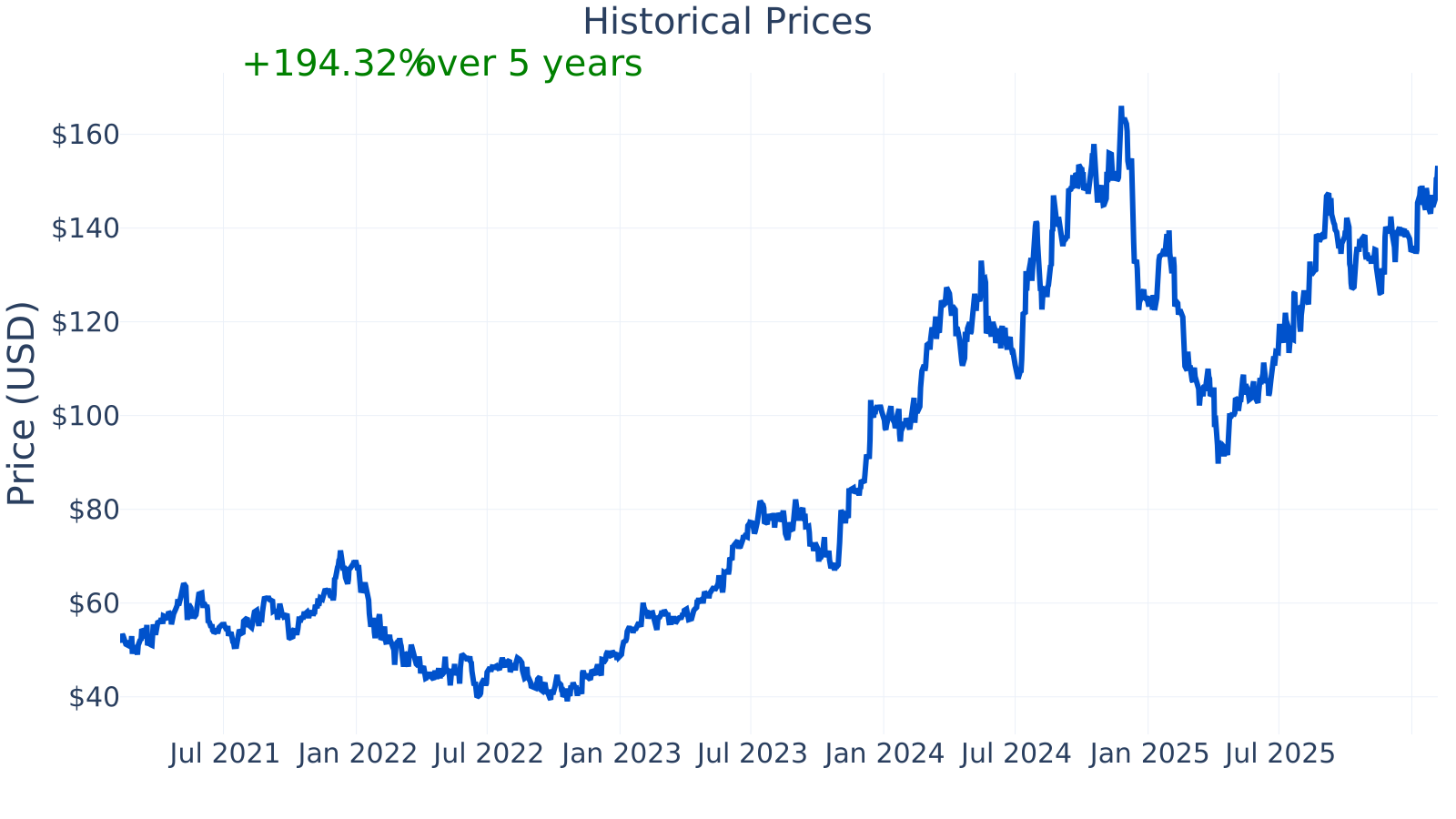
Toll Brothers’ equity value is about $14.6B. The stock’s beta of ~1.47 indicates it has tended to move more than the overall market, which is common for companies tied to the housing cycle.
Profitability stands out versus the industry median: the company’s profit margin is ~12.3% versus an industry median near 8.5%. Recent year-over-year revenue growth is ~2.7%, while the industry median shown is negative (about -4.9%), highlighting that results can differ significantly company-to-company in the same environment.
Leverage is moderate for the sector: debt-to-equity is ~35%, close to the industry median (~35%). Free cash flow over the trailing twelve months is about $1.03B, which can be important for funding land investment, reducing debt, or returning capital to shareholders (depending on management’s choices).
Growth (Medium)
Homebuilding is a large, long-lived industry, but it is also highly cyclical. Demand tends to rise and fall with employment trends, consumer confidence, mortgage rates, and housing affordability. Over long periods, U.S. population growth, household formation, and the need to replace aging housing stock can support baseline demand, even though year-to-year conditions can change quickly.
Toll Brothers’ strategy is oriented toward the luxury segment, where buyers may be less sensitive (though not immune) to changes in mortgage rates and monthly payments. The company’s long-term growth potential is typically tied to a mix of:
- Community count and geographic footprint (more communities and better locations can support volume)
- Pricing power and product mix (higher-end homes and options/upgrade packages can lift revenue per home)
- Cost discipline (materials, labor, subcontractor availability, and cycle-time efficiency)
- Land strategy (balancing owned land vs. optioned land to manage risk through the cycle)
The pattern of year-over-year revenue growth underscores the industry’s cyclicality: there were periods of very strong growth earlier in the timeline (including double-digit and even higher rates), followed by slower growth and some declines in certain periods. The latest reading shown is a return to modest growth (~2.7%).
Free cash flow has also fluctuated, ranging from roughly $0.82B to $1.25B across the periods displayed. For a builder, this variability is common because cash can be absorbed by land and construction work-in-process in some years and released in others when homes close and inventory turns into cash.
Risks (High)
This article is for informational purposes only and does not constitute financial advice. Some content is AI-generated. See Disclaimer