Stock Analysis · Toast Inc (TOST)
Overview
Toast Inc. builds an all-in-one technology platform designed mainly for restaurants and other food & beverage businesses. The product set typically combines point-of-sale (the system used to take orders and accept payments) with software tools that help run day-to-day operations such as menu management, online ordering, delivery integrations, payroll and team management, marketing, and customer loyalty. The goal is to replace a patchwork of separate tools with a more integrated system that can be easier to operate across one location or many locations.
In its SEC filings, Toast describes revenue in two broad categories: (1) subscription-type fees for software products and (2) fees tied to payment processing and other transaction-driven services that tend to move with customer sales volumes. In practice, this means part of Toast’s revenue is more “recurring” (software subscriptions), while another part is more sensitive to restaurant transaction activity (payments and related services).
Main revenue categories (as disclosed in company filings):
- Financial technology solutions (payment processing and other transaction-based services)
- Subscription services (software subscriptions and support-related fees)
One visible trend in the company’s multi-year profitability bridge is that Toast grew revenue substantially from 2021 to 2025, while moving from large net losses to positive net income by 2024 and a larger profit in 2025. That shift suggests operating costs did not rise as fast as revenue over time, improving overall efficiency.
Key Figures
| Metric | Value | Industry ⓘ |
|---|---|---|
| Date | Feb 16, 2026 | |
| Context | ||
| Sector | Technology | |
| Industry | Software - Infrastructure | |
| Market Cap ⓘ | $16.10B | |
| Beta ⓘ | 1.93 | |
| Fundamental | ||
| P/E Ratio ⓘ | 48.80 | 25.13 |
| Profit Margin ⓘ | 5.56% | 6.91% |
| Revenue Growth ⓘ | 22.00% | 15.25% |
| Debt to Equity ⓘ | 1.88% | 19.82% |
| PEG ⓘ | 0.25 | |
| Free Cash Flow ⓘ | $608.00M | |
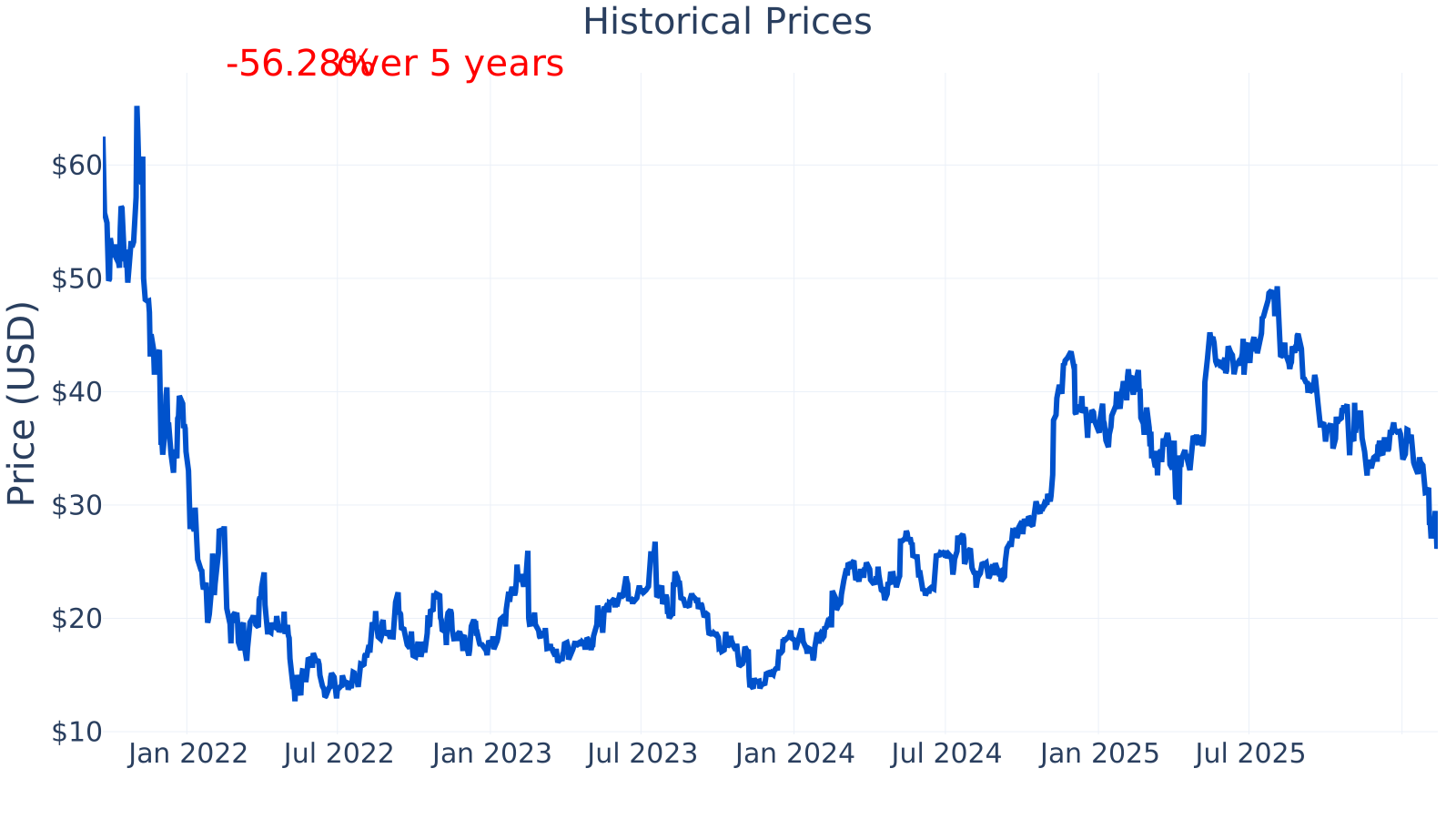
Toast’s market capitalization is about $16.1B, and its beta (1.93) indicates the stock has historically moved more than the broader market (higher volatility). The company’s most recent profit margin is ~5.56% versus an industry median around 6.91%, showing Toast has reached profitability but still trails the typical peer margin in its broad industry grouping. On growth, Toast shows ~22% year-over-year revenue growth versus an industry median around 15.25%. Balance-sheet leverage appears low with debt-to-equity ~1.88% versus an industry median near 19.82%. Free cash flow over the trailing twelve months is shown at about $608M, indicating the business has recently been generating cash after operating expenses and capital spending.
Growth (Medium)
Toast operates in the market for restaurant technology: digital point-of-sale, payments, and software tools that support online ordering, loyalty programs, workforce management, and multi-location operations. Long-term demand in this space is generally tied to restaurants continuing to modernize their operations, adopt more digital ordering, and use software to manage labor and costs. This is less like a one-time hardware purchase and more like an ongoing software-and-services relationship, which can support recurring revenue if customer retention remains strong.
Toast’s strategy is built around bundling: the more a restaurant uses Toast for payments, front-of-house operations, and back-office tools, the more the platform can become embedded in daily workflows. This approach can support expansion within existing customers over time (adding more modules) and can also help Toast serve more complex customers such as larger multi-unit operators, where integration and centralized management can matter more.
Revenue growth has remained positive while gradually slowing from very high rates in 2021–2022 to more moderate levels more recently (around the low-20% range by late 2025). This pattern is common as companies scale, but it also means future results may depend more on execution (retention, product adoption, and payments volume) than on purely adding new customers at an early-stage pace.
Cash generation has improved meaningfully over time, moving from negative levels earlier in the period shown to positive and growing free cash flow more recently. For long-term business durability, consistent positive free cash flow can matter because it may reduce reliance on external funding and provides flexibility for product investment and scaling operations.
Risks (High)
Toast’s business is closely tied to the health of restaurants, which can be a challenging industry. A downturn in consumer spending, rising labor and food costs, or higher restaurant closure rates can reduce transaction volumes and slow new customer wins. Because a meaningful portion of Toast’s revenue is connected to payments and transaction activity, weaker restaurant sales can flow through to slower growth.
Competition is another key risk. Restaurants can choose from established payment companies and point-of-sale vendors, and switching systems can be disruptive but is not impossible. Competitive pressure can show up through pricing, sales incentives, and product feature parity. Major competitors commonly include large payments and commerce platforms (for example, Block/Square) and other restaurant-focused point-of-sale providers (such as Lightspeed), along with a wide range of smaller or specialized software vendors. Toast’s competitive advantage is typically described as a purpose-built restaurant platform with tightly integrated software and payments; however, maintaining that advantage requires continued product execution and service reliability at scale.
Leverage appears low relative to the broader industry median, with debt-to-equity around 1.88%. Low leverage can reduce financial risk during periods of volatility, but it does not eliminate operating risk tied to competition and end-market conditions.
Profitability has improved over time, moving from negative margins earlier in the period shown to a positive margin of about 5.56% by late 2025. Even with that progress, Toast’s margin remains below the industry median (about 7.17% in the latest point shown), which highlights that sustained profitability still depends on maintaining cost discipline while investing enough to compete.
Stock-based compensation and dilution are also worth monitoring for companies that have scaled from high-growth phases: even when a company becomes profitable, shareholder returns can be influenced by how much equity is issued to employees over time (this is typically detailed in SEC filings).
Valuation
One common valuation reference point is the price-to-earnings (P/E) ratio, which compares the stock price to the company’s earnings. Toast’s latest P/E is about 48.8, versus an industry median near 25.1. A higher P/E can be consistent with higher expected growth or improving profitability, but it can also imply the market price already reflects a meaningful amount of future improvement.
The historical P/E series shown only becomes meaningful once Toast reports positive earnings (earlier periods may not display a useful P/E). In the most recent periods shown, Toast’s P/E remains above the industry median, suggesting the market continues to price the company as a faster-growing or improving business relative to typical peers. Whether that valuation level is sustained over time commonly depends on maintaining growth while expanding margins and generating cash consistently.
Conclusion
Toast is a restaurant-focused software and payments platform that has scaled revenue significantly over the past several years and has also shown a notable shift toward profitability and positive free cash flow. The business model blends subscription-like software revenue with transaction-driven payments revenue, which can support growth but also links results to restaurant sales activity.
The key long-term factors to track in company filings are: (1) the pace of revenue growth as the company scales, (2) whether profit margins continue to expand toward (or above) broader software industry levels, (3) free cash flow consistency through different economic conditions, and (4) competitive dynamics in restaurant point-of-sale and payments. The current valuation metrics indicate the stock trades at a higher earnings multiple than the industry median, which places more weight on continued execution and sustained profitability progress.
Sources:
- SEC EDGAR — Toast, Inc. annual and quarterly reports (Form 10-K, Form 10-Q)
- Toast, Inc. — Investor Relations materials (shareholder letters / earnings materials when company-hosted)
- Wikipedia — “Toast, Inc.” (basic company background)
This article is for informational purposes only and does not constitute financial advice. Some content is AI-generated. See Disclaimer