Stock Analysis · Thor Industries Inc (THO)
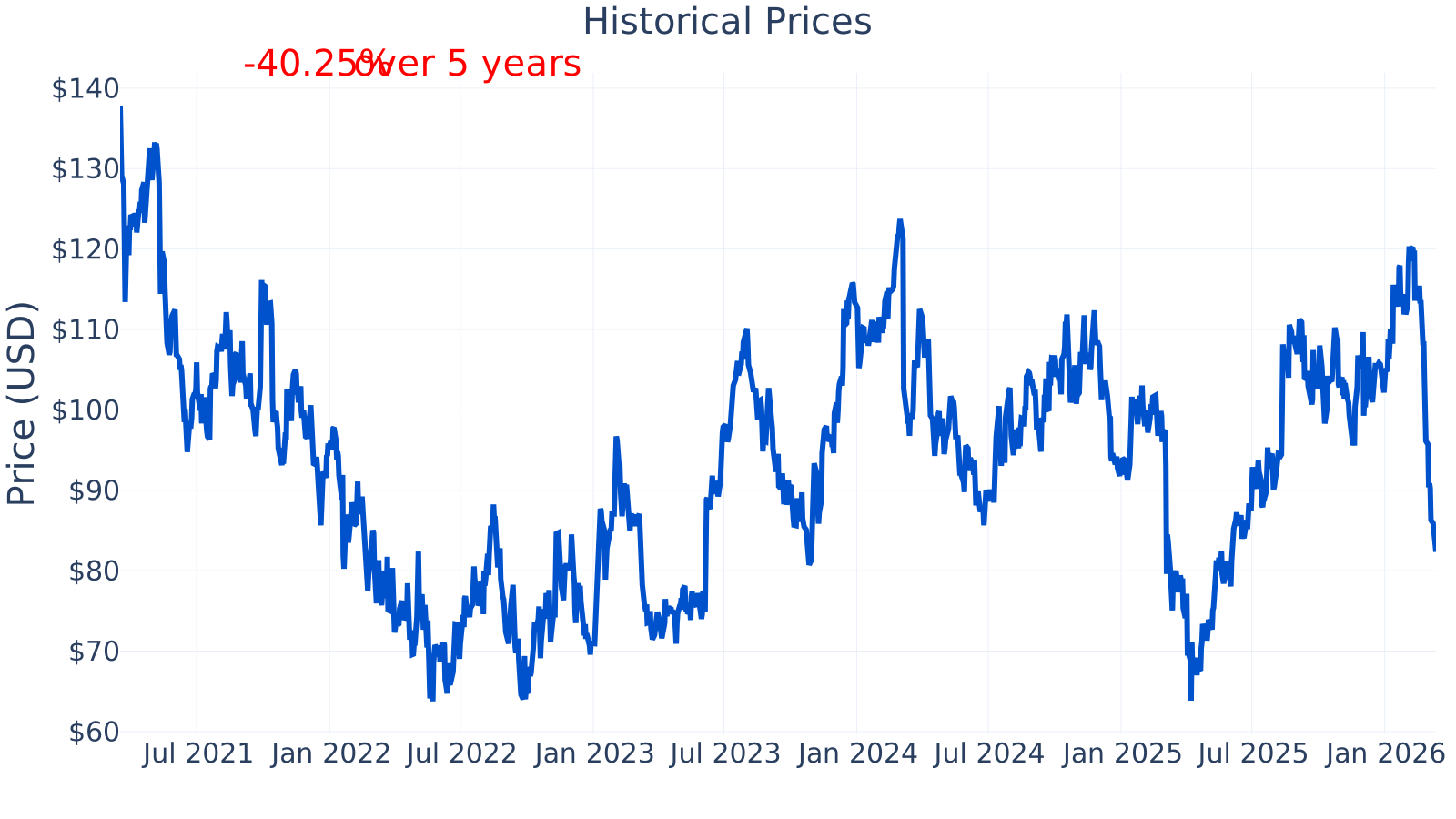
Overview
Thor Industries, Inc. is a manufacturer of recreational vehicles (RVs). In simple terms, it designs and builds motorized RVs (motorhomes) and towable RVs (such as travel trailers and fifth wheels) that are sold through independent dealers. The company operates a portfolio of well-known RV brands and competes mainly on product selection (different sizes, price points, and features), dealer relationships, manufacturing scale, and after-sale support.
Thor reports its business in two main operating segments in its filings: North American RV and European RV. Revenue is primarily generated by selling RV units to dealers, with smaller contributions from parts, accessories, and related services (reported within segment results in company filings).
In practice, the largest revenue drivers typically come from:
- Towable RVs (travel trailers and fifth wheels) — usually the largest category by volume in the U.S. RV market
- Motorized RVs (motorhomes)
- Europe RVs (motorhomes and caravans sold through European operations)
- Parts, accessories, and other (generally smaller than vehicle sales)
Because the exact split between these categories can shift by fiscal year and is reported in more detail inside Thor’s annual filings, the most reliable place to confirm the latest percentages is the company’s most recent Form 10-K segment disclosures.
Over the last several fiscal years shown, total revenue peaked around FY2022 and then moved lower, while profitability fell more sharply than revenue. This pattern is consistent with an industry that can swing between high-demand periods and normalization phases, where pricing, promotions, and production levels can materially affect operating income and net income.
Key Figures
| Metric | Value | Industry ⓘ |
|---|---|---|
| Date | Mar 16, 2026 | |
| Context | ||
| Sector | Consumer Cyclical | |
| Industry | Recreational Vehicles | |
| Market Cap ⓘ | $4.35B | |
| Beta ⓘ | 1.40 | |
| Fundamental | ||
| P/E Ratio ⓘ | 14.63 | 21.21 |
| Profit Margin ⓘ | 3.02% | 2.15% |
| Revenue Growth ⓘ | 5.30% | 10.75% |
| Debt to Equity ⓘ | 23.00% | 117.93% |
| PEG ⓘ | 0.88 | |
| Free Cash Flow ⓘ | $227.76M | |
Thor’s market capitalization is about $4.35B, and its beta of 1.40 suggests the stock has historically moved more than the broader market (up and down). The current P/E ratio is 14.63, below the recreational vehicles industry median of 21.21. Recent profit margin is 3.02%, above the industry median of 2.15%, while year-over-year revenue growth is 5.3%, below the industry median of 10.75%. Leverage appears comparatively conservative with debt-to-equity of 23.0% versus an industry median of 117.9%. Trailing twelve-month free cash flow is about $228M.
Growth (Medium)
RVs sit within a consumer cyclical industry: demand tends to rise when consumers feel confident and financing is accessible, and it tends to fall when interest rates rise or households become more cautious. Long-term demand is influenced by outdoor recreation trends, replacement cycles (older RVs eventually need to be replaced), and the affordability of financing for large discretionary purchases.
Thor’s strategy—maintaining a broad brand portfolio across towable and motorized RVs and operating in both North America and Europe—can support growth over a full cycle by reducing reliance on a single product type or geography. However, the industry’s cyclicality means growth is rarely smooth year to year, and company results can be driven as much by dealer inventory adjustments and pricing as by end-customer demand.
The year-over-year revenue growth trend shows a surge in 2021, followed by a multi-quarter contraction through 2023–2024, and then a return to modest positive growth most recently (about 5.3%). This kind of pattern is typical for RVs: periods of elevated demand can be followed by normalization where dealers work down inventory and manufacturers reduce production.
Free cash flow has remained positive in each period shown but has declined meaningfully from roughly $715M (early 2022) to about $228M (early 2026). For long-term analysis, this matters because free cash flow is a key resource for reinvestment, debt reduction, dividends, and share repurchases; lower free cash flow can reduce flexibility during weaker parts of the cycle.
Risks (High)
The largest risk is the industry’s sensitivity to the economic cycle. RV purchases are big-ticket discretionary items, and demand can weaken quickly when borrowing costs rise, consumer confidence falls, or used RV inventory becomes abundant. This can create rapid changes in production schedules, dealer orders, and pricing.
A second major risk is margin pressure during downturns. When dealer lots are full or demand slows, manufacturers may rely more on discounts, incentives, and lower plant utilization, all of which can compress profitability. Supply chain disruptions and commodity cost swings can also affect production costs and delivery timing.
Profit margins declined substantially from the higher levels seen in 2021–2022 (roughly mid-single digits) to around 3.0% most recently. The industry median also moved lower over time, and Thor’s current margin is roughly in line with peers. This highlights how quickly profitability can change in this business, even when the company remains profitable.
On competitive positioning, Thor is commonly described in its public materials and filings as one of the largest RV manufacturers, with a wide brand lineup and substantial dealer distribution. Scale can help with purchasing, manufacturing know-how, and spreading fixed costs, but it does not eliminate cyclical demand risk. Competitive advantages are generally more about breadth, relationships, and execution than about hard-to-replicate technology.
Main competitors in RV manufacturing include other large RV producers, particularly Forest River (Berkshire Hathaway) and Winnebago Industries (public). Competition typically centers on product features, pricing, brand reputation, dealer support, and the ability to adjust production without damaging long-term dealer relationships.
Thor’s debt-to-equity ratio has trended down materially over the period shown and is currently about 23%, well below the industry median (about 97% at the latest point shown). Lower leverage can reduce financial stress when the cycle turns down, though it does not prevent earnings volatility.
Valuation
Based on the latest metrics shown, Thor trades at a P/E ratio of about 14.6, which is below the recreational vehicles industry median of about 21.2. The historical P/E range displayed shows meaningful swings over time, reflecting that the “E” (earnings) in a cyclical company can rise and fall sharply, which can make a single-year P/E less stable as a long-term yardstick.
From a fundamentals context, several factors pull in different directions. A lower P/E than peers can align with the business’s cyclicality and recent margin compression, while the company’s comparatively low leverage can be a stabilizing factor. At the same time, trailing free cash flow has declined and revenue growth has been uneven. For long-term evaluation, valuation is often best interpreted alongside where the company is in its cycle (dealer inventory levels, production cuts/ramps, and margin trajectory), not only against an industry median at one point in time.
Conclusion
Thor Industries is a large RV manufacturer whose results are closely tied to consumer spending, interest rates, and dealer inventory cycles. The business can produce strong revenue and profit during favorable demand periods, but it can also experience sharp slowdowns and margin compression when the cycle turns.
The facts highlighted here point to a company with meaningful scale in a cyclical industry, profitability that has recently recovered to around 3% after a decline, modest recent revenue growth after a prolonged contraction, and relatively low leverage compared with industry peers. Any long-term assessment typically depends on comfort with cyclical earnings swings and the possibility that results may look very different across economic environments.
Sources:
- SEC EDGAR — Thor Industries, Inc. filings (Form 10-K, Form 10-Q)
- Thor Industries — Investor Relations materials (Annual Report content and press releases, as published by the company)
- Wikipedia — “Thor Industries” (basic company background)
This article is for informational purposes only and does not constitute financial advice. Some content is AI-generated. See Disclaimer


